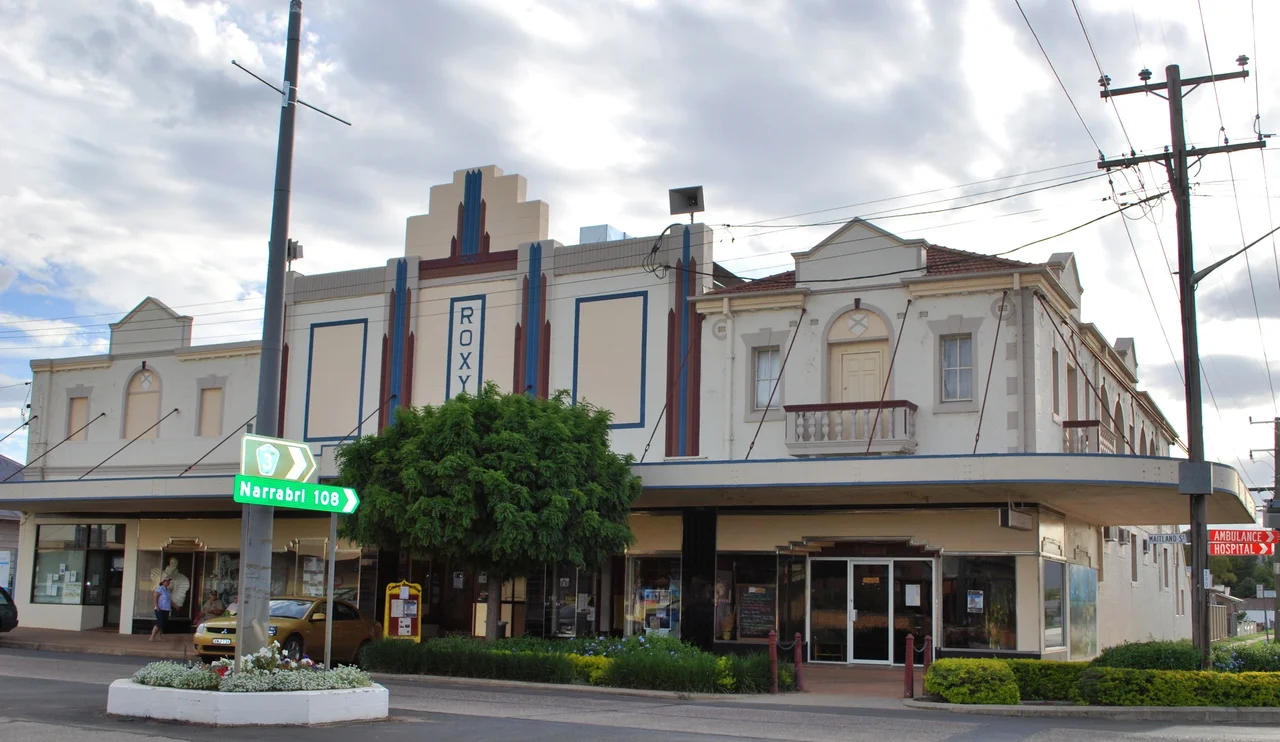

Roxy Theatre and Peters Greek Cafe Complex
On the night of Saturday, 28 March 1936, seven hundred people squeezed into a brand-new picture palace on Maitland Street, and hundreds more were turned away at the door. The local paper declared that probably no event in the history of Bingara had caused more excitement. On the screen flickered Roberta, with Fred Astaire and Ginger Rogers dancing through a glamour that felt impossibly far from this dusty wheat-and-cattle town near the Gwydir River. The men who built the Roxy were three immigrants from a small Greek island, and the triumph they were celebrating that night would, within months, slip through their fingers.
Three Men From Kythera
They came from Kythera, a rocky island off the southern tip of Greece, and they arrived in Australia in the early 1920s carrying little but ambition. Peter Feros, nicknamed Katsehamos, and George Psaltis tried their luck in Bingara, buying a refreshment room from a fellow Greek and trading it under the name Peters and Co. A third partner, Emanuel Aroney, soon joined them. This was the era of the Greek cafe, when families from Kythera and other islands ran the refreshment rooms and milk bars of country Australia - serving sundaes, mixed grills and milkshakes to towns that had never tasted such things. The partners prospered, even opening a second cafe at Barraba in 1930, and traded their way through the worst of the Great Depression. Then they reached higher. They would give Bingara a cinema worthy of New York.
A Palace Named for New York
The name was no accident. The original Roxy Theatre in New York, opened in 1927, was the largest movie palace on Earth, and these Greek-Australian showmen modelled their dream on it - the name, the glamour, the sense of occasion. What they built is a rectangular fantasy in the Art Deco style, its stepped facade picked out in white, blue and two shades of maroon. Inside, a wavy frieze runs along the entablature, fan-shaped panels glow between pilasters, and angular light fittings throw a vase-like shimmer across the auditorium. The front of the hall has a sprung cypress-pine 'waltz floor' for dances and balls. Next door, Peter's Cafe still keeps its timber booths and terrazzo floor. The whole complex was designed to make a night out feel like stepping into the movies themselves.
The Cinema War
Glamour was not enough. A rival named Victor Peacocke had opened his plainer Regent Theatre in 1935, nine months before the Roxy was finished, and he used that head start ruthlessly. He slashed ticket prices; the Roxy partners had to match him. He installed an advanced sound system. The two cinemas in this one small town drove their prices lower and lower in a war neither could really afford. Construction delays and mounting debt did the rest. In August 1936, only months after that euphoric opening night, Peters and Co. were forced into a deed of arrangement with their creditors under the Bankruptcy Act. Feros had been back in Kythera while the dream collapsed. It was the cruelest kind of failure - to have built something beautiful and lose it almost at once.
Forty Years of Silence, Then the Lights Again
Emanuel Aroney did not leave. He stayed in Bingara managing cafes for the next twenty years, while the picture-going boom that built the Roxy slowly faded. The theatre ran as a cinema until 1958, then fell dark, lying dormant for some forty years as television emptied country picture halls across the state. Of the 351 cinemas operating in rural New South Wales in 1951, only a handful survived intact. The Roxy was nearly lost - but the local council bought the building, restored it through the 1990s, and in May 2004 reopened it in its original splendour. Today it still screens films, hosts weddings and reunions, and shelters a museum to the Greek cafe story. One of its shops, fittingly, holds furniture salvaged from a Greek cafe in nearby Inverell.
From the Air
The Roxy sits in the heart of Bingara at roughly 29.87 degrees south, 150.57 degrees east, on the Gwydir River in the rolling country of northern New South Wales. From the air the town is a small grid amid wheat paddocks and grazing land, with the river threading green through the dry plains. The nearest airfields are Inverell (YIVL), about 95 km east, and Moree (YMOR), about 110 km west; Tamworth (YSTW) lies well to the south as the regional hub. Best viewed at low altitude in the clear, dry light typical of the New England tablelands' western fall, where visibility often stretches for tens of kilometres.
Nearby Stories
- Wing Hing Long & Co. Store 18 km away
- Guyra, New South Wales 50 km away
- Tenterfield, New South Wales 98 km away
- Uralla 103 km away
- Tenterfield School of Arts 143 km away
- Bourke Court House 402 km away
- Bourke Post Office 404 km away
- Hornet Bank Massacre 426 km away