.jpg)
Wing Hing Long & Co. Store
Pull the cord at the counter and a small wooden box of money still rides a wire across the ceiling to the cashier's office, exactly as it did a hundred years ago. The shelves are stocked, the signs hand-painted, the wood-fired stove cold but in place. Wing Hing Long is not a recreation of a country store - it is the store itself, on the same patch of Ruby Street in Tingha where Chinese immigrants opened it in 1881 and ran it, family after family, until 1998. Few places in Australia hold the memory of the Chinese tin miners so completely, or so honestly.
The Tin That Drew a World
Tingha exists because of tin. Rich deposits found in the early 1870s turned this corner of the New England tablelands into the largest tin-producing district in New South Wales, and people poured in. At the boom's height in the 1880s, the area held four to five thousand people - perhaps nine hundred of them Chinese, who came to work the alluvial fields and dredge the creeks. They were drawn by the same hope that drew everyone else, but they did not meet the same welcome. The colony's mining camps could be brutal places for Chinese arrivals, who faced exclusion laws, special taxes and open hostility. And yet a community took root: temples, gardens, businesses, families. Wing Hing Long rose to serve it, stocking the Chinese goods and everyday supplies the diggers needed.
One Store, Many Hands
The store passed through a chain of Chinese owners whose names map the migrant world of the goldfields and tin fields. Ah Lin, an Inverell storekeeper, bought the site in 1881. After him came Ding Chee, a butcher from Vegetable Creek; Jock Sing from Glen Innes; Ah Bow, a Tingha miner; and Charles Hing. In 1918 Jack Joe Lowe took it over, and the Lowe family held it for the rest of the century - passing it to his son Edgar, then to his daughter Mavis Pratt, who ran it until 1998. Lowe was more than a shopkeeper. A 1924 advertisement billed him as 'The Noted Chinese Herbalist,' offering remedies alongside the groceries. At its peak the business employed ten to fifteen staff, Chinese and non-Chinese together, a quiet picture of a mixed country town getting on with daily life.
Everything Under One Roof
A country general store had to be everything at once, and Wing Hing Long was. Mavis Pratt remembered the stock of her 1920s childhood: grocery and drapery, hats and children's wear, shoes and wallpaper, furniture and linoleum - and, this being a mining town, explosives for the dredges. The building grew the same way, by accretion: four parallel sections, a jumble of weatherboard and embossed metal and galvanised iron, a rear courtyard with a water tank, and above the storage sheds a steeply gabled iron-clad residence with its verandah turned inward. A heritage architect called that residence almost unique in appearance. The arrangement said something simple and true - that for this family, commercial life and home life were one and the same.
The Last of Its Kind
Chinese-owned stores once stood in country towns across New South Wales. Almost all are gone. When experts assessed Wing Hing Long, they found only about four Chinese-Australian stores still identifiable anywhere in the state - and of those, this was the only one that kept its original fabric, its fittings, and astonishingly its stock, counters, ledgers and that working cashier's pulley. Little had changed since the Second World War. When the Lowe family sold the property in 1998, the shire council acquired it whole, contents and all, and it reopened as a community museum. Tingha's population has fallen to around seven hundred, the dredges long silent. But on Ruby Street, the store keeps the record of the people who came for the tin and stayed to build a town - their work, their dignity, and their place in the country's story preserved exactly where they left it.
From the Air
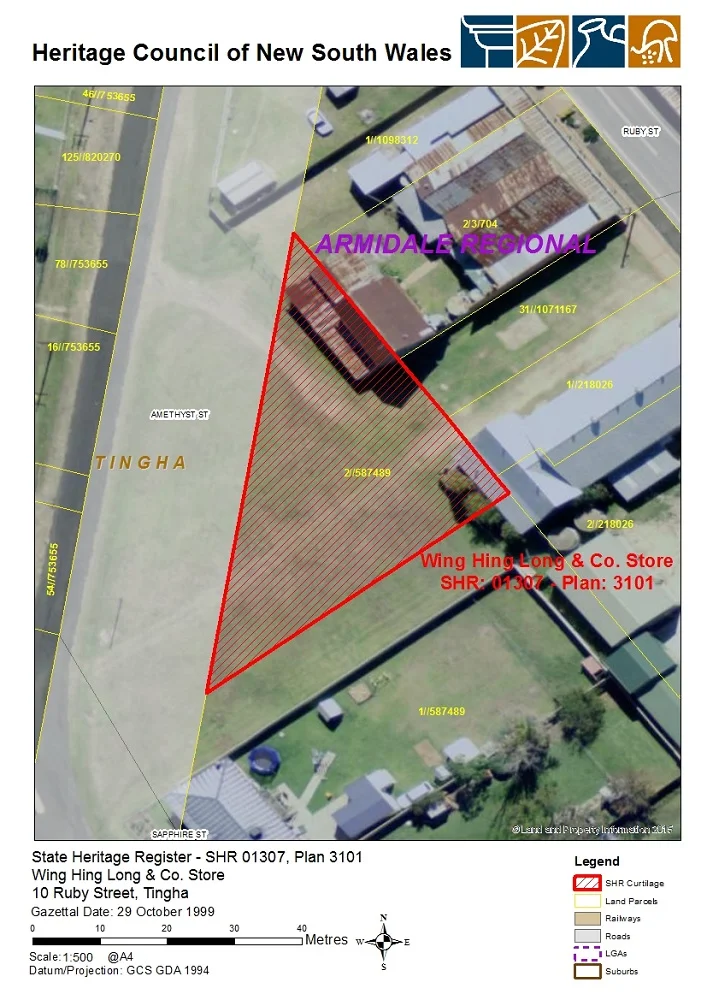
Wing Hing Long stands on Ruby Street in Tingha at roughly 29.96 degrees south, 151.21 degrees east, on the southern New England tablelands about 25 km south of Inverell. From above, the old tin country shows as a pocked, creek-laced landscape of former diggings and dredge lines among grazing paddocks. The nearest airfield is Inverell (YIVL), a short hop north; Armidale (YARM) lies to the south-east and Tamworth (YSTW) further south as the regional hub. Best viewed at low to moderate altitude; the tablelands sit around 600-700 metres elevation, and the high, dry air usually offers long, clear sightlines.
Nearby Stories
- Myall Creek Massacre 24 km away
- Warialda 31 km away
- Wollomombi Falls 37 km away
- Booloominbah 40 km away
- Guy Fawkes River National Park 42 km away
- Gibraltar Range National Park 47 km away
- Tenterfield, New South Wales 97 km away
- Mount Drysdale, New South Wales 484 km away