
Gibraltar Range National Park
Stand at the foot of the Needles and the rock seems impossible: great fingers of granite thrust straight up out of the forest, sheer and weathered, with a drop-away view to the ranges beyond. They are the signature of Gibraltar Range, where ancient granite has been carved by tens of millions of years of weather into tors, crags and balancing boulders. The park sits high in the northern tablelands of New South Wales, 79 kilometres northeast of Glen Innes, and it forms part of the Gondwana Rainforests of Australia, a World Heritage Area inscribed in 1986 for forests that trace their lineage back to the supercontinent of Gondwana. This is deep time made visible: rock older than memory, rainforest older than the country itself.
Granite Carved by Time
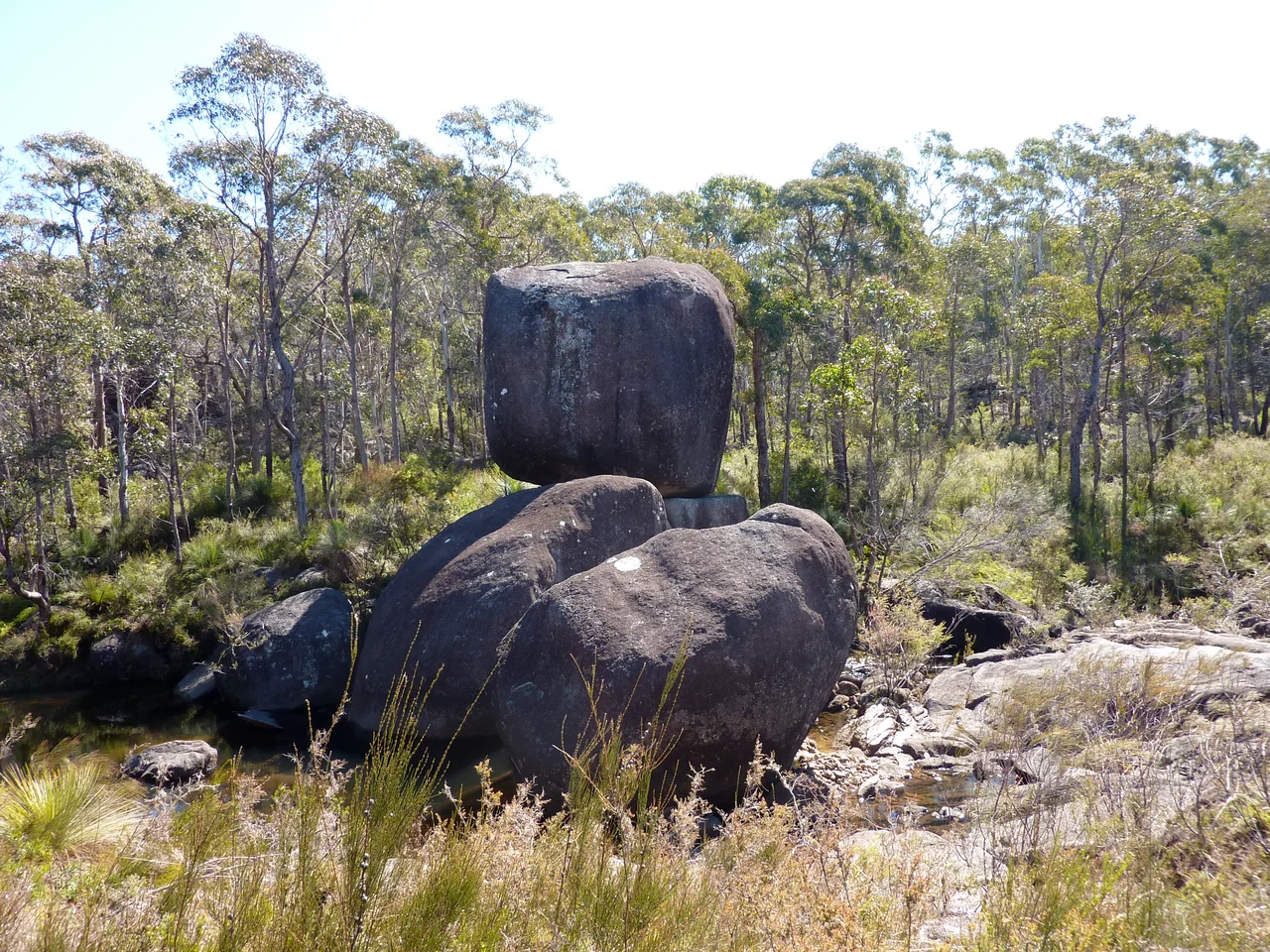
Gibraltar Range is, above all, a landscape of stone. The granite here has been weathering for so long that it has taken on architecture: the Needles standing like a row of stone teeth, the Dandahra Crags rising in tumbled outcrops, granite boulders scattered along Surveyors Creek as if set down by hand. Walking tracks lead out to these formations, and the reward at the end of the Needles track is a dramatic view across towering rock to the country falling away below. The stone is the bones of the place. Everything else, the forest, the heath, the creeks, has arranged itself around these durable outcrops, which shrug off the millennia while the softer ground erodes away between them. To walk here is to move through a sculpture garden that no one designed, shaped entirely by water, frost and time.
A Gondwana Inheritance
The World Heritage listing is not decoration. The Gondwana Rainforests preserve plant communities with direct ancestral links to the forests that covered Gondwana before the southern continents split apart, and they survive in a string of parks running from the Barrington Tops up into southern Queensland. Gibraltar Range is one link in that chain. Its forests were added to the Australian National Heritage List in 2007, reinforcing a recognition the world had already granted. To walk through this rainforest is to walk through a living museum of ancient lineages, the descendants of plants that grew when the land mass that became Australia was still joined to Antarctica and South America. The trees here are not merely old. They are old in a way that reaches back past the existence of the continent they stand on.
Spring and the Wildflowers
For all the gravity of granite and Gondwana, the park has a lighter season. In spring the heathlands and sedge swamps catch fire with colour: Christmas bells, Blandfordia grandiflora, raise their red-and-yellow tubular flowers in the boggy ground near Surveyors Creek, joined by a profusion of other wildflowers across the open country. The displays are famous enough to draw people up from Glen Innes and Grafton just to see them. Waterfalls add to the spectacle, with tracks like the one to Duffer Falls reaching cascades tucked into the forest. The contrast is what makes a spring visit memorable: the same park that feels stern and stony in its granite country turns delicate and bright in its heath, the towering crags looming over fields of small, vivid flowers.
The Bird That Almost Isn't
BirdLife International recognises this park as the Gibraltar Range Important Bird Area for a specific and urgent reason. It is a block of highland forest that holds one of only five remaining populations of the rufous scrub-bird, a small, secretive, ground-dwelling bird so reluctant to fly that it is heard far more often than seen, and so reduced in range that its survival is a matter of careful watching. It shares the forest with green catbirds, whose calls sound startlingly like a wailing cat, with Australian logrunners scuffling in the leaf litter, with paradise riflebirds and pale-yellow robins. The presence of the scrub-bird is a kind of certificate: it persists only where the highland forest is intact and undisturbed. That it still calls here is a sign that Gibraltar Range remains, against the odds, genuinely whole.
From the Air
Gibraltar Range National Park lies at 29.55°S, 152.32°E in the northern tablelands of New South Wales, about 79 km northeast of Glen Innes and roughly midway between Glen Innes and Grafton along the Gwydir Highway. From the air the granite tors and crags break through the forest canopy as pale outcrops, with the Needles and Dandahra Crags the most prominent. The park covers around 366 square kilometres of high forested country adjoining Washpool National Park to the north. Nearest airports are Glen Innes (ICAO YGLI) to the southwest and Grafton (YGFN) to the east; Coffs Harbour (YCFS) is the nearest major field, on the coast to the southeast. Recommended viewing altitude 5,000–7,000 ft to resolve the rock formations against the forest. This is elevated tableland: expect cool temperatures, frequent low cloud and fog, and reduced visibility in the wetter months.
Nearby Stories
- Grafton Gaol 6.5 km away
- Glen Innes Showground 19 km away
- Guy Fawkes River National Park 19 km away
- Woolgoolga, New South Wales 37 km away
- Guyra, New South Wales 41 km away
- History of New Italy, New South Wales 42 km away
- Tenterfield School of Arts 50 km away
- Darling Downs 172 km away