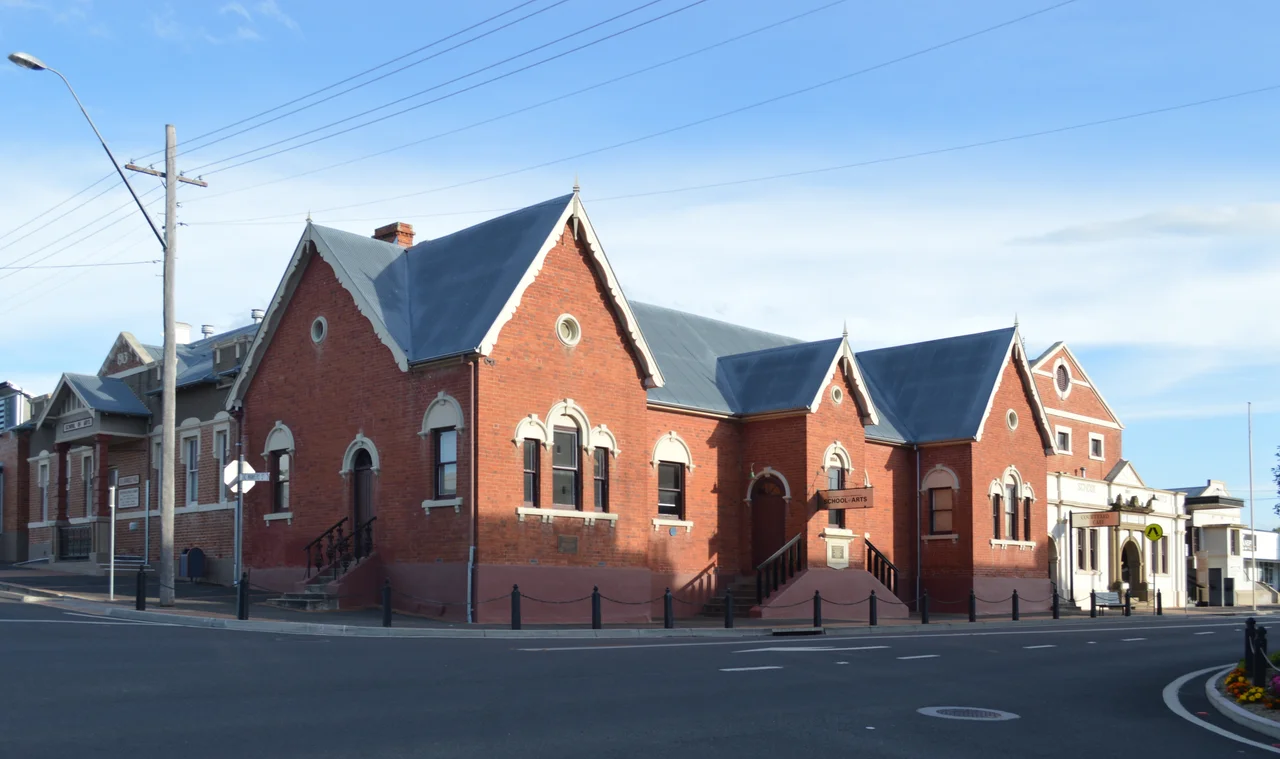

Tenterfield School of Arts
On the evening of 24 October 1889, a heavy-set 74-year-old with a flowing white beard rose to speak in a brick hall on Rouse Street, and what he said turned a country town into a footnote that schoolchildren would memorise. Sir Henry Parkes was old, in debt, and out of office, but at the Tenterfield School of Arts he made the case of his life: that the six squabbling British colonies scattered across the Australian continent should stop acting like neighbours and become one nation. The room was not grand. The crowd was not large. Yet the Tenterfield Oration is remembered as the first time a leader appealed directly to ordinary Australians, rather than to politicians, for federation, and twelve years later the Commonwealth of Australia was born.
The Speech That Made a Country
Parkes framed federation in practical terms, not poetry. He argued that a single national government could raise one army from the colonies' separate militias, and that uniform railway gauges would let trains run from one colony into the next without passengers changing carriages at the border. These were the irritations of daily colonial life, and they landed. In the nine months that followed, Parkes carried versions of the same address to roughly fifteen other towns, and newspapers printed his words across the continent. He did not live to see the result, dying in 1896, but his petitioning of the Crown and his hand in drafting the constitution earned him the title 'Father of Federation.' The hall where it began still stands, which is why locals call Tenterfield the birthplace of the nation.
A Building Assembled Across Eras
What looks like a single landmark is really a complex grown together over half a century. The story starts in 1863, when Edward Reeves Whereat opened a humble reading room in a township barely ten years old. The original hall and reading rooms were finished in 1876, opened with such fanfare that the day was declared a general holiday. In 1884 the building more than doubled, gaining a second hall and steep Gothic-and-Romanesque frontages. The grandest piece, the Main Hall in Federation Free Classical style, was completed in 1903. Walk between these sections and you can read the changing ambitions of a frontier town in stone and timber, each addition a snapshot of a different decade's idea of what a community should be.
Memory in the Walls
The building does double duty as a war memorial, and its grief is specific. The Main Hall honours the men of Tenterfield who died in the Boer War of 1899 to 1902, many of them drawn from the Upper Clarence Light Horse, a mounted unit raised locally in 1885. The Billiard Room, completed in 1913 and later renamed the A. D. Donnelly Hall, became a quieter shrine: it held the names of 117 young men of the town who marched off to the Great War, into a conflict no one yet knew how to measure. These were not abstractions to Tenterfield. They were sons and brothers from a town of a few thousand, and the rooms built for billiards and meetings became places to keep their names safe.
Still the Heart of Town
Most heritage buildings become museums of themselves. This one kept working. The Tenterfield Municipal Library has operated continuously on the site since its predecessor, the Literary Institute, opened there in 1871, and the halls still host the meetings, films, and gatherings that hold a small town together. In 1957 the National Trust of Australia took the building into its care, the very first property it ever held in New South Wales, and in 2002 the site was added to the State Heritage Register. There is a postscript the town enjoys: Tenterfield's other famous son, the entertainer Peter Allen, immortalised his saddler grandfather in song, and the place that gave the nation a federation also gave it a Broadway voice.
From the Air
The Tenterfield School of Arts sits at 29.06°S, 152.02°E, on the New England tableland at roughly 850 metres elevation, where the high country rolls in granite-strewn ridges. From the air, Tenterfield reads as a compact grid astride the New England Highway, the long north-south ribbon that was once the only all-weather road between Sydney and Brisbane. Best viewed from 3,000 to 5,000 feet AGL in the clear, dry air typical of the tablelands. The nearest airports with scheduled services are Armidale (YARM) to the south, Inverell (YIVL) to the southwest, and Lismore (YLIS) to the east; Brisbane (YBBN) lies well to the north across the Queensland border. Watch for the granite domes of Bald Rock and the surrounding ranges, which break the horizon to the north.
Nearby Stories
- Washpool National Park 28 km away
- Kyogle 47 km away
- Susan Island Nature Reserve 49 km away
- Casino, New South Wales 52 km away
- Inverell 60 km away
- Glengallan Homestead 81 km away
- Inverell Post Office 86 km away
- Jimbour Homestead 210 km away