
Casino, New South Wales
Once a year, the streets of a country town in northern New South Wales fill with the smell of barbecue smoke and the bellow of prize bulls, and Casino makes its annual case to the nation: this, not Rockhampton up in Queensland, is the real Beef Capital of Australia. The two towns have squabbled over the title for decades, and Casino is not a place to back down. Sitting on the Richmond River where the Bruxner Highway meets the Summerland Way, it is the hub of a very large cattle industry and the service centre for rich farming country all around. To the Bundjalung people whose country this is, the place is Djanangmum.
Beef Week
The festival that anchors the town's identity is Casino Beef Week, a sprawling celebration that turns a working cattle centre into a party for the better part of a fortnight. It has been a fixture for decades, missing only the occasional year, including 2007 and the pandemic year of 2020, and in 2024 it ran from 18 to 26 May. There are rodeos and street parades, a beef-themed everything, and the particular pride of a community that knows exactly where its prosperity comes from. Casino positions itself flatly as Australia's Beef Capital, and while Rockhampton in Queensland makes the same boast, few towns have leaned into a claim quite so wholeheartedly. The Richmond River runs straight through the middle of it all, splitting South Casino from the rest of the town, the same river that drew settlers and cattle to these flats in the first place.
Bundjalung Country
Long before the cattle yards and the highway junction, this was Bundjalung country, and it still is. The wider Northern Rivers region was home to an estimated twenty different language groups under the broad Bundjalung umbrella, and the traditional custodians of the Casino area, Djanangmum, are the Galibal. That heritage is no museum piece. At the 2021 census, Aboriginal and Torres Strait Islander people made up 11.5 per cent of the town's population, well above the national figure, and the community remains a living one. Casino has produced figures like Clive Andrew Williams, an Aboriginal activist born here in 1915, whose generation fought for rights and recognition that earlier Australia had refused. To drive into Casino is to arrive in a place where two deep histories run side by side: the cattle country the settlers built, and the far older country it was built upon.
The Town the Railway Built and Forgot
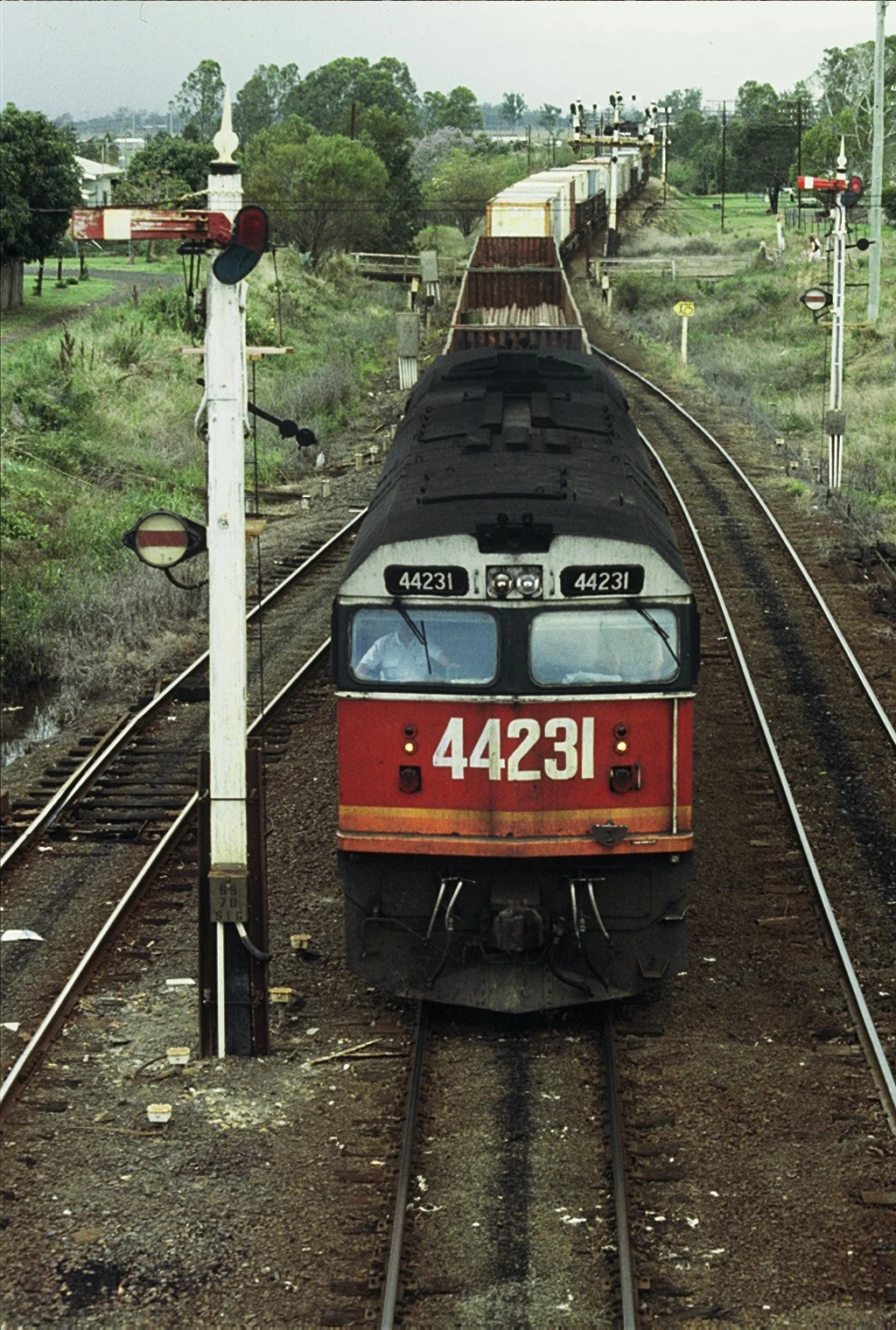
Casino is a railway town in its bones. Its station is the terminus of the daily XPT from Sydney and a junction for services running north to Brisbane, and the rails are stitched into the local story, including the ones that were never finished. In the 1920s a branch line toward Bonalbo was begun and abandoned; other lines were proposed to Tabulam and even all the way to Tenterfield, and never built. Today a miniature railway runs beside the Casino Golf Club on Sundays, hauling visitors along two and a half kilometres of track to a small museum. The song "I've Been Everywhere," that breathless Australian roll-call of place names, name-checks Casino in its second verse, a small immortality for a small town.
A Town That Plays Itself on Screen
Casino has a knack for standing in for the archetypal Australian country town, partly because it so thoroughly is one. The 2014 drama series The Gods of Wheat Street was set here and partly filmed on its streets, and in 2018 a Coca-Cola television advertisement used the Richmond Dairies factory and a corner general store as its backdrop. The roll-call of locals who left and made their mark is long and varied: High Court judge Ian Callinan, crime novelist Michael Robotham, country songwriter Stan Coster, paratriathlete Katie Kelly, and Jeff Fatt, the purple Wiggle, who grew up here before becoming one of the most-watched faces in Australian children's entertainment.
From the Air
Casino sits at about 28.87 degrees south, 153.05 degrees east, on the Richmond River in the Northern Rivers of New South Wales, inland from the coast at the junction of the Bruxner Highway and Summerland Way. From the air the town is marked by the looping Richmond River dividing it, the surrounding patchwork of green cattle country, and the rail lines converging on the station. Best viewed from 2,000 to 4,000 feet; the subtropical climate brings hot, humid summers, so winter mornings offer the clearest light. The old Casino aerodrome lies just outside town, but scheduled air travel for the district now runs through Ballina Byron Gateway (YBNA), roughly 66 km east toward the coast. Lismore (YLIS) lies about 30 km to the east, and Grafton (YGFN) is south down the highway.
Nearby Stories
- Cape Byron Light 1.6 km away
- Nimbin Rocks 10 km away
- Cape Byron Marine Park 27 km away
- Ulgundahi Island 30 km away
- Washpool National Park 31 km away
- Bald Rock National Park 52 km away
- Spicers Gap Road 66 km away
- SS Elingamite: Gold, Fog, and a Captain Wrongly Blamed 1825 km away