
Cape Byron Light
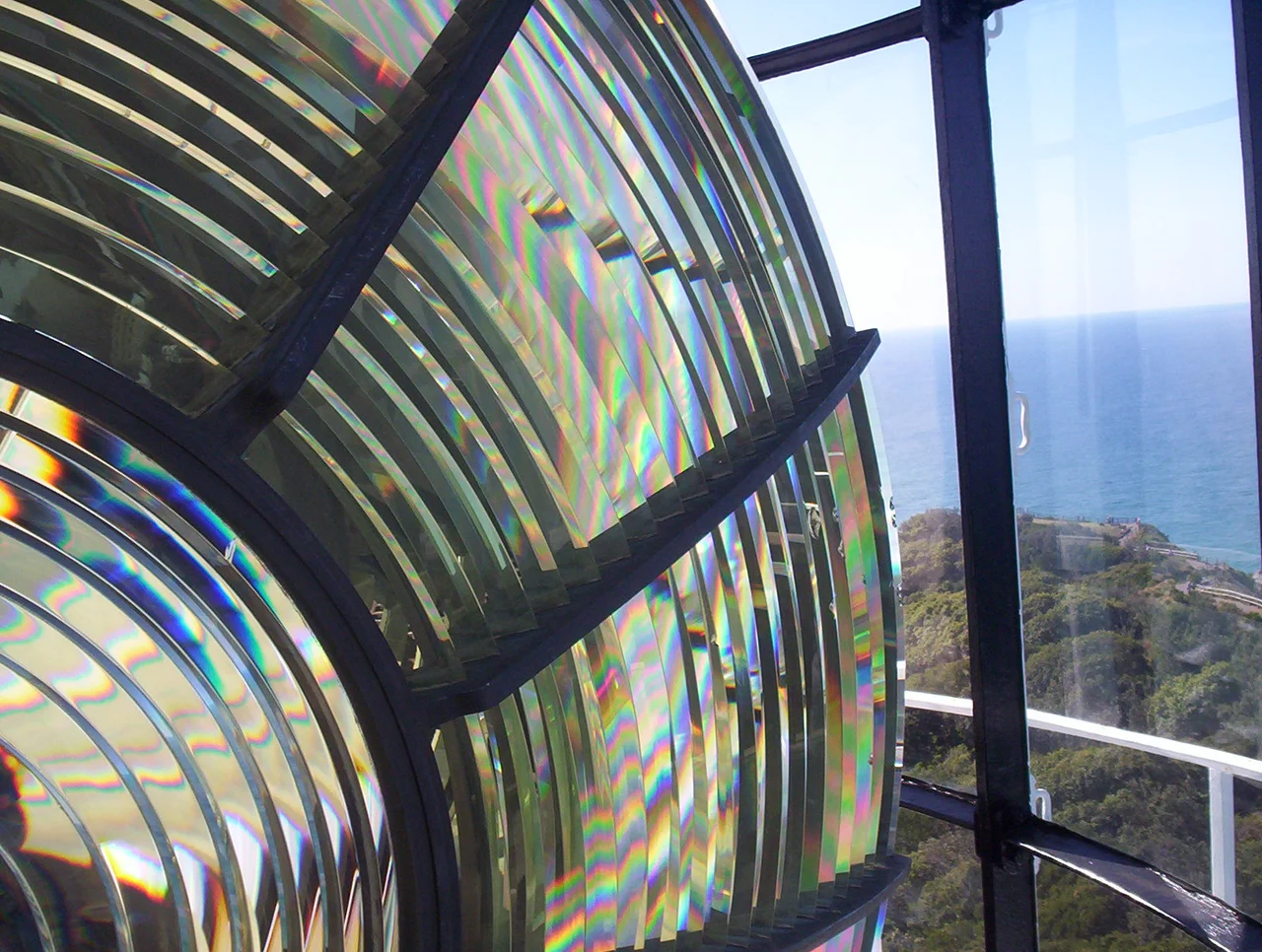
Eight tons of glass turn here, floating on a pool of liquid mercury. That is how the lens of the Cape Byron Lighthouse has rotated since 1901, friction so close to nothing that a clockwork weight once spun the whole assembly. The lens was cut in Paris by the firm of Henry-LePaute, 760 pieces of polished prismatic glass arranged to gather a single flame and hurl it out to sea. It remains the only Henry-LePaute apparatus in Australia, and Cape Byron was the first lighthouse on the continent to spin its optic on mercury. Standing white against the Pacific on the most easterly point of mainland Australia, it is the most photographed and most visited lightstation in the country.
Walgun, the Shoulder
Long before the tower, this headland had a name. The Arakwal people, part of the wider Bundjalung nation, call it Walgun, meaning 'the shoulder', and for thousands of years the cape and its waters provided both sustenance and spiritual meaning. Building the lightstation in 1899 to 1901 damaged sacred sites, a loss the modern record does not paper over. Yet the Arakwal connection to this place did not end with construction. Today the Arakwal are formal joint managers of the Cape Byron Headland Reserve, running educational programs at the headland that frame the lighthouse within a far older story. The cultural heritage here, as they put it, is not confined to the past. It is being practised now.
The Last of the Highway of Lights
Through the 19th century, New South Wales strung its coastline with lighthouses, a 'highway of lights' guiding the busy colonial shipping that moved produce, passengers, and goods up and down a treacherous shore. Cape Byron was among the very last to complete that chain. The design fell to Charles Harding and engineer-in-chief Cecil Darley, who inherited the architectural language of the long-serving colonial architect James Barnet and adapted it with newer technology. Rather than quarried stone, they built the tower from precast concrete blocks, cast on the ground, hoisted into place, and rendered smooth, only the second NSW lightstation to use the method. The opening, set for 30 November 1901, was to feature a grand banquet attended by Premier John See, arriving by government steamer from Sydney. Bad weather delayed his ship, and the banquet went ahead without him. He opened the light a day late.
A Flame That Became the Brightest in Australia
The light grew steadily fiercer over the decades. The original 1901 source was a concentric six-wick kerosene burner throwing 145,000 candela out across the water. In 1922 a vaporised kerosene mantle burner more than tripled that, reaching 500,000 candela. The great leap came in 1956, when the station was connected to mains electricity, its clockwork drive swapped for an electric motor and its burner replaced by a 1,000-watt tungsten-halogen lamp. The beam jumped to 2,200,000 candela, making Cape Byron the most powerful lighthouse in Australia, a distinction it still holds. On a dark night the loom of that light can be seen far out to sea, a steady sweep marking the corner of a continent.
The View That Made It Famous
What draws more than half a million visitors a year is not really the optics. It is where the tower stands. The Cape Byron walking track loops 3.7 kilometres through the surrounding reserve, climbing from the beaches to the white tower on its clifftop, and from the lookout the Pacific fills the entire eastern horizon. Migrating humpback whales surface offshore in winter. Dolphins ride the breaks below. The image of a small, well-proportioned white tower against an endless wild ocean has become one of the most recognisable in the state, a symbol of human persistence at the edge of a vast and indifferent sea. The keepers' quarters that flank it now house guests; the maritime museum and interpretive centre tell the rest.
From the Air
Cape Byron Light stands at 28.6386 degrees S, 153.6363 degrees E, perched on the white headland that marks the easternmost point of mainland Australia, about 3 km northeast of Byron Bay town. The tower itself is the landmark: a white-painted concrete lighthouse, brilliant against the dark Pacific and visible from a great distance. A viewing altitude of 1,500-3,000 feet frames the headland, the walking track, and Julian Rocks just to the north. Nearest airports are Gold Coast Airport (YBCG / OOL) roughly 45 km north and Ballina Byron Gateway (YBNA / BNK) about 30 km south. Coastal conditions can bring sea fog and onshore winds; clearest viewing is typically a settled offshore-wind morning.
Nearby Stories
- Nimbin 6.1 km away
- Casino Post Office 22 km away
- Richmond River Light 22 km away
- Fingal Head Light 26 km away
- Glow-Worm Caves Tamborine Mountain 42 km away
- HMS Porpoise (1799) 687 km away
- Wreck Reefs 717 km away
- SS Elingamite: Gold, Fog, and a Captain Wrongly Blamed 1777 km away