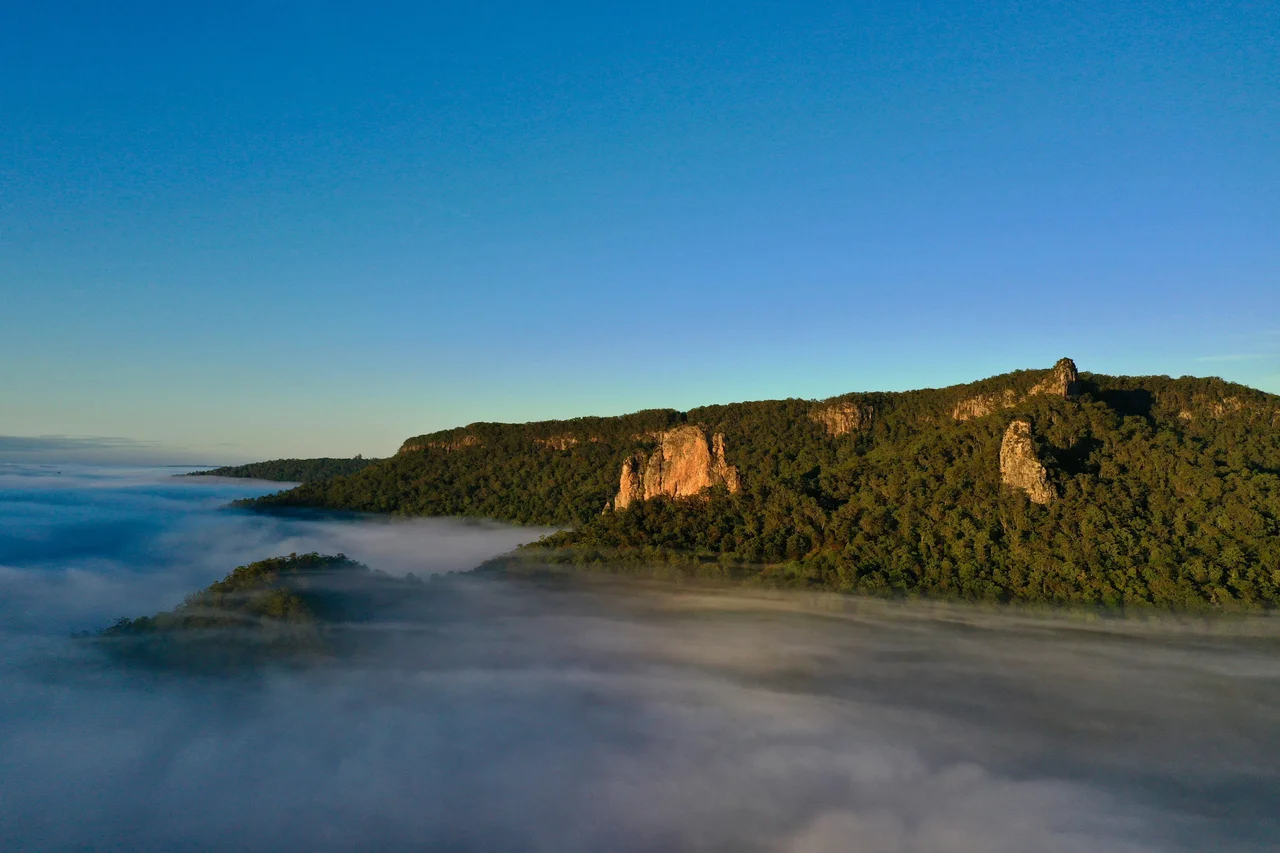

Nimbin Rocks
Long before the volcano fell silent, this was already a place of power. The Nimbin Rocks rise abruptly from the green valley floor a few kilometres south of Nimbin village - sheer grey spires of rhyolite that catch the first morning light and hold it. To the Bundjalung people, on whose country these rocks stand, they are far more than scenery. They are a profoundly sacred place, home in the Dreaming to the Nimbinjee, the clever-men or spirit beings of Bundjalung tradition. Out of respect, this is told from a distance: the rocks belong to the Bundjalung, and direct access to them remains closed.
Country of the Clever Men
The Nimbin Rocks are among the most significant sites in Bundjalung country. In the Dreaming they are associated with the Nimbinjee, the clever-men - spirit beings and keepers of knowledge whose presence makes this ground sacred. The valley below, where the village now sits, was a gathering place, with the rocks to the south held as a site of men's business and other places nearby reserved for women's business. They served as initiation grounds where young men were brought into knowledge and responsibility. These are living traditions, not relics, and the Bundjalung continue to hold this place as theirs. The Dreaming story connected to the rocks is shared, on Bundjalung terms, at the Nimbin Museum in the village.
Bones of a Vanished Volcano
Around twenty million years ago, the great Tweed shield volcano - centred on what is now Wollumbin, or Mount Warning - poured lava across this corner of the continent. The Nimbin Rocks are what survived: part of an eroded dyke, a sheet of harder rhyolite that once filled a crack in the volcano and then stood firm as the softer rock around it weathered away over the eons. They sit just outside the present-day caldera wall, about twenty kilometres from Wollumbin. The three most prominent spires carry the names the Thimble, the Cathedral and the Needle - shapes that hint at how strange and arresting they look when the valley mist parts and they appear, suddenly, like sentinels.
Seen From a Respectful Distance
There is a designated viewing area where visitors can look toward the rocks and take in the surrounding valley, but the rocks themselves are not a place to climb, scramble, or wander into. Access to the formation is restricted out of respect for its sacred status to the Bundjalung, and that boundary is the point - not an inconvenience to be worked around, but an act of recognition. The most fitting way to encounter the Nimbin Rocks is the way they ask to be encountered: from a distance, in silence, with the understanding that some places are kept rather than consumed. They have watched over this valley for millions of years, and over the Bundjalung for far longer than any visitor has been here to look.
From the Air
The Nimbin Rocks stand at approximately 28.616°S, 153.202°E, about 3 km south of Nimbin village in the Northern Rivers of New South Wales. From the air they appear as a cluster of sharp grey rhyolite pinnacles rising abruptly from the green valley floor, unmistakable against the surrounding pasture and rainforest. Wollumbin/Mount Warning - the eroded plug of the ancient Tweed volcano - lies roughly 20 km to the north-east and makes the dominant regional landmark. The nearest airport is Lismore Regional (YLIS), about 25 km to the south; Ballina Byron Gateway (YBNA) lies roughly 45 km east on the coast. Please note this is a sacred Bundjalung site with restricted ground access; observe from a distance and from the designated viewing area only. Clear early mornings, when valley mist lifts off the rocks, offer the most striking view.
Nearby Stories
- Casino Post Office 5.5 km away
- Cape Byron 7.7 km away
- Spicers Gap Road 29 km away
- David Fleay Wildlife Park 39 km away
- Bald Rock National Park 51 km away
- Allan Cunningham Monument 60 km away
- HMS Porpoise (1799) 701 km away
- SS Elingamite: Gold, Fog, and a Captain Wrongly Blamed 1840 km away