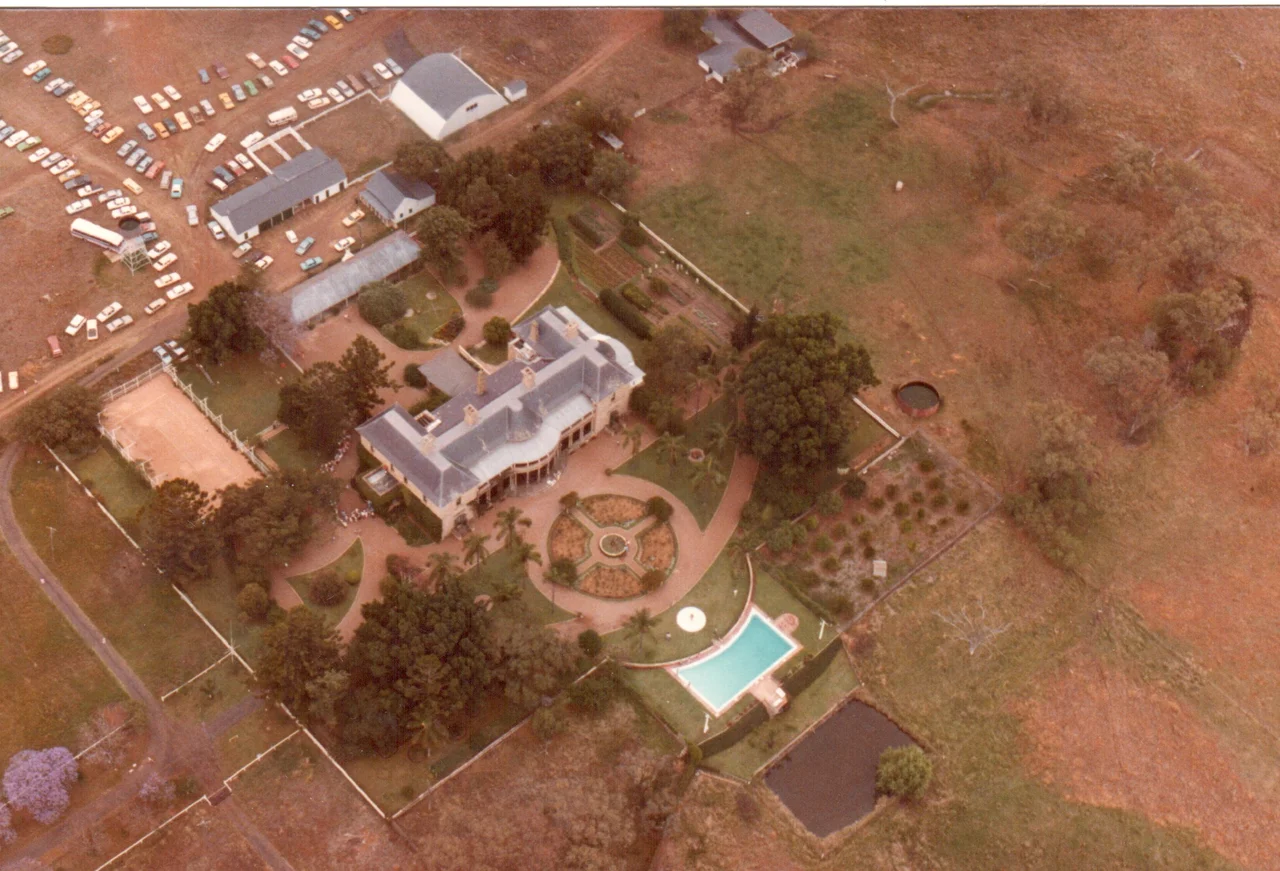

Jimbour Homestead
Four great chimneystacks rise above a Welsh-slate roof, and beneath them a colonnade of Doric columns runs the length of a sandstone facade that would not look out of place in the English shires. Yet Jimbour House stands on the open Darling Downs in Queensland, hundreds of kilometres from anything resembling an English county. It is the only genuinely grand country house in the English manner ever built in the state, and when it was finished in the 1870s it was also the largest, most expensive private home in Queensland. The ambition behind it was naked and deliberate: a colonial pastoralist announcing that he had arrived.
The Edge of the Known World
Long before the mansion, Jimbour was simply the farthest outpost of settlement on the Downs, the last station before the map ran out. That is why, on 1 October 1844, the Prussian naturalist Ludwig Leichhardt assembled his small party here and rode north into country no European had crossed. His goal was Port Essington, a remote military outpost near the top of the continent, nearly 5,000 kilometres away. For fifteen months he and his men were gone, given up for dead by many in the colony. Then, in December 1845, the survivors stumbled into Port Essington, gaunt and triumphant. Jimbour's claim to history was sealed before its grandest building existed: it was the threshold from which one of Australia's great inland journeys began.
A Pastoralist's Statement in Stone
The house that stands today belongs to Joshua Peter Bell, a grazier who became one of Queensland's most important politicians and businessmen, and who wanted a home equal to his standing. Around 1873 he commissioned the fashionable Brisbane architects Richard Suter and Annesley Voysey to design something handsome and ambitious. Work began in late 1874 and was complete by early 1877. With the single exception of the Welsh slate on the roof, everything was sourced locally; the honey-coloured sandstone came from quarries at Bunjinnie, a few miles off. Inside, a wide hall runs the building's length on both floors, each with a fireplace set into the wall like the winter galleries of an English country house. One upstairs bedroom still carries hunting-scene frescoes painted directly onto the plaster and dated 16 November 1879. Under Bell, the property earned a grand and slightly absurd nickname: 'The Mecca of Civilization on the Darling Downs.'
A Working Estate in Miniature
Jimbour was never a single building but a small world. A timber chapel, finished in 1868, sits west of the main drive; for a time it doubled as the Jimbour school and even gained a film-projection room above its porch. Nearby, a four-storey timber water tower leans inward as it rises, its top room decorated with naive paintings made between 1924 and 1956 by a station hand who clearly had time and a brush. A great sandstone store, designed by the architect Benjamin Backhouse, still shows the barred windows of its strongroom days and a mail hatch from when it served as the post office. Among the people who made the place run were Aboriginal stockmen of the surrounding country, including the Wakka Wakka, whose labour and knowledge of the land underpinned the pastoral life the grand house celebrated.
Living History on the Downs
The Bells eventually faced the squeeze that broke many pastoral fortunes. In 1877, 40,000 acres were resumed from the run for closer settlement, and in 1881 a shortage of capital pushed the brothers to fold their interests into the Darling Downs and Western Land Company alongside Premier Thomas McIlwraith. A simple obelisk near the water tower, the Bell Memorial, marks Sir Joshua Peter Bell, who died in 1881, and his son. Today Jimbour is a working property still, producing beef and grain, but it has also become a stage. Its garden amphitheatre can hold crowds in the thousands and has hosted major music festivals, and the house has played a film set, standing in for old-money grandeur in the 1983 television series Return to Eden. The frontier outpost where Leichhardt rode into legend now greets visitors with manicured gardens and the quiet authority of stone.
From the Air
Jimbour House lies at 26.96 degrees south, 151.24 degrees east, on the open plains of the Darling Downs north of Dalby in the Western Downs. From the air the formal sandstone house, its dark slate roof and four prominent chimneys, and the surrounding gardens and outbuildings read clearly against geometric cropland. The nearest field is Dalby Airport (YBDL), roughly 30 km south; Toowoomba Wellcamp Airport (YBWW) lies about 75 km southeast, and the Army aerodrome at Oakey (YBOK) is to the south. The terrain is gentle and the winter skies often crystal clear, making low-level passes rewarding; watch for agricultural traffic around Dalby.
Nearby Stories
- Jondaryan Woolshed 28 km away
- Main Range Railway 30 km away
- Cressbrook Homestead 53 km away
- Conondale National Park 77 km away
- Montville Memorial Precinct 154 km away
- Hornet Bank Massacre 178 km away
- Warialda 256 km away
- Myall Creek Massacre and Memorial Site 311 km away