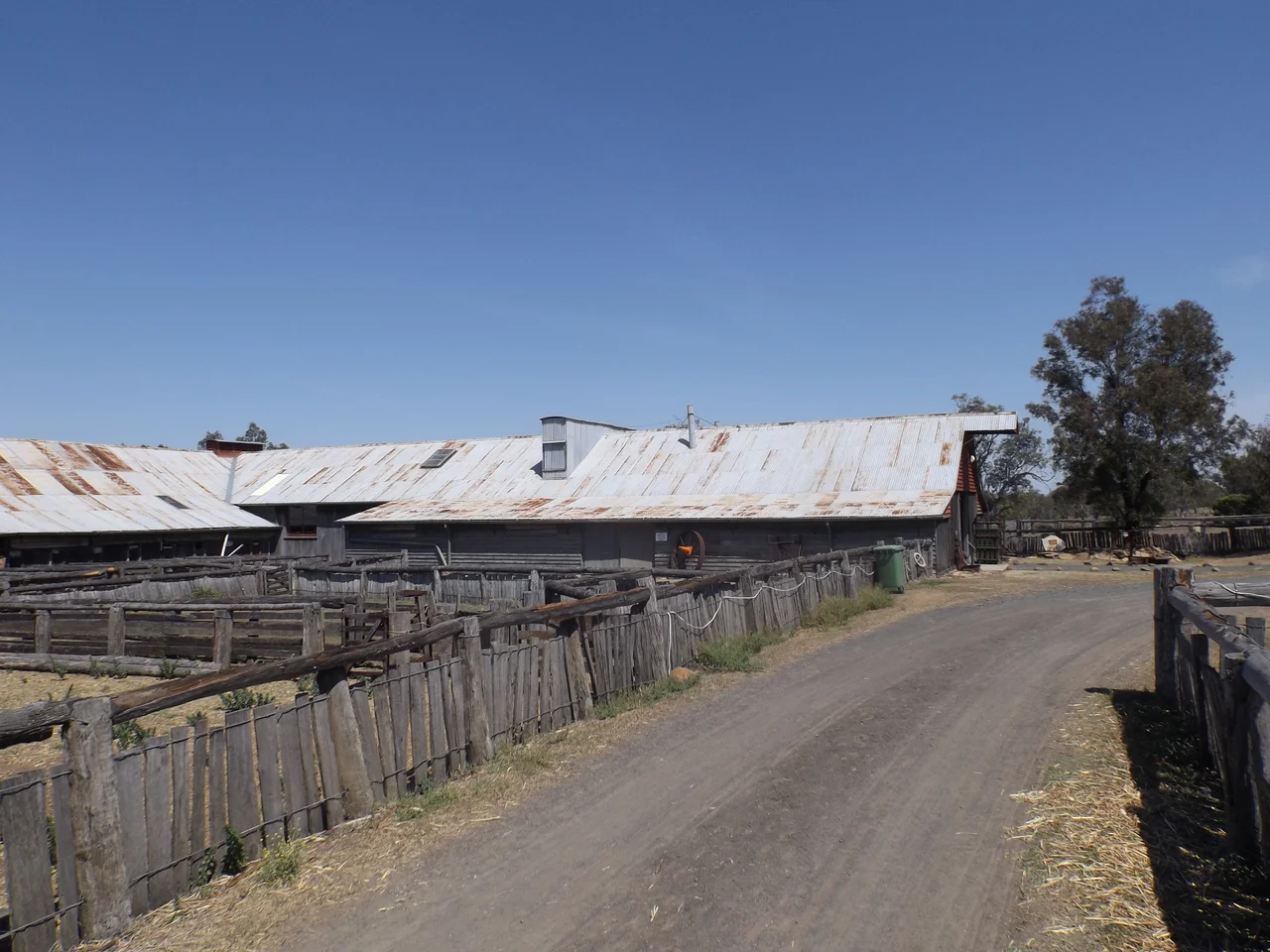

Jondaryan Woolshed
Stand at one end of the Jondaryan Woolshed and the far wall seems to recede into shadow. The building runs nearly 300 feet, a low timber nave braced by hand-cut trusses, and in its prime it swallowed three thousand sheep at a time. Built in 1859 and 1860 on what was then the largest freehold station in Queensland, it was a factory before Queensland had factories. Fifty-two men once stood along its board, blades flashing, fleeces peeling away in a single piece, while the smell of lanolin and dust thickened the air. More than a century and a half later, you can still walk that board.
A Cathedral Built for Sheep
The Darling Downs opened to grazing after the botanist Allan Cunningham crossed it in 1827 and reported rich pasture, though the penal colony at Moreton Bay kept settlers out for years. By 1840 the first sheep runs appeared, and Jondaryan, named from an Aboriginal word for a large lagoon, grew into a giant. When the partnership of Kent and Wienholt set out to expand it, they hired J. C. White, a former clerk of works, to design a new shed. The carpenter T. Jones began building in 1859. White laid it out in a T-shape: a short central bay for baling and loading, two long wings for shearing. Sheep entered from each end and flowed through pens to the board, where 52 stands lined the perimeter. The roof was meant to be shingled. Instead, in 1860, they shipped in corrugated iron. The first clip came off in 1861.
The Village That Wool Built
Jondaryan was never just a shed. At its peak the station sprawled across 300,000 acres, with 155,000 of them freehold, and it ran like a small kingdom. A station store, a butcher's shop, a hide-and-tallow house, shearers' quarters, a stable, and a tiny church called St Anne's clustered around the homestead, supporting families who lived and worked far from any town. Sheep arrived from neighbouring stations to be shorn here; in the 1873 season alone, 24,000 of them belonged to other properties. When the Western railway pushed through in 1867 and reached Dalby the next year, a settlement grew around the siding and took the station's name. For decades the manager of Jondaryan was, in effect, the most powerful man on the Downs.
The Ban That Lit a Fuse
That power is exactly what made Jondaryan a flashpoint. Shearing relied on an itinerant workforce, and the big stations set the terms. In 1887 the Queensland Shearers Union formed at Blackall and signed up 1,300 members within a year. When Jondaryan's management used non-union labour in 1888, union shearers refused to sign on. By 1890 the shed was under a union ban. The owners brought in non-union hands and the wool was shorn, but it could not move: at every stage of its journey, other unionists refused to touch it. Bales of Jondaryan wool simply sat on the Rockhampton wharves until a compromise was struck. It was the first time Australian unions had acted in federation, and that solidarity fed directly into the great shearers' strike of 1891 and the birth of the Australian Labor Party. A wool shed on a quiet plain helped change a nation's politics.
Saved by Its Own Town
Wool eventually receded. In 1891 machine shearing arrived and the stands dropped from 52 to 36. New land laws forced the sale of freehold from 1906, and through the 1940s the great station was carved into farms. On the first day of 1946, Jondaryan ceased to exist as a station, and the block holding the woolshed was sold off. It might have rotted into a hay barn. Instead, in 1972, after the local school's centenary celebrations spilled into the old shed, the owner offered it and twelve acres to the people of Jondaryan. They took it. The Jondaryan Woolshed Historical Museum and Park Association formed in 1976, and the place was added to the Queensland Heritage Register in 1992. Today shepherd's huts, a blacksmith's shop, and an old police lockup have been gathered around it, but the woolshed itself remains what it always was: one of the oldest and largest surviving in the country, still standing watch over the plain.
From the Air
Jondaryan Woolshed sits at 27.39 degrees south, 151.57 degrees east, on the flat western Darling Downs about 3 km south of Jondaryan township and close to Oakey Creek. From the air the long pale corrugated-iron roof stands out sharply against open farmland; the historic park clusters around it. The Western railway line runs nearby as a navigational thread. The closest field is the Australian Army's Oakey aerodrome (YBOK) roughly 25 km east; Toowoomba Wellcamp Airport (YBWW) lies about 40 km east-southeast, and Dalby (YBDL) is to the northwest. Best viewed at low altitude in the clear, dry winter air of the Downs, when long shadows rake across the plain.
Nearby Stories
- Cressbrook Homestead 18 km away
- Royal Bull's Head Inn 21 km away
- Main Range National Park 25 km away
- Bunya Mountains National Park 34 km away
- North Ipswich Railway Workshops 60 km away
- Warialda 223 km away
- Hornet Bank Massacre 230 km away
- Inverell 271 km away