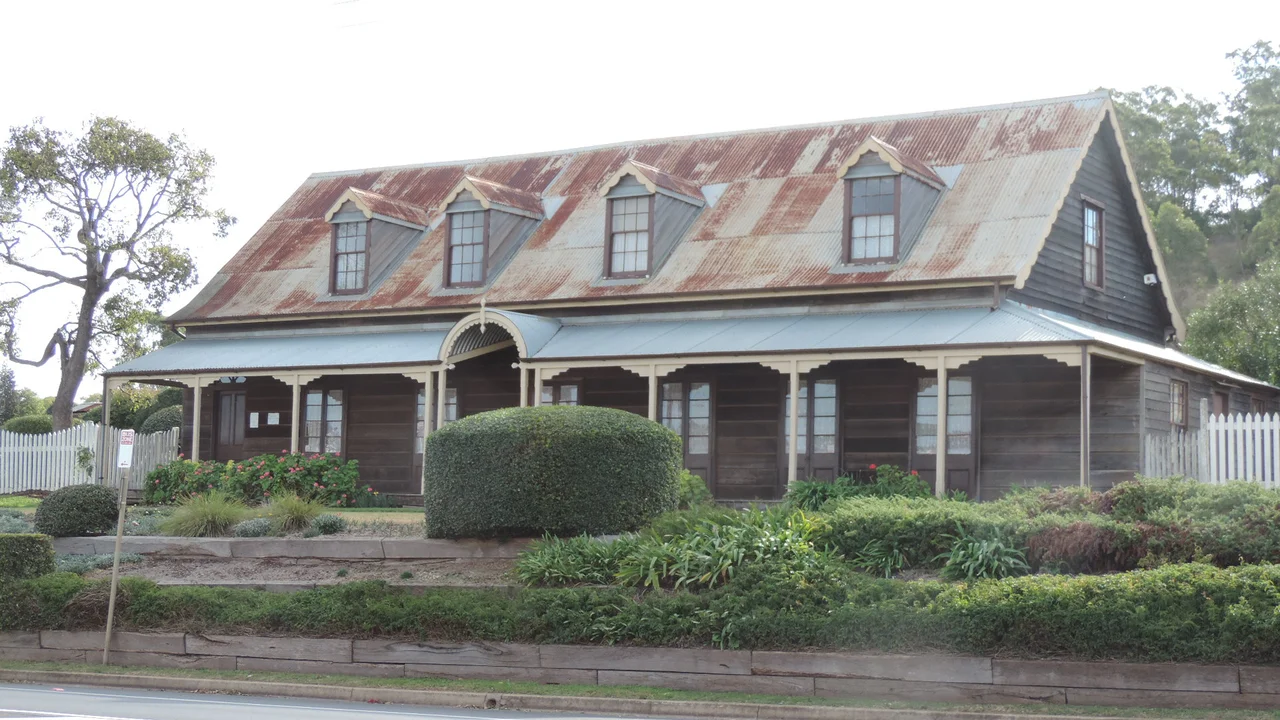

Royal Bull's Head Inn
The man who built this inn arrived in Australia at sixteen, a convict transported from England for theft. By the time William Horton raised the timber-and-brick building that still stands on Brisbane Street in Drayton, he had become something else entirely: the most celebrated host on the Darling Downs. He named his hotel the Bull's Head, after a prize Durham bull called Champion that grazed the plains at Cecil Plains station. Then a governor came to stay, and the place got a crown in front of its name.
Water Springs Up
Before there was a town, there was a spring. The Aboriginal name for this place was chinkerry, meaning water springs up, and the people who named it had drawn on it for thousands of years. When squatters pushed onto the Darling Downs in the early 1840s, they camped where the water was. In 1842 a storekeeper named Thomas Alford set up at the junction of two routes that threaded through gaps in the Great Dividing Range, and the cluster of buildings that grew around him became known to Europeans simply as The Springs. Bullock drivers, pastoralists, and travellers needed beds and beer. Horton, who had learned the trade running a hotel at Ipswich, opened his first inn here in 1847 and set out to make it a byword for comfort on the Downs.
A Crown and a Congregation
Horton was a genial host, and his inn became the social engine of the district. Squatters met here to talk politics and arrange horse races. Auctions were held in its rooms. Lodging, stabling, gossip, governance: all of it ran through the Bull's Head. On 20 August 1848, the Reverend Benjamin Glennie conducted the first Church of England service on the Darling Downs within these walls, before there was any church to hold it. In 1858 Horton returned to Drayton and threw up a major extension in brick, cedar, and timber along Brisbane Street, the structure that survives today. Two years later, when Queensland's first governor, Sir George Bowen, stopped here on his travels, the hotel earned its royal prefix. It has been the Royal Bull's Head Inn ever since.
The Town That Drifted Away
Drayton had a problem it could never solve: water. The springs that gave the place its name could not keep pace with the people and animals crowding in. Wells were sunk and failed. The town sat in a gully, hemmed in, unable to grow. Meanwhile, an area called The Swamp, about six and a half kilometres away, was filling up fast. That swamp became Toowoomba, and as it rose, Drayton faded. Without Horton's personal touch the inn declined too. Licensees came and went, none of them prospering, and in 1865 and again in 1867 the contents were sold off at auction. The building that had hosted governors slipped quietly into the role of a family home.
What the Walls Remember
The Lynch family lived here for generations, and the inn absorbed their lives. When the last surviving son died in 1973, the National Trust of Queensland acquired the building and, after careful restoration, opened it to the public in 1985. Walk through it now and the layers are visible: ten rooms downstairs, five up, four dormer windows breaking the corrugated-iron roof. Upstairs, original wallpaper still clings to calico scrim stretched between the studs. Some of the joinery is painted with decorative scenes. The pressed-metal ceiling survives in the parlour. As a pre-Separation inn, built before Queensland became a colony in its own right in 1859, it is a genuine rarity, one of the oldest surviving buildings on the Darling Downs and a fragment of the frontier that everything else around it has long since outgrown.
From the Air
The Royal Bull's Head Inn sits at 27.601 degrees south, 151.914 degrees east, in the Toowoomba suburb of Drayton on the eastern edge of the Darling Downs, at roughly 600 metres elevation atop the Great Dividing Range. Toowoomba Wellcamp Airport (YBWW) lies about 8 nautical miles to the west; the Oakey Army Aviation Centre (YBOK) is just north, so expect military restricted airspace in the vicinity. Brisbane Airport (YBBN) is roughly 70 nautical miles to the northeast, beyond the escarpment and down on the coastal plain. From the air, look for the historic Drayton street grid southwest of central Toowoomba, where the inn's pale timber form and steep dormered roof stand on a slight rise above Brisbane Street. Clear, dry winter days offer the sharpest visibility over the Downs.
Nearby Stories
- Talgai Homestead 16 km away
- Purga Aboriginal Cemetery 17 km away
- Brisbane Tramway Museum 36 km away
- Jondaryan Homestead 47 km away
- Jimbour Homestead 59 km away
- Border Ranges National Park 61 km away
- Warialda 199 km away
- Inverell 235 km away