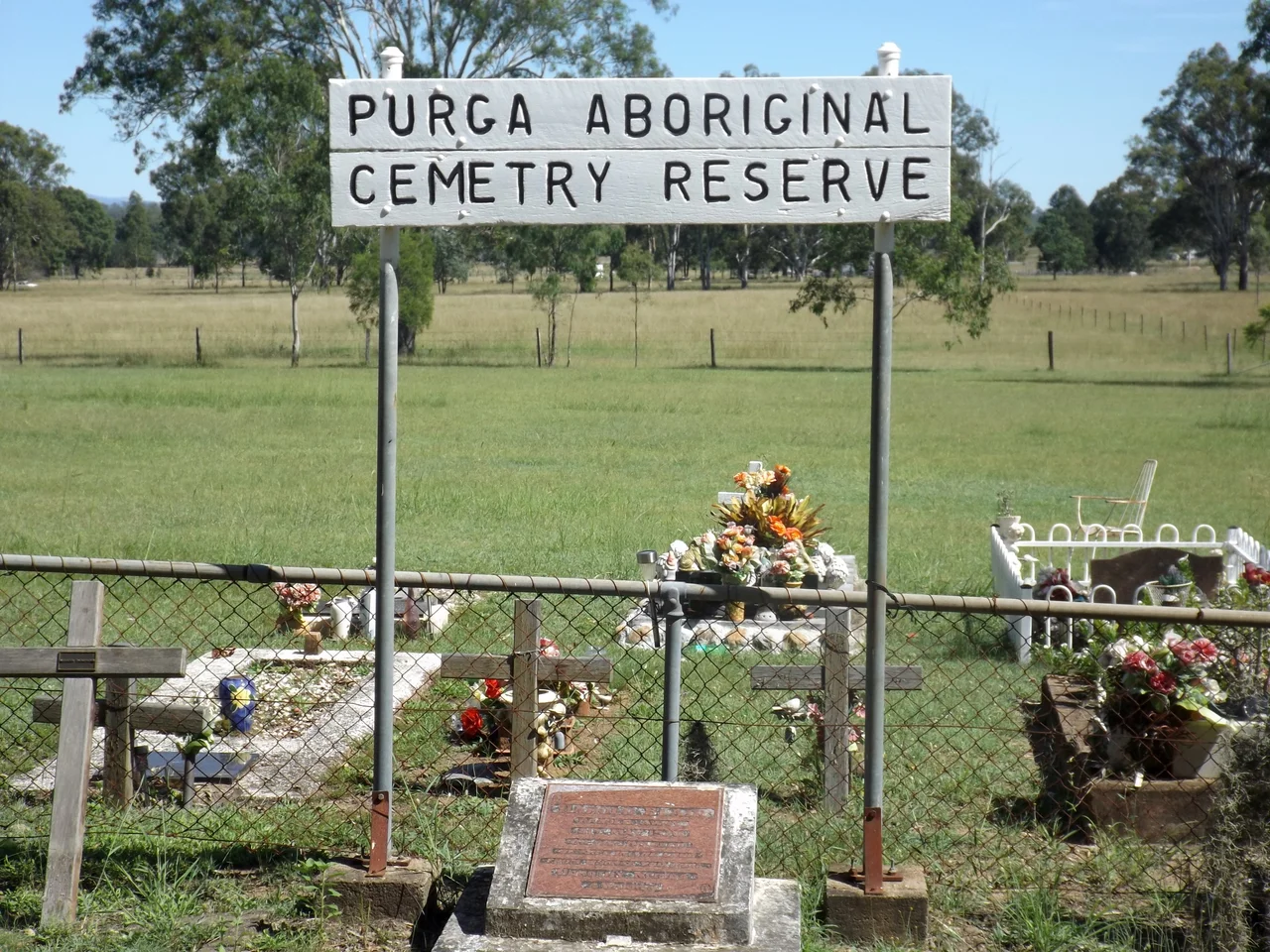

Purga Aboriginal Cemetery
An acre of red earth lies off Carmichaels Road, fenced with chain wire, fifteen kilometres south of Ipswich. A few marble headstones lean among simple timber crosses, the oldest reading 1918. This is the resting place of the Aboriginal people who lived and died at the Purga mission - and of many more whose graves bear no stone at all. The land itself is the country of the Yugarabul people, who have been its custodians since time immemorial. To stand here is to stand among people who were carried far from their own country and laid to rest in someone else's. The cemetery is quiet now, but it is not empty. It is held, carefully, by the descendants who still come.
Sent Far From Country
Under the Aboriginal Protection and Restriction of the Sale of Opium Act of 1897, the lives of Queensland's Aboriginal people fell under the control of the State. Officials called Protectors could decide where people lived, where they worked, and what wages they were allowed to keep. Families were moved onto reserves, often the traditional lands of entirely different groups, far from the places their own ancestors had walked. Those carried away from their country in this way came to be known as 'historical' people. From North Queensland and from as far west as Charleville, Aboriginal children and adults were sent to Purga. The reserve was never their home in the way home is meant to be. It became home only because they were left no choice, and because the people there made what life they could within its fences.
Deebing Creek and Purga
The story begins a few kilometres north, at Deebing Creek, where a mission was set up in 1892. By 1914 the work had shifted to Purga Creek, partly because the new site sat closer to the railway, and partly - as the records bluntly state - to put distance between the residents and the alcohol of Ipswich. Timber cottages were built on stumps around a square paddock, arranged so the official quarters could watch over every door. Married couples cooked for themselves from weekly rations in their own huts. Orphaned children and unmarried adults lived in dormitories. The Salvation Army took over in 1920 and ran the place for nearly three decades. When the mission closed on 30 June 1948, only seven residents remained, and the children among them were sent on to yet other settlements - moved again, as so many had been before.
The Graves That Have No Stone
The cemetery was formally gazetted in 1968, but people had been buried here since the mission's earliest years - the marble headstone dated 1918 proves it. Inside the small fenced enclosure, early marble markers stand beside low concrete headstones and timber crucifixes. Beyond the fence, in the wider reserve, more graves are scattered: some marked by crosses and brass plaques, some by granite, and many by nothing the eye can read. These unmarked graves are the cemetery's heaviest truth. Among those who rest here are children who never grew up, and adults whose names the official record never bothered to keep. A timber sign in the south-west corner names the ground the Doreen Thompson Memorial Cemetery, a reminder that this is a living place of grief, tended by people who have not forgotten.
Those We Can Name
Some who rest here are remembered by name, and through them the others are honoured too. Aunty Janey Arnold was born around 1908 near Mitchell; at the age of one, her family was moved to Deebing Creek, and later to Purga. She became a long-serving campaigner for Aboriginal rights and equity, and when she died in 2002 she was buried in the fenced enclosure. The mission's most celebrated child was Harold Blair, born in 1924, a Wulli Wulli man brought to Purga as an infant and raised there until he finished school. He became one of Australia's great tenors, studied in Melbourne and the United States, sang in the first opera staged at the Sydney Opera House, and spent his life fighting for Aboriginal rights. When he died in 1976, his ashes were scattered at Purga - the boy from the mission returning, at the end, to the people who raised him.
Why It Endures
The Purga Aboriginal Cemetery was added to the Queensland Heritage Register in 2008. The listing recognises it as a physical reminder of the practice of isolating Aboriginal people from the wider Queensland community in the early twentieth century - a policy written into law and enforced for decades. But the cemetery is more than a record of what was done to people. It is a place of ritual and ceremony, of mourning and return, bound to the community whose forebears lie here. The mission buildings are long gone; nothing of them survives. What remains is this acre of ground, the headstones and the crosses and the quiet earth between them, and the families who still arrive to remember the people - named and unnamed - who were sent here, and who never left.
From the Air
The Purga Aboriginal Cemetery lies at approximately 27.72°S, 152.75°E, about 15 km south of Ipswich on the rural flats near the Ipswich-Boonah Road, west of Purga Creek and the old Fassifern railway line. It is a small, unobtrusive site - an acre of fenced ground amid open farmland - and not a visual landmark from altitude; the broader Ipswich urban area and the Brisbane River valley to the north-east are the navigational references. The nearest major airport is Brisbane (YBBN), roughly 50 km north-east; Archerfield (YBAF) lies about 35 km to the north-east, closer to the city. This is a place of mourning and deep cultural significance to the local Aboriginal community; it warrants quiet respect rather than spectacle.
Nearby Stories
- 2010-2011 Queensland Floods 12 km away
- Surfers Paradise International Raceway 12 km away
- Brisbane Tramway Museum 18 km away
- Dreamworld 20 km away
- Glengallan Homestead 24 km away
- Moreton Island 31 km away
- Spicers Gap Road 37 km away
- Jondaryan Homestead 64 km away