.jpg)
Jondaryan Homestead
A man went looking for land for other people and quietly kept the best of it for himself. In 1840 Henry Dennis, scouting the newly-opened Darling Downs for his employer, marked out a run between Oakey Creek and Myall Creek - and then, the story goes, neglected to register it because he wanted it for his own. The oversight cost him. By 1842 Charles Coxen had taken up the ground, and it was Coxen's nephew Henry who gave the place the name it still carries: Jondaryan, thought to be a settler's rendering of an Aboriginal word for a large lagoon. From that contested beginning grew one of the largest pastoral empires in Queensland.
Built of Slab and Ironbark
The first house at Jondaryan was a mistake of siting. James Chatman, a convict carpenter who had walked north with Henry Coxen, raised an early dwelling on an ironstone ridge - and the ridge drew lightning. After storms hammered the spot through 1844, the owners moved two miles upstream and built again, this time in sturdy ironbark slabs and floorboards, on the ground where the homestead stands today. That timber house served as the heart of the station for nearly a century. Around it, through the prosperous 1860s, a whole working settlement took shape: a kitchen, a butcher's shop, shearers' quarters, stables, a store, a dairy, even a glasshouse tended by a Chinese gardener. A visitor in 1922 wrote that the cottages and outbuildings made quite a little township of themselves.
From Licence to Empire
Jondaryan grew at the pace of the frontier. It began as 13,000 acres held by little more than a licence; by 1845 it covered 65,000. The run passed through a parade of owners - Andrews and Campbell, then the brewing-and-banking Tooth brothers, then the partnership of William Kent and Edward Wienholt - most of them absentees who ran the place from comfortable houses in Sydney while managers and workers did the labour on the Downs. Under the company the Kents and Wienholts built, called Jondaryan Estates, the holding swelled past 300,000 acres of leasehold and freehold, making it for a time the largest freehold station in Queensland. The pre-emptive purchases, the new woolshed, the stud yards - all of it was paid for by the extraordinary profits that wool returned in those decades.
The Shed That Sparked a Strike
The wealth of stations like Jondaryan rested on the backs of the men who sheared the sheep, and at Jondaryan that arrangement finally broke. The station's great woolshed - completed around 1859 to 1860 and now a separately listed museum down the road - became a battleground. In 1890, partly because of Edward Wienholt's high-handed dealings with his workers, Jondaryan was chosen as a test case by the new Queensland Shearers Union. The shed became the first flashpoint of a confrontation that swelled into the great Australian shearers' strike of 1891, one of the defining labour struggles in the nation's history and a seedbed of the Australian Labor Party. The grand pastoral run, in other words, helped give birth to the movement that would challenge the squatters' world.
The Land Carved Away
Empires of land do not last forever, and Jondaryan was dismantled acre by acre. Government resumptions chipped at the leasehold through the 1890s; the first subdivision came in 1908, more sales followed in the 1920s, and when Jondaryan Estates finally went into voluntary liquidation in 1946, the once-vast run had been broken into 184 parcels sold off to 220 different owners. The grand house did not survive to see it whole again either - fire destroyed the old ironbark homestead on 30 December 1937, and the present house was built on its footprint. Only the original 1844 kitchen came through the flames, the last fragment of the first house still standing. The Kent family held the homestead block, some 2,000 acres, until 1974.
What Still Stands
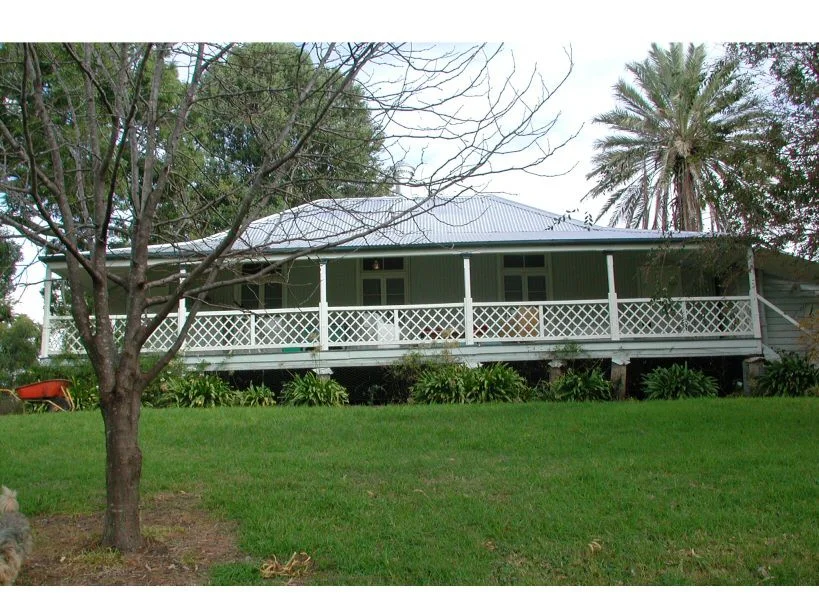
Three and a half kilometres southwest of the township of Jondaryan, off Evanslea Road and bordered to the north by Oakey Creek, the homestead survives as a remarkable cross-section of early Queensland pastoral life. Listed on the Queensland Heritage Register since 1992, the site keeps its low corrugated-iron house with its long verandah and canvas blinds, and around it a constellation of slab-walled outbuildings from the 1860s - the butcher's shop with its scalloped bargeboards, the stables of split timber, the shearers' quarters insulated with charcoal and railed with diagonal wool-bale straps. There are stables and horse stalls, a killing shed, the remains of the gardener's glasshouse, and gravestones among the trees. Few places in Australia preserve so completely the hand-built fabric of a great squatting run from its earliest days.
From the Air
Jondaryan Homestead sits at 27.40 degrees south, 151.57 degrees east, on the open Darling Downs of southern Queensland, about 3.5 km southwest of Jondaryan township and roughly 45 km west of Toowoomba along the Warrego Highway. From the air the setting is flat black-soil cropping country threaded by Oakey Creek, which borders the property to the north; the cluster of low iron-roofed heritage buildings and the separately preserved Jondaryan Woolshed are the local landmarks against an otherwise geometric agricultural patchwork. Nearest major airport is Toowoomba Wellcamp (YBWW / WTB), about 30 km east; Oakey Army Aviation Centre (YBOK) lies closer, around 20 km southeast, so expect military rotary traffic in the area. Brisbane (YBBN / BNE) is about 160 km east beyond the range. Best viewed in clear morning or late-afternoon light when low sun picks out the buildings; the plains are subject to summer dust haze and rapid afternoon storm development.
Nearby Stories
- Cressbrook Homestead 18 km away
- Royal Bull's Head Inn 21 km away
- Main Range National Park 25 km away
- Bunya Mountains National Park 34 km away
- North Ipswich Railway Workshops 60 km away
- Warialda 223 km away
- Hornet Bank Massacre 230 km away
- Inverell 271 km away