
North Ipswich Railway Workshops
Queensland did something no other Australian colony did: it began its railway not in the capital, but in a provincial town. Brisbane already had the river; what the young colony needed was a way to reach the rich farmland of the Darling Downs. So in 1864 the first tracks were laid at Ipswich, and beside them rose the workshops that would build the trains. More than 160 years later they have never once stopped - the oldest continuously operating railway workshops in Australia, still ringing with the work of forge and lathe on the banks of the Bremer River.
Iron Shipped Halfway Round the World
In the beginning, everything came from Britain. The construction contract went to the famous firm of Peto, Brassey and Betts; the rails, the first locomotives, even two complete prefabricated 'erecting shops' with cast-iron frames were loaded onto ships in England, sailed to Brisbane, and carried the last stretch upriver to Ipswich by paddle steamer. The first section of line opened in 1865, and that same year the workshops turned out their first piece of rolling stock - a single engine truck. Ten wagons followed in 1866. It was modest, imported, dependent. But the men working the floor were learning, and they were impatient to build for themselves.
Two Hundred and Eighteen Engines
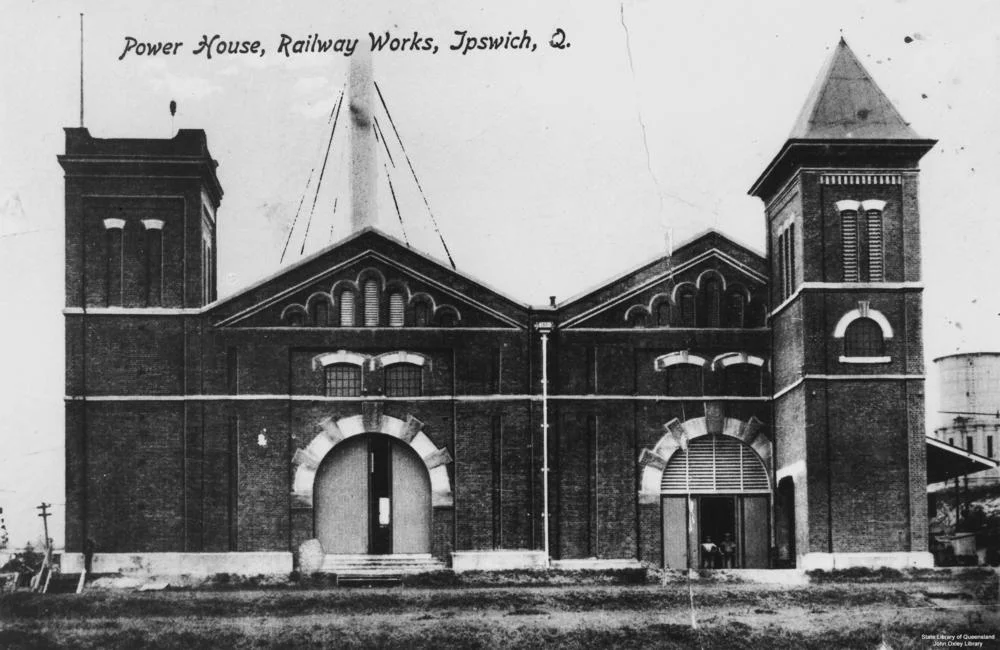
In 1877 they did it. The workshops assembled their first locomotive, an A10 class cobbled largely from existing spare parts - proof that Queensland could make its own engines rather than buy them. From that first machine the floodgates opened. Over the decades that followed, North Ipswich built 218 steam locomotives in all, the last of them a DD17 class rolled out in 1952. Around the turn of the century the cramped early sheds gave way to a grand vision: under engineer William Nisbet, the site was rebuilt at scale, with a 1902 power house that lit the whole complex sixteen years before mains electricity reached Ipswich itself, and a great traverser to shuttle locomotives between the rows of soaring brick shops.
The Day They Rebuilt a Record-Breaker
In December 1919, a battered Vickers Vimy biplane sat stranded near Charleville in the Queensland outback. Aboard it were Ross and Keith Smith, who had just completed the first flight from England to Australia by an Australian crew - and now their machine had broken down, far from any aircraft factory. The job came to the railway men of North Ipswich. With no drawings or patterns to work from, they reverse-engineered the broken parts by eye: forging and machining new connecting rods, repairing the cracked crankcase, and carving an entirely new propeller from Queensland maple. Engine men who built steam locomotives sent a record-setting aeroplane back into the sky.
A Workshop, a Community, a Museum
The workshops were never only machinery; they were a society. For most of their history they employed more than 1,500 people at a time, peaking above 3,000 just after the Second World War - making them one of the great engines of Ipswich life, woven through thousands of families across generations. The men planted gardens and built lunch shelters between the sheds, personalising the soot-stained yard; in the Bogie and Brake Shop their chalked notes still mark the old timber lockers. In the First World War some 300 of the 1,600 workers turned to munitions, forging shell casings from Australian steel; in the Second, the floor produced a special Tool and Gauge Shop, one of only two of its kind in the country, along with the largest casting ever poured here - thirty tons of metal in 1942. Today the front third of the site is The Workshops Rail Museum, run by the Queensland Museum - while behind it, Queensland Rail's tradespeople still work, as they have without pause since 1864.
From the Air
The North Ipswich Railway Workshops occupy the north bank of the Bremer River at roughly 27.60 degrees south, 152.76 degrees east, off North Street in North Ipswich, South East Queensland. From the air the complex is identifiable by its long rows of brick industrial sheds aligned along the central traverser, the tall elevated water tower at the northern end, and the power house, all hard against a tight bend of the Bremer River just north of central Ipswich. Nearest major airport is Brisbane, YBBN, about 35 km east-northeast; RAAF Base Amberley, YAMB, lies roughly 12 km southwest - active military controlled airspace, so check NOTAMs. Recommended viewing altitude 2,000 to 3,500 feet, clear of Amberley's zone. The museum and rail yards are easily picked out against the surrounding suburbs; visibility is best in dry winter conditions.
Nearby Stories
- 2010-2011 Queensland Floods 12 km away
- Surfers Paradise International Raceway 12 km away
- Brisbane Tramway Museum 18 km away
- Dreamworld 20 km away
- Glengallan Homestead 24 km away
- Moreton Island 31 km away
- Spicers Gap Road 37 km away
- Jondaryan Homestead 64 km away