
Brisbane Tramway Museum
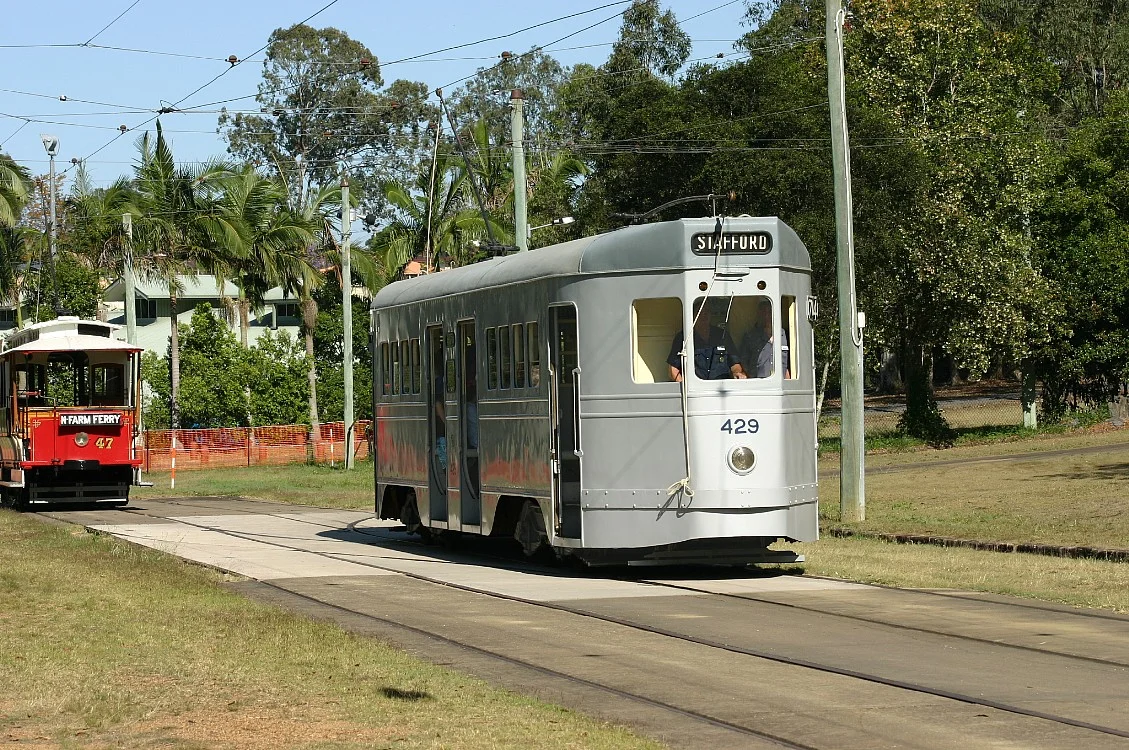
On 13 April 1969, around 70,000 people crammed onto Brisbane's trams to ride them one last time. The city was tearing up the tracks that had carried it since 1897, swapping rails for buses in the name of progress. But a year earlier, a small group had seen it coming and formed a society to save what they could. Today, on a quiet 250-metre loop of track at Ferny Grove, their trams still run every Sunday afternoon, and the bell still rings out across the grass exactly as it did when these cars worked the city streets.
Saving the Fleet
The Brisbane Tramway Museum Society was founded in 1968, the moment it became clear the Brisbane City Council meant to close the system down. There was an urgency to it; trams that were scrapped would be gone forever, and the volunteers were racing the cutting torches. In 1972 a site at Ferny Grove was secured, and after eight years of weekend labour the museum opened in June 1980. The collection that survived is substantial: 25 trams, 24 of them Brisbane's own, plus a single Sydney car for good measure. There are also two single-deck trolley-buses, built in Wolverhampton, England, on Sunbeam chassis and given Brisbane-made bodies, a reminder that for a while the city ran on overhead wires of more than one kind.
The Cars That Ran the City
The fleet reads like a roll call of a vanished daily life. The oldest runner is No. 47, a "California Combination" or "Matchbox" tram from 1901, with open and enclosed sections so passengers could choose breeze or shelter. There is a ten-bench "Toastrack," open to the air on every side; a stubby centre-aisle car nicknamed the "Baby Dreadnought"; and elegant "Dropcentre" cars that sat low to the road for easy boarding. The newest, No. 554, carries a darker story in its timber. It is one of the "Phoenix" trams, rebuilt by the council in the 1960s from the wreckage of cars destroyed in a catastrophic depot fire, and it entered service in 1964. A selection of these veterans takes passengers down the demonstration track each Sunday, weather permitting, the way they always stopped for the weather.
Fire and Aftermath
That fire shadows the whole story. On the night of 28 September 1962, one of Brisbane's fiercest blazes tore through the Paddington tram depot and destroyed 67 trams, roughly a fifth of the entire fleet, in a single night. The council rebuilt some as the Phoenix cars, but the disaster handed momentum to those who already wanted the trams gone. Within seven years the network was finished. The museum, in a sense, is the long answer to that fire: a deliberate act of rescue set against an accidental act of destruction. To watch No. 554 glide past today is to see a survivor twice over, once from the flames, and once from the scrapyard.
A System Rebuilt from Salvage
What makes Ferny Grove special is that almost nothing here is a replica. The depot sheds are built from bays salvaged from the old Ipswich Road tram depot. The substation that feeds direct current to the overhead wires was assembled from equipment pulled out of Brisbane's original tramway substations. An elevated signal cabin that once stood at a Fortitude Valley street corner has been carried here and preserved. Even the short track is genuine Brisbane practice, laid in solid mass concrete rather than on sleepers, and outside the main shed sits a rare three-way set of points rescued from the Light Street depot. Inside are the conductors' tickets, the uniforms, and the distinctive kepi caps the crews wore into the 1960s. It is less a display than a working fragment of the city, reassembled piece by piece by people who refused to let it disappear.
From the Air
The Brisbane Tramway Museum lies at approximately 27.407 degrees S, 152.938 degrees E at Ferny Grove, in Brisbane's leafy northwestern suburbs at the foot of the forested D'Aguilar Range. Useful landmarks are the green ridgeline of Mount Coot-tha and the D'Aguilar foothills to the west, with the Ferny Grove rail terminus and Kedron Brook nearby. Brisbane Airport (ICAO YBBN) lies about 16 km to the east-northeast; Archerfield Airport (ICAO YBAF) about 15 km to the south. Best viewed from 1,500 to 3,000 feet; the surrounding hills can generate afternoon cumulus and the site is small, so good visibility helps in picking out the depot sheds and demonstration loop.
Nearby Stories
- Bribie Island 12 km away
- Cressbrook Homestead 17 km away
- Beenleigh Rum Distillery 18 km away
- Main Range National Park 39 km away
- 2010-2011 Queensland Floods 47 km away
- Cape Byron 115 km away
- Cape Byron Light 145 km away
- HMS Porpoise (1799) 570 km away