.jpg)
Talgai Homestead
Six days of rain in the winter of 1886 did what no excavation had intended. When fencing contractor William Naish returned to his line along Dalrymple Creek, the downpour had cut the erosion channel deeper, and out of the bank came a human skull, crusted hard with carbonate. He could not have known he was holding one of the oldest human remains then found on the continent, the cranium of an Aboriginal man who had walked this country thousands of years before any sandstone homestead rose beside the creek. The discovery would make Talgai famous. It would also reveal how easily a person can be turned into a specimen.
Sixty Squares of Sandstone
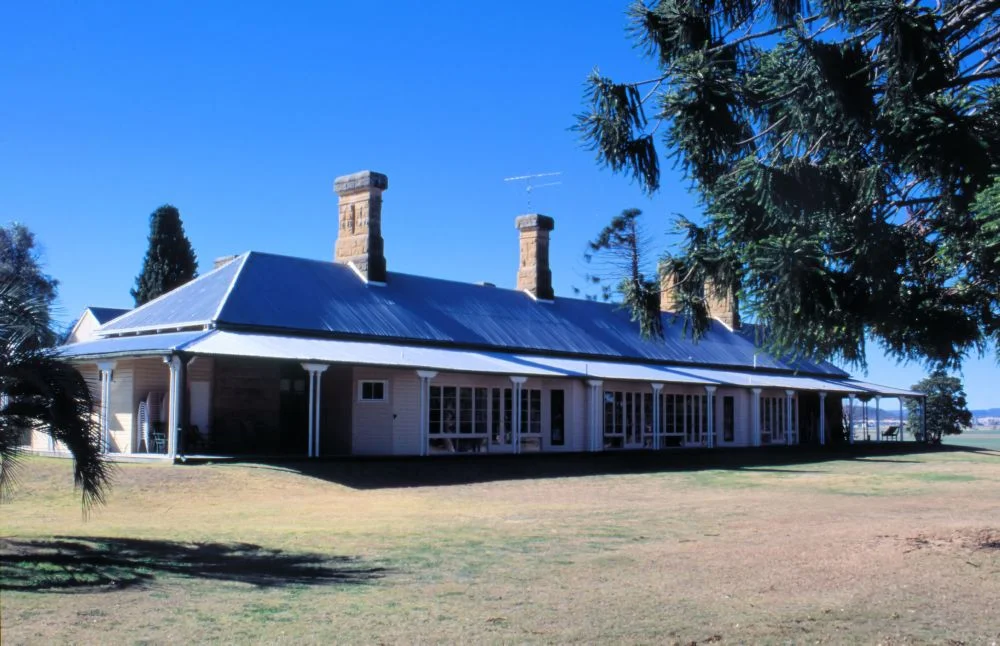
The homestead itself was built in 1868 for the pastoralist and politician George Edwin Clark, on the eastern portion of a run first taken up by Ernest Dalrymple in 1840. When Clark secured the land, the only structure on it was an old shepherd's hut. In its place he raised a sprawling single-storey sandstone house covering sixty squares, designed by Richard George Suter, one of Queensland's most prolific colonial architects and the hand behind Jimbour House and St Mark's Church in Warwick. Unusually for the period, Suter attached the kitchen to the main house rather than setting it apart. Cedar doors, spotted-gum verandahs, seven stone chimneys, French doors opening onto shaded walkways: East Talgai was built to display wealth, and it did.
The Richest Wool in the Colony
George and Ellen Clark lived an affluent life behind those walls, the rooms filled with antique furniture likely brought as part of Ellen's dowry. Through the 1860s and 1870s Talgai grew into what was arguably the most successful sheep stud in Queensland, producing enormous quantities of fine merino wool and trading rams prized as far away as Tasmania and Germany. By the 1880s the station ran some twenty thousand sheep and three thousand cattle, a self-contained village with cottages, a smithy, stables, a slaughterhouse, a dairy, even a school and a private chapel. Clark threw himself into colonial politics too, founding the pro-squatter Warwick Examiner to wage editorial war against the anti-squatter Argus, run by his own former station manager. The wealth was real, and so were the fights over how it had been won, including accusations that Clark gamed the survey office to grab more land than the law allowed.
The Man From the Creek Bank
For nearly thirty years the skull sat in obscurity. Then, in 1914, the geologist Edgeworth David visited Talgai and recognised what it might mean, presenting it as evidence of deep human antiquity in Australia and estimating an age around twenty thousand years. Later, more careful dating placed the remains nearer thirteen and a half thousand years, still ancient almost beyond comprehension. But age became the whole story, and the man was lost inside it. In a 1918 debate, scientists argued over his significance while others suggested he was merely an Aboriginal man shot in colonial times, an argument that treated a human being as a curiosity to be classified. He was not a missing link or a fossil. He was someone's ancestor, a person who lived and died on this land long before it was fenced, and the descendants of his people are here still.
What Remains
The skull was taken to Sydney, where it has been held in a museum collection ever since, far from the creek that gave it up. The homestead followed a gentler arc. After George Clark died in 1907, Talgai passed to his son and slowly contracted, its great studs sold at auction in 1934, the family selling out entirely in 1942. From the 1960s a series of owners restored the house, which served for years as a function and accommodation venue before becoming, once again, a private home. The grand piano in the eastern wing is the only original piece of furniture left inside. Outside, near the back gate, an olive tree still stands where George Clark planted it beside a chapel long since pulled down, quietly outliving the empire it once shaded.
From the Air
Talgai Homestead lies at 28.05 degrees south, 151.93 degrees east, about 6 km west of Allora on Dalrymple Creek Road, with the house facing east across a shallow valley. From the air, look for the pale U-shaped sandstone roofline among landscaped grounds, an avenue of bunya pines to the south, and the thread of Dalrymple Creek to the southeast where the Talgai skull was found. A private airstrip sits just south of the homestead. Warwick aerodrome (YWCK) is roughly 25 km south; Toowoomba Wellcamp Airport (YBWW) is about 55 km north. The Great Dividing Range rises to the east. Clear mornings give the best light; expect afternoon convective cloud over the ranges in summer.
Nearby Stories
- Purga Aboriginal Cemetery 18 km away
- Picnic Point, Toowoomba 22 km away
- Border Ranges National Park 41 km away
- Deebing Creek Mission 43 km away
- Bald Rock National Park 61 km away
- Jimbour Homestead 95 km away
- Warialda 166 km away
- Inverell 196 km away