.jpg)
Myall Creek Massacre and Memorial Site
A path of crushed white granite curves along a ridge in northern New South Wales, threading past seven boulders that each carry a plaque, toward a single fourteen-tonne stone. The country here is unremarkable to a passing eye — grazing paddocks, a wooded slope, the slow line of Myall Creek below. That ordinariness is the point. On this ground, on 10 June 1838, at least twenty-eight Wirrayaraay men, women and children of the Kamilaroi people were murdered. For more than 160 years the place held its grief in silence. Then, in 2000, descendants of the victims and descendants of the perpetrators walked this ridge together and built a memorial "in an act of reconciliation and in acknowledgement of the truth of our shared history."
Why This Ground Matters
Myall Creek is not remembered because it was rare in its cruelty — frontier massacres of Aboriginal people were tragically common across colonial Australia. It is remembered because, almost uniquely, it was documented and answered. After two trials, seven of the colonists were convicted and hanged, the only time settlers were executed for killing Aboriginal people on the frontier. The substantial public record that survives — the police investigation by Magistrate Edward Denny Day, the court testimony, the despatches sent to London — exists because the truth here was written down rather than buried. That paper trail is why the site can speak so plainly today, and why it carries national weight as both a crime scene and a teaching place.
The Long Silence
For the Wirrayaraay and Gamilaroi peoples, the loss was generational. A descendant whose great-great-great-grandfather survived the killing remembered the unspoken dread: "We didn't want to talk about it because of how dreadful it was." The wider history was uneven too — prominent through the 1850s, quieter from the 1920s, then returning to Australian classrooms and conscience in the late twentieth century. By the 1990s the massacre was being taught in New South Wales schools as part of a unit on democracy and citizenship. The story had never fully vanished, but it had not yet been gathered, owned, and marked on the land where it happened.
A Memorial Built Together
The turning point came in 1998, when the Uniting Church held a reconciliation conference at Myall Creek. Out of it grew the Myall Creek Memorial Committee — descendants of survivors, local residents, and conference participants working side by side. After several years, on 10 June 2000, the memorial opened. Its design is deliberate and unhurried: a walkway lined with seven granite boulders, one for each hanged man's chapter of the history, leading to a great stone ringed by white granite and edged with rocks gathered from across New South Wales. It overlooks the gully where the people died. To walk it is to be slowed down, to read, and to arrive at last at remembrance rather than spectacle.
Where Descendants Meet
Every year, on the June long weekend, people travel from across the country to the annual Friends of Myall Creek Memorial Service. What makes the gathering extraordinary is who attends: descendants of the murdered, and descendants of those who murdered them, standing on the same ground. In 2001, law students welcomed by the Blacklock mob took part in a smoking ceremony here. The memorial's role as a place of healing has been formally honoured — it received the Judith Wright Reconciliation Prize from Australians for Native Title and Reconciliation in 2003. It was added to the Australian National Heritage List in 2008 and the New South Wales State Heritage Register in 2010.
Tested, and Held
Reconciliation is not the same as the absence of conflict, and this site has been wounded more than once. In January 2005, vandals chiselled away the words "murder," "women" and "children" in an attempt to make the plaque unreadable. In September 2021, the memorial was struck again, with damage to buildings, steps and railings, and a racist slogan scratched into the ground. Each time, the community has repaired the stone and returned. Co-chair Keith Munro and the Friends of Myall Creek — Aboriginal and non-Aboriginal members alike — continue to care for the place and to insist that the truth it tells will not be erased. The boulders still stand. The names are still read. The path still leads, every June, to the same quiet ridge.
From the Air
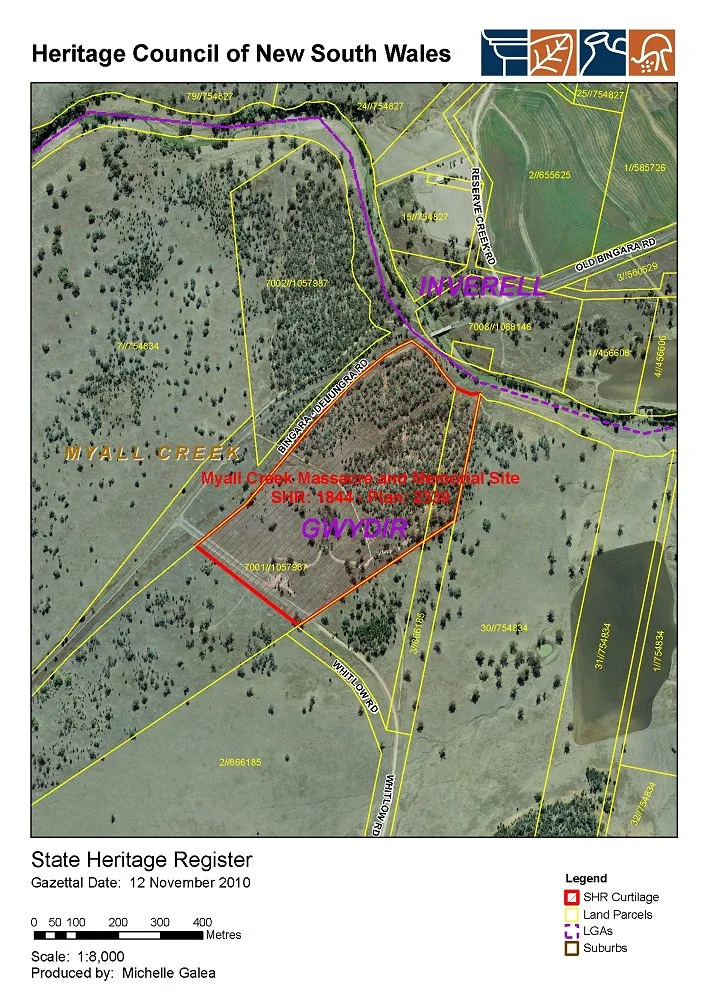
The Memorial Site sits near 29.78°S, 150.72°E, at the junction of Whitlow and Bingara-Delungra Roads, about 25 km north-east of Bingara in the Gwydir Shire. From the air, the granite walkway is small, but the setting is legible: a wooded ridgeline above Myall Creek, with open grazing country falling away to the west where the killing occurred. Best seen at lower altitudes in clear, calm light. Nearest airports: Inverell (YIVL) roughly 55 km north-east, Armidale Regional (YARM) about 150 km south-east, and Tamworth (YSTW) to the south. A place to slow down and reflect, not to overfly casually.
Nearby Stories
- Wing Hing Long & Co. Store 18 km away
- Guyra, New South Wales 50 km away
- Tenterfield, New South Wales 98 km away
- Uralla 103 km away
- Tenterfield School of Arts 143 km away
- Bourke Court House 402 km away
- Bourke Post Office 404 km away
- Hornet Bank Massacre 426 km away