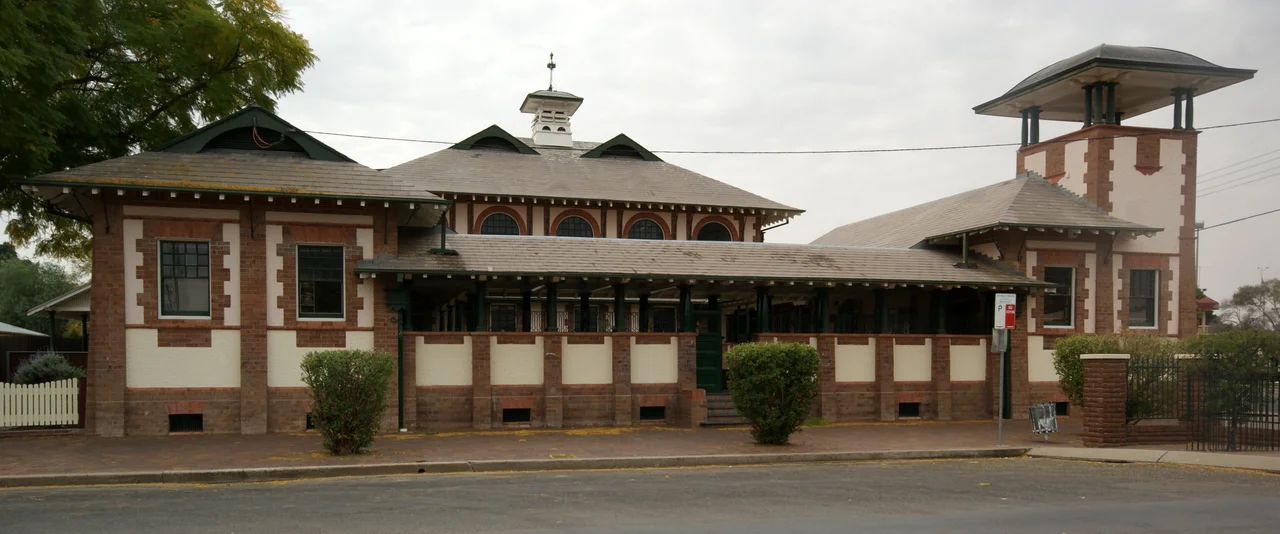

Bourke Court House
There is no ocean within hundreds of kilometres of Bourke, and yet its courthouse can hear cases in maritime law. It is the only inland maritime court in Australia, a quirk left over from the days when the Darling River was a crowded highway and this dusty outback town was a busy port. Stand in Richard Street and look up at the building's turret and slate roofs, and the riddle resolves itself: this grand 1900 courthouse was not built for a backwater. It was built for a boomtown, in the brief golden age when wool went out by paddle steamer and Bourke believed it would matter forever.
The Inland Port
To understand the courthouse, you have to picture the river as it was. In the 1880s the Darling carried a steady traffic of paddle steamers, and Bourke sat near the head of it as a major inland port. Wool came overland from stations hundreds of kilometres away, hauled in by bullock teams, horse teams and strings of camels, then loaded onto barges and shipped downriver toward the railheads and the coast. The traffic was extraordinary for so dry a country: by 1890 there were at least 170 steamers working the roughly 5,600 kilometres of the Murray-Darling system that was navigable. The original bridge across the Darling at Bourke even had an opening span built into it, so the tall vessels could pass through. River trade brought money, ambition, and the legal machinery to govern it - including, eventually, the maritime jurisdiction that makes this landlocked courthouse unique in the country.
A Courthouse for a Boomtown
The building that stands today is the third courthouse Bourke has had, raised between 1897 and 1900 at a cost of 9,596 pounds. Its design is credited to George Oakeshott, working under the New South Wales Government Architect Walter Liberty Vernon, and it was built by J. Douglas of Orange. The style is Federation Free - confident, eclectic, a little theatrical - and it was deliberately adapted to the punishing climate of the far west. The central courtroom dominates the composition, its importance announced by a corner turret, the whole thing assembled from rough-cast render and face brick beneath hipped roofs of slate.
Built for the Heat
Look closer and the building reveals how carefully it was made for where it stands. Bourke summers are brutal, and the courthouse answers them with architecture rather than machinery. Covered walkways run between its scattered pavilions, throwing shade across the routes people walked. An enclosed garden court sits at its heart, drawing air and offering relief from the glare. The composition breaks into several pavilions of different scales precisely so that air can move around and between them. It is a public building that takes the climate as seriously as the law - a design philosophy of verandahs and sheltered courtyards that defined the best Federation buildings of the dry interior.
After the River
The river trade faded as railways pushed further inland and the steamers fell silent, but the courthouse endured. It was restored in 1968, and its courtroom bench seating renewed in 2010 - a project that drew some local outrage at the time, a reminder that people in Bourke still feel a fierce ownership of the building. It remains in service for the justice it was built to dispense. Today it is recognised as one of the finest Federation Free style public buildings in Australia and a defining landmark of Bourke's streetscape, listed on the New South Wales State Heritage Register in 1999. It stands as a monument to a vanished moment - the years when an outback town on a brown river believed it would be a great inland city, and built accordingly.
From the Air
Bourke Court House stands at 30.09 degrees S, 145.94 degrees E on Richard Street in the town of Bourke, far northwestern New South Wales, on the banks of the Darling River. From the air, Bourke reads as a compact grid town beside the dark, winding line of the Darling, which is the dominant navigation feature across an otherwise flat, pale landscape; the courthouse sits within the town grid, its slate roofs and corner turret distinguishing it among lower buildings. Bourke Airport (ICAO YBKE) lies just outside town with a sealed runway, making this one of the more accessible outback fields; Cobar (YCBA) is the next option to the south, with Broken Hill (YBHI) the larger regional hub further southwest. Visibility is typically excellent year-round, with summer heat haze and occasional dust the main constraints. Recommended viewing altitude is 2,000-4,000 feet AGL to take in the town, the river bends, and the surrounding plains that wool once crossed to reach this inland port.
Nearby Stories
- Toorale Station 20 km away
- Gundabooka National Park 36 km away
- Louth, New South Wales 42 km away
- Murrawarri Republic 103 km away
- Royal Mail Hotel, Hungerford 148 km away
- Roxy Theatre and Peters Greek Cafe Complex 383 km away
- Bingara 384 km away
- Captain Thunderbolt's Death Site 465 km away