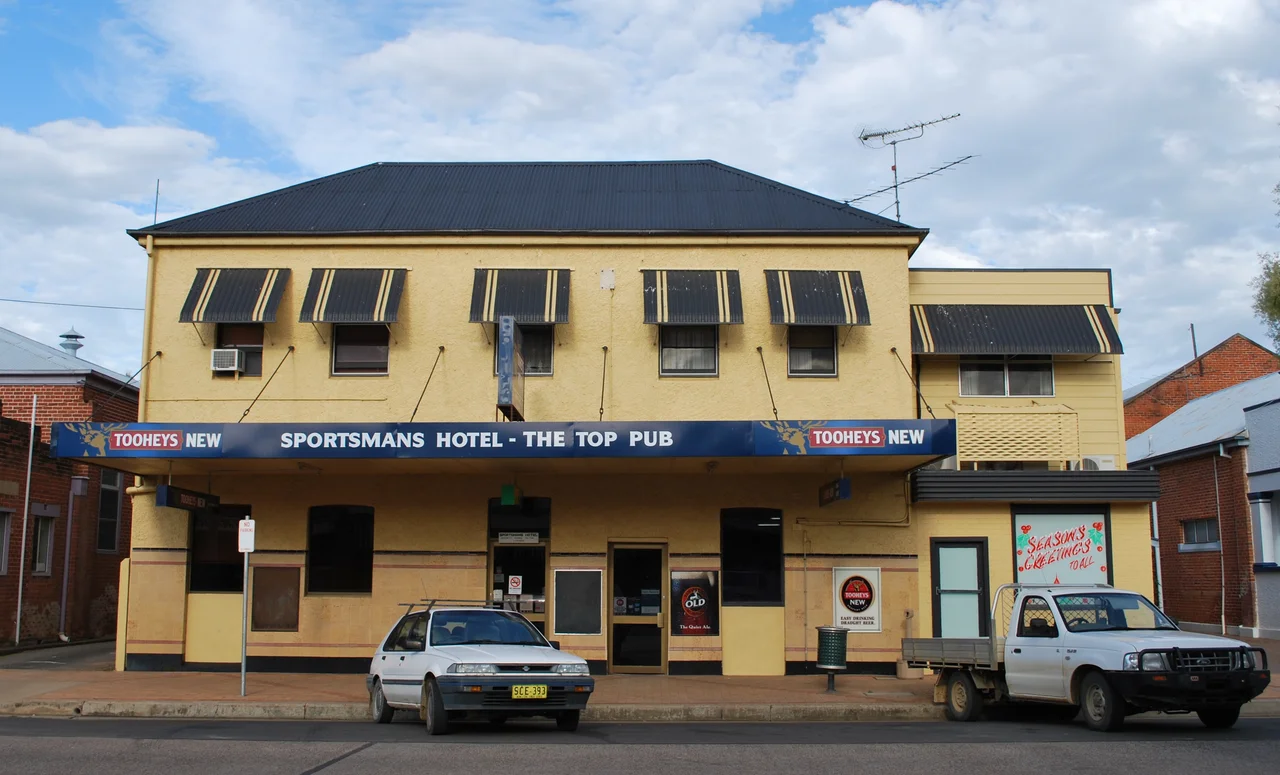

Bingara
Once a year, on a chosen morning in June or July, the schoolchildren of Bingara are turned loose to raid the town. They are after the oranges — the fruit of the trees that line Finch Street and ring the Gwydir oval, left untouched all season until a memorial ceremony at the Returned Services Club releases the young "Orange Police" to harvest them. Those trees are not decoration. They were planted in the 1950s as a living memorial to local soldiers killed in two world wars, and they have made this Gwydir River village, population around 1,400, quietly famous as the "Orange Town." It is a fitting emblem for Bingara: a place where the ordinary and the deeply remembered grow on the same branch.
The River and the Rush
The European story here begins at the water. In 1827 the explorer Allan Cunningham crossed the Gwydir River near the site of the town, and the first farms followed in the 1830s. Then came the metals. The discovery of gold in 1852 brought prospectors flooding into the district, and fossicking continues to this day — gold, sapphires and tourmalines still turn up in the river and the local creeks. In the 1880s came copper, and from 1872 diamonds began turning up in the creeks — finds that would lift Bingara to brief fame as Australia's diamond-mining capital through the 1890s. The old diggings at Upper Bingara survive as a window onto that frenzied era, and visitors can still try their own luck panning for colour, a direct line back to the hopefuls of nearly two centuries ago.
A Greek Picture Palace on the Plains
Bingara's most surprising treasure is a cinema. In 1936, three Greek immigrants from the island of Kythera — Peter Feros, Emanuel Aroney and George Psaltis — built the Roxy Theatre, a confident piece of Art Deco that would not look out of place in a city. It ran films until 1958, then sat closed and untouched for some forty years, its 1936 fittings frozen in place. In 2004 the Roxy was restored to its original splendour and reopened, ornate plasterwork, paintwork and coloured lights intact, alongside a Greek café and museum that honour the Kytherian families who brought a touch of the Mediterranean to the New England plains. It is one of the finest surviving picture palaces of its kind in New South Wales.
The Gwydir Crossroads
Bingara is the main centre of the Gwydir Shire, sitting on the Fossickers Way — the touring route whose very name nods to the district's mining past. The town anchors a web of country roads: north to Warialda, south through Barraba toward Tamworth, and east toward Inverell. There is no train and no scheduled flight; a NSW TrainLink coach passing the old courthouse connects travellers to the long-distance trains at Tamworth, and the nearest airports lie at Inverell, Narrabri, Armidale and Tamworth. This is unhurried country, the kind where private transport is essential and the journey between towns is half the point — birdwatching, bushwalking, horse riding and four-wheel-drive trails fill the days for those who linger.
A Gateway to Hard Truths
Bingara is also a threshold to one of the most significant sites in Australia's history of reconciliation. The road east toward Delungra and Inverell passes the Myall Creek Massacre and Memorial Site, where at least twenty-eight Wirrayaraay people of the Kamilaroi were murdered in 1838. It is the place where, almost uniquely on the colonial frontier, the killers were tried and hanged, and where descendants of victims and perpetrators now gather each year. That the memorial sits just down the road from the orange trees and the picture palace says something honest about this corner of New South Wales: its pleasures and its griefs share the same quiet roads, and the town does not hide either one.
From the Air
Bingara lies at 29.87°S, 150.57°E, on the Gwydir River in the New England region of northern New South Wales. From the air, look for the river threading through town, the green run of orange trees along Finch Street, and the surrounding mix of grazing land and timbered ridges of the Fossickers Way. The town has no airstrip with scheduled service; the nearest airports are Inverell (YIVL) about 70 km north-east, Narrabri (YNBR) to the south-west, Armidale Regional (YARM) to the south-east, and Tamworth (YSTW) to the south. Best appreciated at lower altitudes in clear weather; note hilly, twisting terrain on the approaches from the west and south.
Nearby Stories
- Wing Hing Long & Co. Store 18 km away
- Guyra, New South Wales 50 km away
- Tenterfield, New South Wales 98 km away
- Uralla 103 km away
- Tenterfield School of Arts 143 km away
- Bourke Court House 402 km away
- Bourke Post Office 404 km away
- Hornet Bank Massacre 426 km away