
Captain Thunderbolt's Death Site
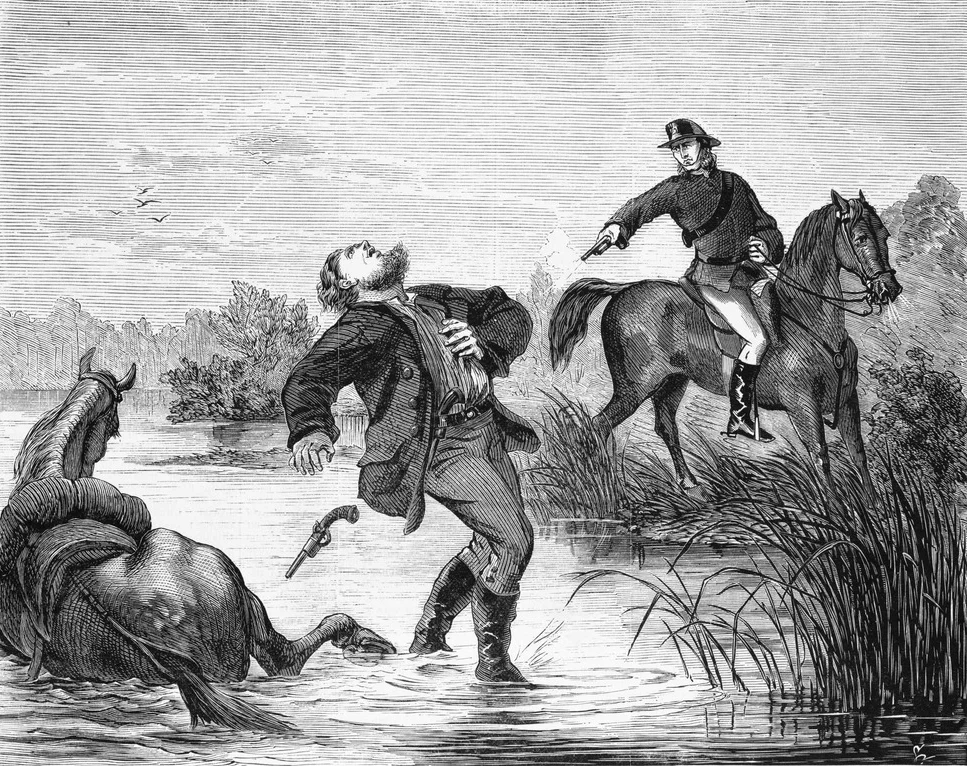
There is nothing dramatic to see now, just pasture, a creek, and the still water of a small dam. Yet this unremarkable paddock in the Kentucky district near Uralla is where one of the most famous chases in colonial Australia came to its end. On the afternoon of 25 May 1870, the bushranger Frederick Ward, known across northern New South Wales as Captain Thunderbolt, was run down here after six and a half years on the loose, longer than any bushranger before or since. The man who caught him was a single ordinary constable, and the contest between them lasted only a few breathless minutes by the edge of Kentucky Creek.
The Alarm at the Inn
It began with a robbery. An Italian hawker named Giovanni Cappisotti raised the alarm in Uralla after Thunderbolt held up travellers near Blanch's Royal Oak Inn that afternoon. Senior Constable John Mulhall and Constable Alexander Walker rode south from town to investigate. Mulhall had the faster horse and reached the inn first, exchanging shots before his mount bolted and carried him out of the fight. Walker, about half a mile behind, heard the gunfire and pressed on alone. As he crested the hill he saw two men on grey horses ahead of him, and the younger appeared to be herding the older away from the road, west along the line of Blanch's fence.
Run Down at the Creek
What followed was a single-handed pursuit of several miles across rough country and a string of creeks, with Thunderbolt firing back as he fled. The chase ended at the water of Kentucky Creek. Walker shot the bushranger's horse, then closed with the man himself. Accounts differ on the exact words, but the substance is consistent. By one version Thunderbolt levelled his revolver and said 'Keep off'; Walker asked whether he would surrender, and the bushranger answered, 'No, I will die first.' In the struggle that followed Walker fired, and the outlaw rose once more before a blow to the head from the constable's pistol finally felled him. The man who had eluded the colony for six and a half years was identified the next day partly by an old gunshot scar behind his left knee. The longest bushranging career in Australian history was over, ended not by a posse or a siege but by one tired policeman in a paddock.
A Rare Kind of Ending
Thunderbolt's death is remembered partly because of how unusual it was. Most New South Wales bushrangers met their end in sieges inside buildings, on the gallows at Darlinghurst Gaol, or quietly and without record. To be run down and killed in the open bush, in a documented chase that can still be traced across a real landscape, was rare. Walker's career, by contrast, only rose from here. He was promoted after the shooting and eventually reached the rank of Superintendent, was later sought to help hunt Ned Kelly, and died at his home in Cremorne in 1929 at the age of 81. In 1970 a memorial to him was unveiled in Uralla to mark the centenary.
The Vanished Spot
The exact place where Thunderbolt fell can no longer be stood upon. In the 1960s a dam was built on Kentucky Creek downstream of the site, and the death spot itself now lies submerged. Even the precise location is uncertain: the surviving evidence, based on Walker's own police report, cannot settle whether the bushranger died in the north-south or the east-west reach of the creek. The adjoining landholder once allowed visitors to walk in, but stopped after too much rubbish was left behind. So the most famous bushranger death in the New England now rests, fittingly, just out of reach, marked by water rather than stone.
From the Air
The death site lies near 30.69 degrees south, 151.45 degrees east, in the Kentucky district a few kilometres south of Uralla, on the New England Tablelands at roughly 1,000 metres elevation. From the air the key feature is the Kentucky Creek dam, a small body of water surrounded by open pasture; the actual death spot is submerged near where the creek bends from a north-south to an east-west course. The nearest airport is Armidale (ICAO YARM), about 30 kilometres north, with Tamworth Regional (YSTW) roughly 70 kilometres south-west. The high tableland is prone to morning frost and fog in the cooler months, so the reflective surface of the dam shows best under clear midday light.
Nearby Stories
- Wollomombi Falls 22 km away
- Walcha, New South Wales 23 km away
- Guyra, New South Wales 39 km away
- Ebor Falls 45 km away
- Bingara 65 km away
- Roxy Theatre and Peters Greek Cafe Complex 93 km away
- Jervis Bay 458 km away
- SS Elingamite: Gold, Fog, and a Captain Wrongly Blamed 1920 km away