
Walcha, New South Wales
A whale breaches from a traffic island. Down the main street, a wedge-tailed eagle balances on a steel post, and a granite seat curls like a wave outside the bakery. Walcha is a wool and cattle town of barely 1,400 people on the southern edge of the New England Tablelands, yet it carries more public art per resident than anywhere else in Australia. The idea took root in 1996, when local farmer and sculptor Stephen King proposed a fountain for the park in the middle of town. One sculpture became dozens. Today the streetscape doubles as an Open Air Gallery, and a rural service centre most travellers would have driven straight through is now a reason to stop.
Where the Wild Rivers Begin
Walcha sits where the tablelands break apart. The Apsley River slips quietly through town, then plunges over Apsley Falls about 20 kilometres east, dropping in two stages into a gorge that the rivers have been cutting for a very long time. This is the southern doorway to Oxley Wild Rivers National Park, a maze of plunging gorges and remnant rainforest that forms part of the World Heritage-listed Gondwana Rainforests of Australia. The country here has long shaped how people live in it. In 1818 the explorer John Oxley became the first European to reach the falls that would later bear the name Apsley, and the river, the gorge and the cold high plains have defined the district ever since.
The First People
Long before any of that, this was Dunghutti country, also recorded as Dhanggati, who are the Traditional Owners of the Walcha region and have cared for these tablelands for thousands of years. The high plains held places for ceremony and trade, and traces of bora grounds still survive near the town. The pattern of life followed the seasons: in the colder months, when frost and even snow settle on the tablelands, people moved east into the warmer gorge country where fish and game were plentiful. That deep connection has not vanished. In the heart of town a Rainbow Serpent mosaic, made by the renowned Aboriginal artist Gordon Hookey with local community members, overlooks the mill-hole said to be the home of the serpent itself.
Wool, Gold and a Town Takes Shape
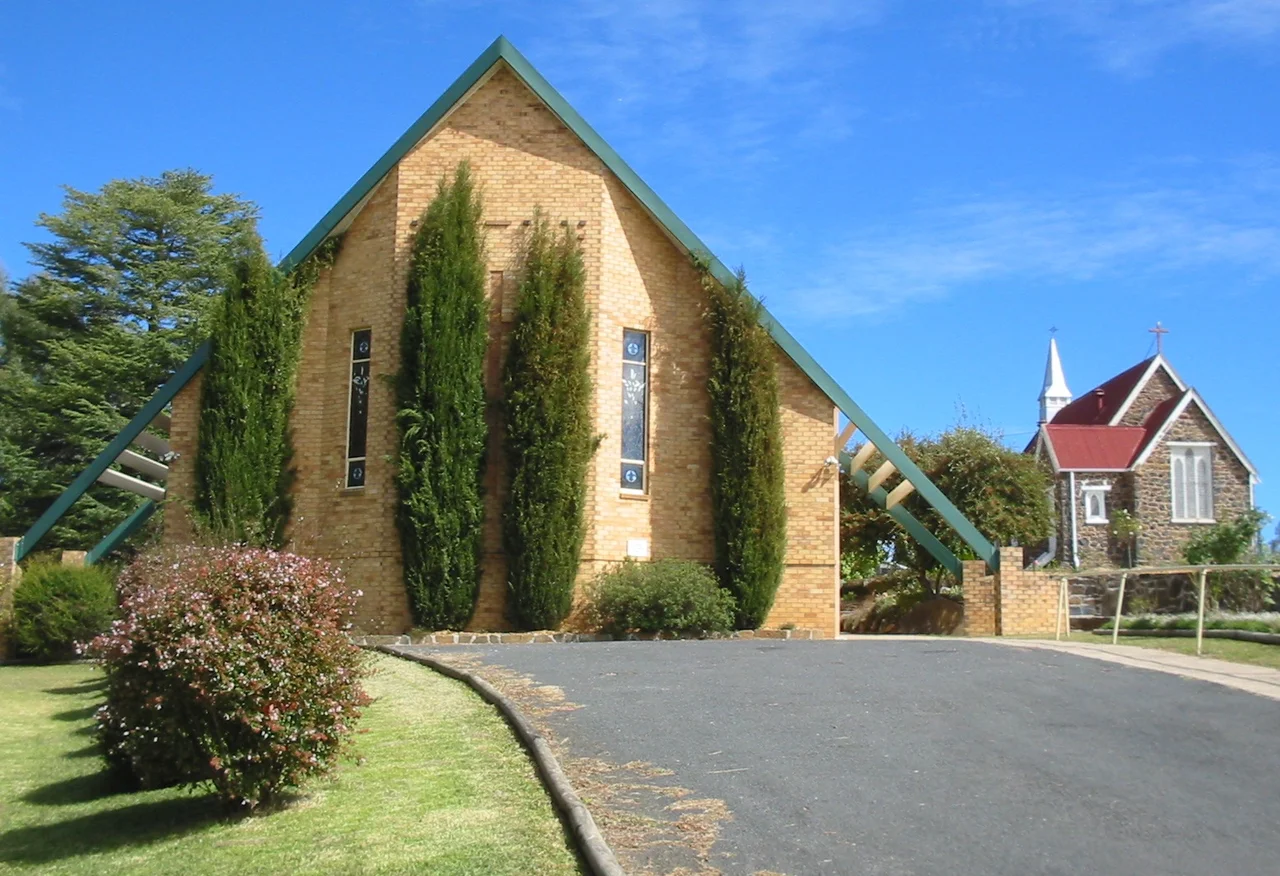
European settlement arrived in 1832, when Hamilton Collins Sempill took up the 'Wolka' run and built slab huts near where Langford homestead stands today. Other runs followed across the 1830s, and a 'wool road' was pushed through to Port Macquarie so the clip could reach the coast. The town was gazetted as a village in 1852 and proclaimed a town in 1878. Gold turned up in the surrounding hills in the 1870s, along with antimony, silver and high-quality slate, and red cedar getters worked the rainforests. The Anglican church, built in 1862, was raised from stone salvaged from a demolished 1840s homestead, so the town quite literally built its faith from its first houses.
Sculpture in the Streets
What makes Walcha unusual is not its history but what it has done with the present. The Open Air Gallery now holds more than fifty works, scattered along verandah posts and footpaths and parks, much of it carved from local timber and shaped by the same gorge-country materials the district has always traded in. The collection makes a town of fewer than 1,400 people one of the most concentrated displays of public art in the country. Walcha also produced an unlikely champion: Casey Stoner, two-time MotoGP world champion in 2007 and 2011, grew up here before the world tracks called. A wool town learned to think of itself as a gallery, and the two identities now stand comfortably side by side along the same quiet streets.
From the Air
Walcha lies at 30.98 degrees south, 151.58 degrees east, on the New England Tablelands at roughly 1,070 metres elevation, at the junction of the Oxley Highway and Thunderbolts Way. From the air the most striking landmark is the Apsley River gorge system about 20 kilometres east, where Apsley Falls drops into a deep cleft in the tableland. The nearest controlled airport is Armidale (ICAO YARM), roughly 60 kilometres north; Tamworth (YSTW), with its larger runway, lies about 90 kilometres west. The tablelands sit high enough that winter frost, fog and occasional snow reduce morning visibility, so clear mid-day light is best for spotting the green ribbon of the Apsley as it cuts toward the eastern gorges.
Nearby Stories
- Captain Thunderbolt's Rock 23 km away
- New England National Park 39 km away
- Ebor Falls 70 km away
- Copeton Dam 98 km away
- Inverell Post Office 139 km away
- Parramatta Female Factory and Institutions Precinct 280 km away
- Manly, New South Wales 282 km away
- SS Elingamite: Gold, Fog, and a Captain Wrongly Blamed 1877 km away