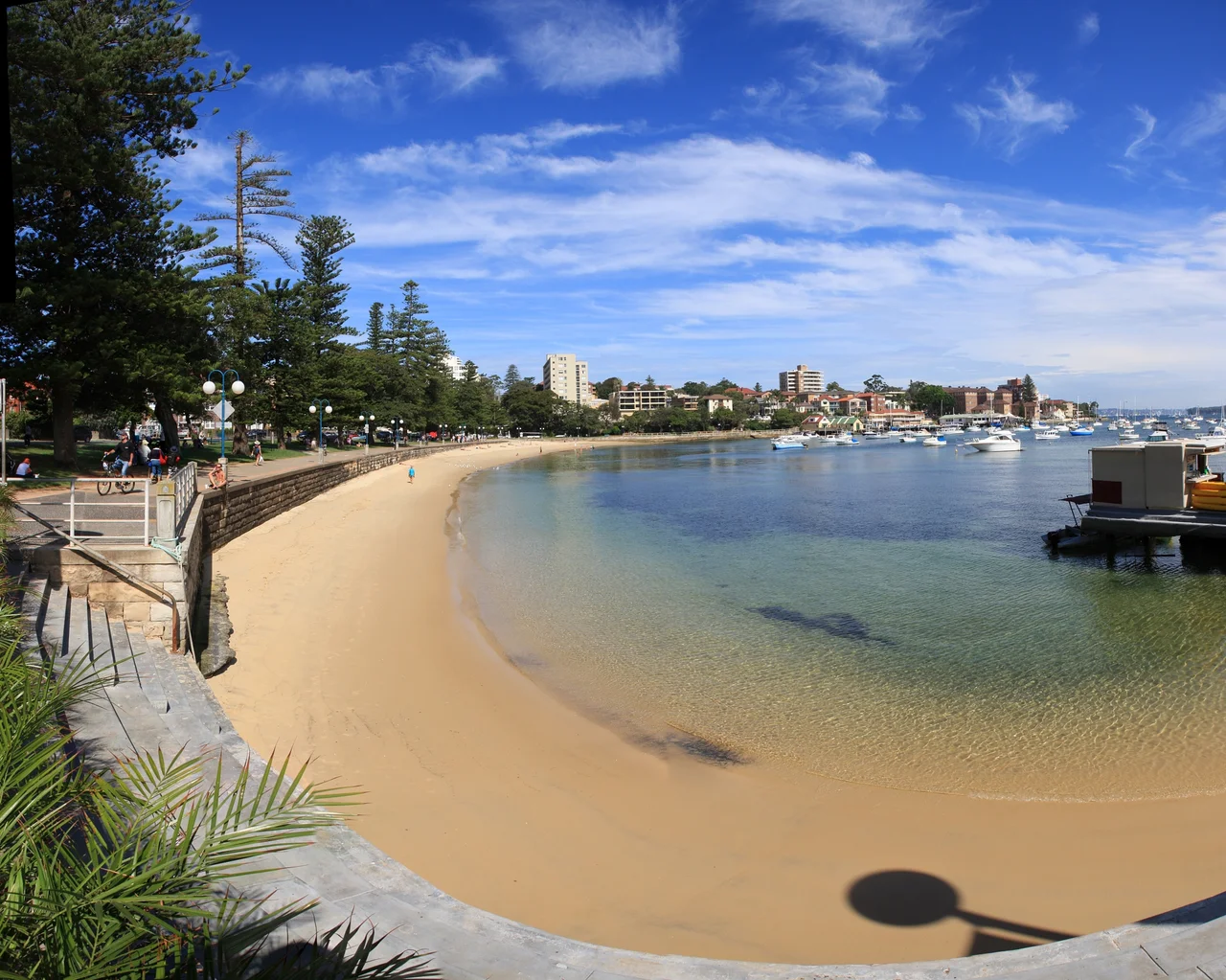

Manly, New South Wales
It got its name from a compliment. In January 1788, Governor Arthur Phillip rowed into a cove on the northern side of the harbour and met members of the Kay-ye-my clan, Dharug-speaking Gayemaygal people who had lived along these shores for thousands of years. Something in their bearing struck him. Their "confidence and manly behaviour," he wrote, made him call the place Manly Cove. The name stuck to the whole peninsula that grew up around it: a strip of land with the open Pacific on one side and the sheltered harbour on the other, seventeen kilometres from the city centre and, by the reckoning of a long-ago ferry advertisement, a thousand miles from care.
A Spear and a Restraint
The friendly naming was not the whole story of contact here. The harbour mouth was the scene of some of the earliest and most fraught meetings between the Gayemaygal and the British. In 1790, on a beach near Manly, Phillip himself was speared through the shoulder by a man named Wil-le-me-ring during a confused encounter while Aboriginal men were feasting on a beached whale. The spear ran so far through that Phillip could barely reach the boat, the shaft dragging on the ground. What is remarkable is what he did next: he ordered his men not to retaliate, apparently understanding the spearing as a ritual response to grievances over kidnappings he had authorised. The two men he had earlier seized, Bennelong and Colebee, were present that day. The wound healed. The relationship between two peoples did not mend so easily.
A Thousand Miles from Care
Manly became a resort almost by design. In the 1850s an Englishman named Henry Gilbert Smith bought up land and set about turning the peninsula into a seaside escape, building a wharf in 1855 and running steamers to carry day-trippers across the harbour. The ferries became the lifeblood of the place. The Port Jackson and Manly Steamship Company that eventually ran them coined the slogan that defined Manly for generations: "Seven miles from Sydney and a thousand miles from care." The pitch worked. Through the nineteenth and early twentieth centuries Manly was one of Australia's most popular holiday towns, its Norfolk Island pines lining the beachfront like a row of green exclamation marks. The ferry crossing, twenty minutes past the Opera House and under the Harbour Bridge, is still one of the loveliest commutes in the world.
The Man Who Swam at Noon
Manly helped overturn one of colonial Australia's odder laws. In the early 1900s, swimming at the beach in daylight was forbidden as indecent. In October 1902, a local newspaperman named William Gocher decided to test it. He announced in print that he would bathe at midday, then walked into the surf in a neck-to-knee costume and dared the authorities to act. They ignored him at first. He kept going, kept publicising it, and was eventually escorted from the water by police, though no charge was laid. By November 1903 Manly Council had relented and allowed all-day bathing, provided swimmers wore the regulation neck-to-knee suit. The freedom came at a cost: during that first official bathing season in 1903, seventeen people drowned at Manly Beach. The response was to form a surf lifesaving club the following year, and the Manly Life Saving Club ranks among the first such clubs in the world.
First Films and Famous Faces
For a small suburb, Manly has left an outsized mark on the screen. In 1896, the very first film made in Australia was shot at the Manly wharf: Marius Sestier's short of passengers stepping off the ferry Brighton, which premiered later that year at Australia's first cinema. No copy is known to survive. More than a century later the peninsula stood in for 1920s Long Island when Baz Luhrmann filmed The Great Gatsby here in 2013, using the grand St Patrick's Seminary as Jay Gatsby's mansion, with the palm trees digitally erased to look more like the American east coast. Manly has produced a roll call of notable residents too, from seven-time world surfing champion Layne Beachley and Booker Prize winner Thomas Keneally to Olympic swimmer Boy Charlton and the electronic musician Flume.
Surf Town
Above all, Manly is about water. The ocean beach runs in a long unbroken stretch from Queenscliff through North Steyne to South Steyne, giving way to the rock pools of Fairy Bower and the calm of Shelly Beach, while a string of quieter harbour beaches hides along the peninsula's western side. In March 2012, the four-kilometre stretch between Freshwater and Shelly Beach was declared the Manly–Freshwater World Surfing Reserve, dedicated in a ceremony led by champion surfer Kelly Slater. The honour fits the history: Freshwater is where Hawaiian legend Duke Kahanamoku famously gave surfing demonstrations in 1914, helping plant board-riding in Australian soil. The bustle of the Corso, the cafés, the jazz festival each October, all of it still orbits the simple pleasure that drew the first day-trippers across the harbour more than a century and a half ago.
From the Air
Manly occupies the peninsula on the northern side of Sydney Harbour's entrance, about 17 km northeast of the Sydney CBD, centred near 33.80°S, 151.28°E. From the air it is unmistakable: a narrow neck of land with the long surf beach and its line of Norfolk Island pines facing the open Pacific to the east, and the sheltered coves of Manly Cove and the harbour to the west. North Head and the Quarantine Station lie just to the south. Best viewed from 1,500–2,500 feet. The nearest major airport is Sydney Kingsford Smith (YSSY / SYD), about 18 km south across the harbour; Bankstown (YSBK) lies to the southwest. This is busy controlled airspace beneath approaches to YSSY, and harbour seaplane traffic operates nearby.
Nearby Stories
- Royal National Park 28 km away
- Jervis Bay 107 km away
- Hive shipwreck 149 km away
- Apsley Falls 283 km away
- Smoky Cape Lighthouse 316 km away
- South West Rocks Pilot Station Complex 346 km away
- Roxy Theatre and Peters Greek Cafe Complex 413 km away
- 2003 Fiordland Earthquake 1774 km away