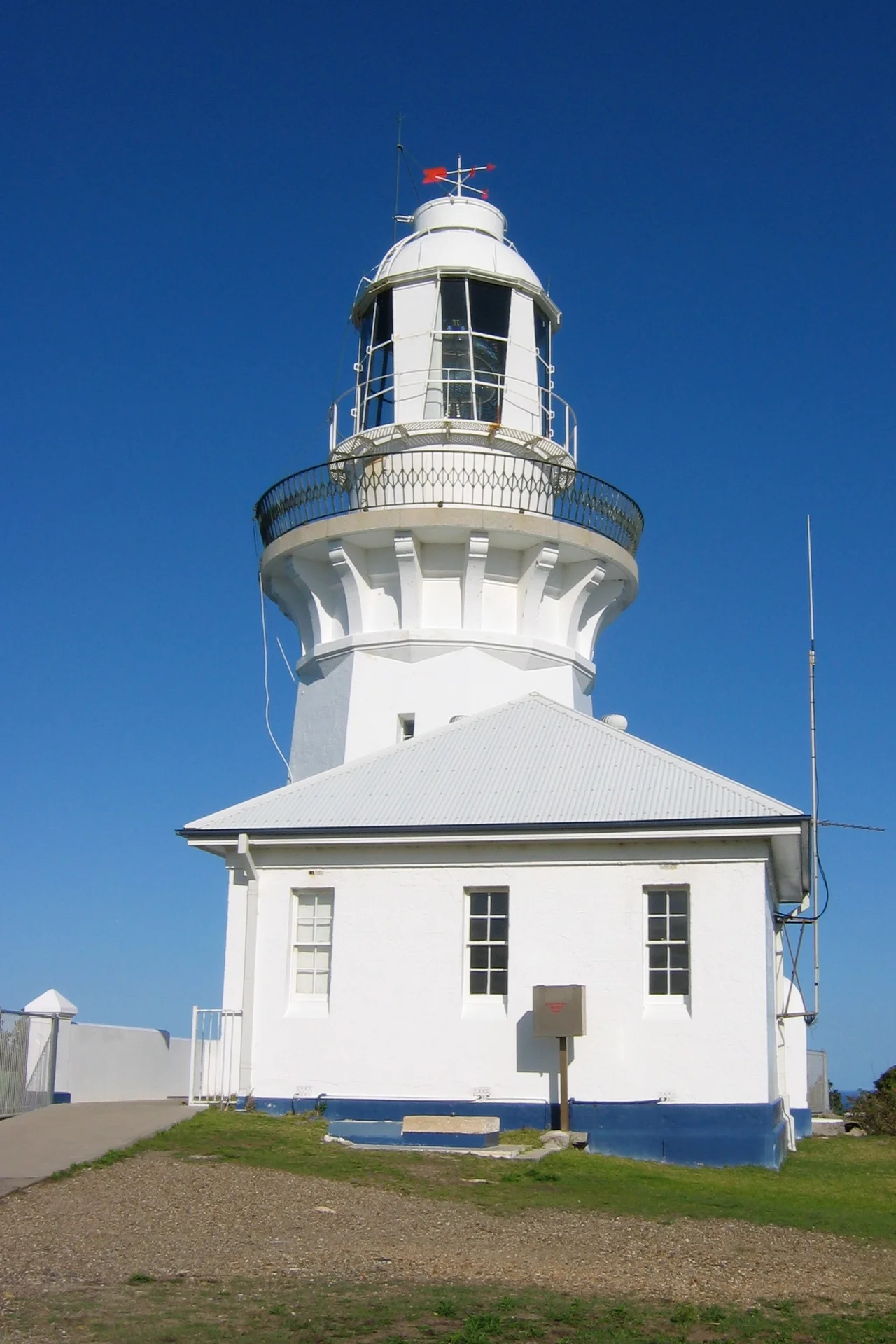

Smoky Cape Lighthouse
On a Sunday in May 1770, sailing north up an unmapped coast, James Cook looked west and saw smoke. Fires were burning along a high green range, sending up "a great quantity of smoke," and into his journal went a name: Smoky Cape. The fires belonged to the Aboriginal people whose country this had been for thousands of years, tending the land as they always had. More than a century later, on the very headland Cook had marked, colonial engineers raised a lighthouse, and its lamp became the highest in all of New South Wales.
The Highest Light
The lighthouse first threw its beam out to sea on 15 April 1891. What makes it remarkable is not the tower itself, a modest 17.4 metres, but the ground it stands on: a granite bluff 111 metres above the waves, lifting the light higher than any other in the state. From here the beam reaches far out over the shipping lanes, guiding vessels toward the entrance of the Macleay River just to the north. The tower's shape is unusual too, octagonal rather than round, an eight-sided column of mass concrete. The choice was pure pragmatism. It was simply easier to build the angular formwork than to bend timber around a circle.
Barnet's Last Masterwork
Smoky Cape was among the final great lighthouse complexes designed by James Barnet, the colonial architect whose towers are reckoned the most architecturally refined in Australia. He brought to this remote outpost the same care he lavished on grand public buildings: a bracketed granite gallery, a gunmetal balustrade stamped with Queen Victoria's mark, an ornamental cast-iron stair winding up inside the walls. Barnet selected the site himself and prepared the plans. The contractor, a man named Oakes, died during construction, and the work was finished by his heirs, within budget, on the windswept headland he never saw completed.
Granite, Concrete, and a Rare Lens
The tower is a study in early engineering experiment. Its walls, 920 millimetres thick at the base and tapering to 620 at the top, were poured as mass concrete using granite quarried on the spot as aggregate. Only three nineteenth-century concrete lighthouses were ever built in New South Wales, and Smoky Cape is the finest. At its summit sits a treasure: the original revolving optic from Chance Brothers of England, its triple-panel array throwing a distinctive triple-flash signal. It is one of only four such lanterns known to combine a trapezoidal glazing pattern with a Trinity-type vent, a genuine relic of Victorian industrial craft, still turning after more than a century.
Layers of a Lonely Outpost
A lightstation was a small isolated village. Below and behind the tower, sheltered from the worst weather, sit the head keeper's cottage and two semi-detached assistant keepers' quarters, all of the same rendered concrete, arranged on terraces cut into the steep slope and held by high retaining walls. The path up from the car park is so punishing that locals call it Heart Attack Hill. In the Second World War the precinct took on a harder purpose, with a searchlight battery and gun emplacement watching the coast; their concrete stumps still sit among the grass. Today the keepers are gone, the light is automated, and the cottages welcome holidaymakers, while the headland draws watchers of a different kind, scanning the swell for the spouts of passing whales.
From the Air
Smoky Cape Lighthouse stands at 30.92 degrees south, 153.09 degrees east, on a 111 m granite headland within Hat Head National Park, just east of South West Rocks and south of the Macleay River mouth. The white octagonal tower on its high bluff is an unmistakable visual landmark, with the dark sweep of Trial Bay and Laggers Point to the north-west. Nearest airports are Kempsey (YKMP) about 35 km south-west and Port Macquarie (YPMQ / PQQ) roughly 55 km south; Coffs Harbour (YCFS / CFS) lies to the north. Coastal sea breezes and afternoon haze are common; the headland is exposed and the light is screened toward the settled areas to the south-west, so its beam reads cleanly only from seaward.
Nearby Stories
- New England National Park 12 km away
- Bellingen, New South Wales 25 km away
- Ebor Falls 55 km away
- Cape Byron Marine Park 212 km away
- Cape Byron Light 246 km away
- Manly, New South Wales 322 km away
- North Head Quarantine Station 345 km away
- SS Elingamite: Gold, Fog, and a Captain Wrongly Blamed 1754 km away