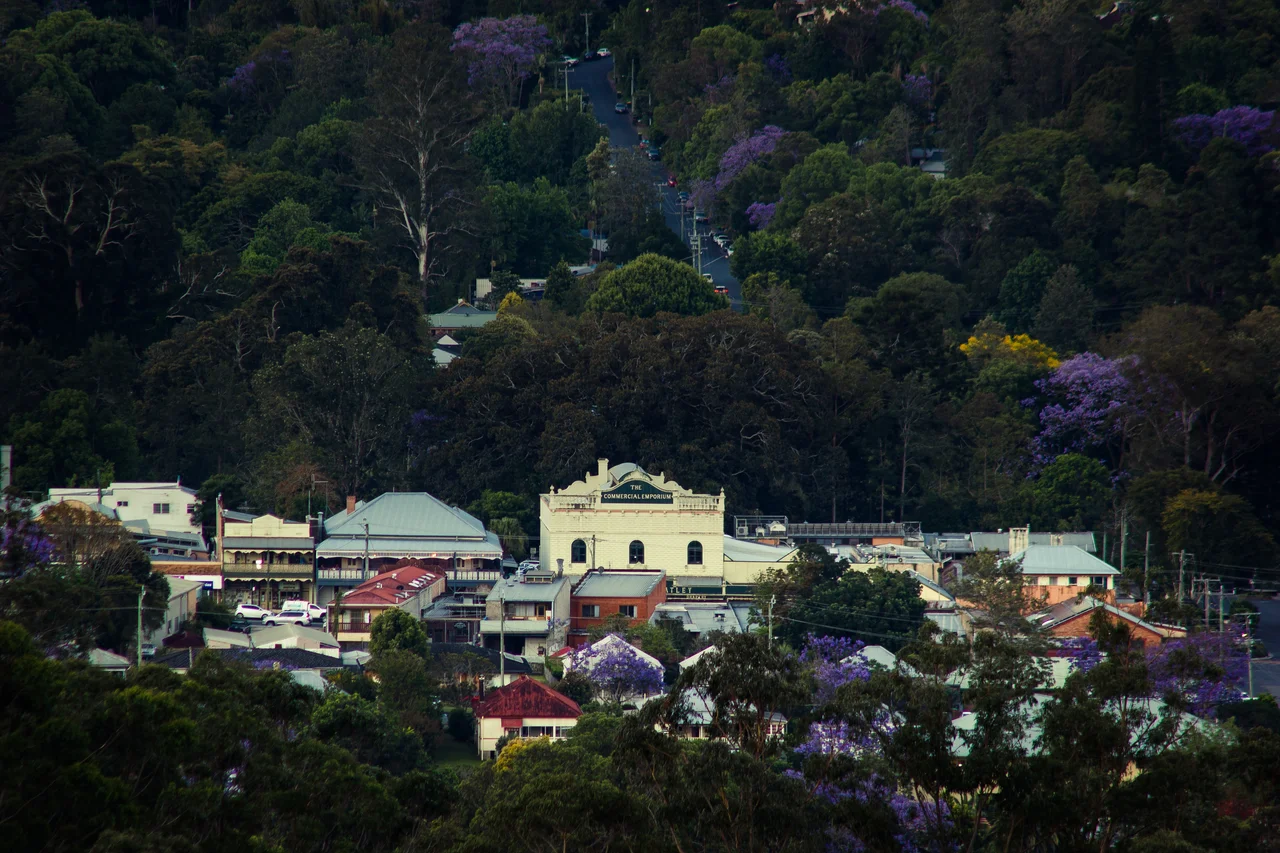

Bellingen, New South Wales
The town and its river do not quite agree on how to spell themselves, and the reason is a single careless stroke of a draughtsman's pen. The Gumbaynggirr people called the waterway Billingen. When the surveyor Clement Hodgkinson wrote the name down in the 1840s, it became Bellingen, and that is the name the town still wears. But somewhere in a colonial drawing office, a clerk copying the map mistook Hodgkinson's final "n" for an "r," and so the river became, and remains, the Bellinger. One valley, two spellings, divided forever by a slip of the hand.
Country and Cedar
Long before any of that, the Bellinger Valley was Gumbaynggirr country, lived in and cared for across countless generations. The first European through was the stockman William Myles in 1840, hunting new pasture north of the Macleay; he returned the next year with Hodgkinson, who took one look at the timber and spread the word. The valley was rich in red cedar, the so-called red gold of the colony, and the rush was fierce. By 1843 twenty pit-sawyers were working the riverbanks, and at its height the valley was giving up more than two million feet of cedar a year. The boom remade the land and pressed hard on the people whose country it had always been.
Heritage on Hyde Street
What the cedar money built still gives Bellingen its grace. The main street is a parade of timber and brick from the late nineteenth and early twentieth centuries, deep verandahs throwing shade over the footpath, a working country town that somehow kept its good bones. The setting helps: the valley is famously green and famously wet, prone to flooding, with nearby Tallowwood Point sometimes recording the highest annual rainfall in the whole state. That abundance of water is the source of the lushness, the towering subtropical growth, the mist in the hills, and, every so often, the brown floodwater rising in the streets that the town has learned to live alongside.
The Alternative Valley
Sometime after the timber ran down, Bellingen became something else entirely: a haven for artists, musicians and seekers, a byword for the alternative life on the Mid North Coast. The Bellingen Community Market has run monthly for more than forty years, drawing over two hundred stalls and live music into the heart of town, and the calendar overflows with festivals, jazz and blues, global carnival, readers and writers, winter music. The most celebrated resident is the pianist David Helfgott, whose turbulent life inspired the film Shine and who lives in a valley near town that locals call the Promised Land. He still plays here, a virtuoso at home among the rainforest hills.
A Town on the Page and Screen
Bellingen has a way of catching the imagination of writers and filmmakers. Peter Carey set his Booker Prize-winning novel Oscar and Lucinda notionally here. The 2003 comedy Danny Deckchair was shot in the town. Most poignantly, it was chosen to stand in for the world of Murray Bail's novel Eucalyptus, and a film set worth 6.4 million dollars was actually built, before a falling-out between the director and star Russell Crowe killed the production and the cameras never rolled. The town simply absorbed the disappointment and carried on, as it has through cedar and flood, with the unhurried confidence of a place that knows exactly what it is.
From the Air
Bellingen lies at 30.45 degrees south, 152.90 degrees east, on the Bellinger River in the green Bellinger Valley, on Waterfall Way roughly halfway between Sydney and Brisbane and about 25 km inland from the coast at Urunga. The town's heritage street grid sits in a broad river flat ringed by densely forested hills, with the escarpment and Dorrigo plateau rising to the west. Nearest airport is Coffs Harbour (YCFS / CFS) about 35 km north-east; Port Macquarie (YPMQ / PQQ) lies further south. The valley is one of the wettest districts in the state, so expect frequent low cloud, valley fog on still mornings, and rapid build-up of rain over the ranges; the river and its flood plain read clearly between weather.
Nearby Stories
- Wollomombi Falls 18 km away
- South West Rocks Pilot Station Complex 30 km away
- Woolgoolga, New South Wales 45 km away
- Guyra, New South Wales 54 km away
- Apsley Falls 54 km away
- Angourie, New South Wales 84 km away
- Yamba, New South Wales 118 km away
- SS Elingamite: Gold, Fog, and a Captain Wrongly Blamed 1797 km away