.jpg)
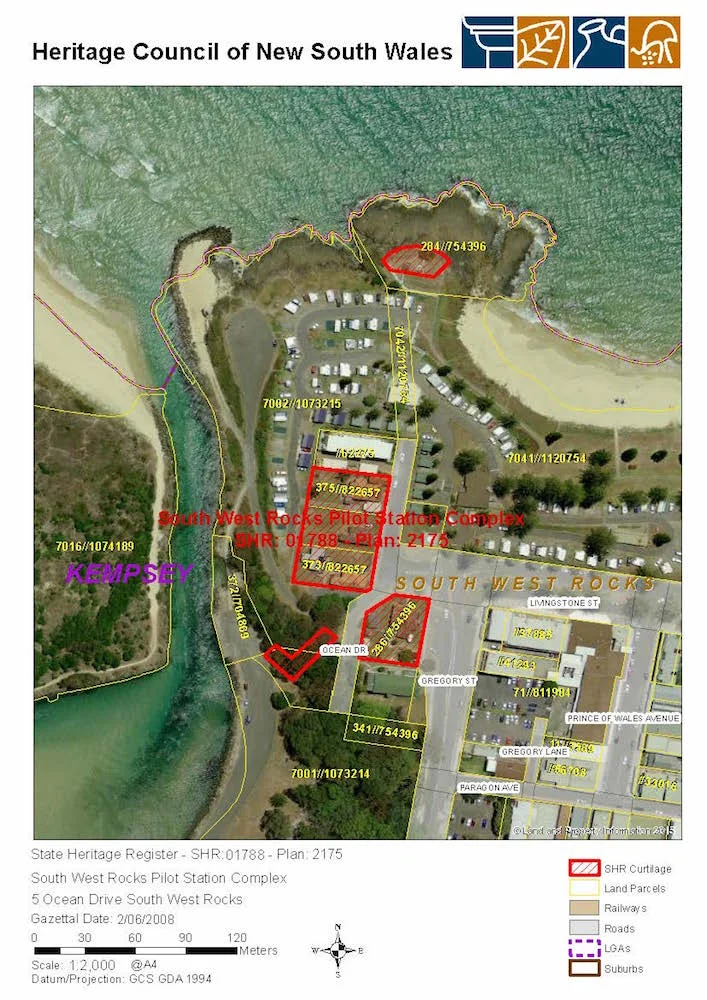
South West Rocks Pilot Station Complex
On the night of 8 March 1893, an easterly gale drove rain and surf into the Macleay Valley, and by morning the river had done something extraordinary: it had burst straight through the sand dunes near South West Rocks and carved itself a brand-new entrance to the sea. The flood that rearranged the coastline also rearranged the lives of the men who guided ships across it. Their old pilot station at Grassy Head was suddenly stranded on a channel that was silting shut, so the whole establishment, pilot, crew, families and all, packed up and moved south to where the water now ran.
A Station on the Move
The government acted in 1895, voting three thousand pounds to stabilise the new river mouth and build a fresh pilot station beside it. The lowest tender came from a builder named C. B. Smith, who agreed to absorb the navigation department's design changes without raising his price. His cottages arrived pre-cut, probably the first prefabricated buildings ever raised in the Macleay Valley, and by 1902 the new station stood on the eastern bank of Backwater Creek. Five cottages went up: one for the pilot, four for his boatmen, numbered in sequence eastward from his door. Captain John Jamieson, who had run the old Grassy Head station, became the first pilot of South West Rocks.
Eyes on the Bar
Everything about the site was chosen for sightlines. From here the pilot could watch both ways at once, north toward the river entrance, east across Trial Bay, ready to launch his crew the moment a vessel appeared. On the headland at Point Briner stood a small signal house and a nineteen-metre flagstaff, the nerve centre of the whole operation. Inside, lockers held the signal flags, and windows fitted with copper flaps served as steadying rests for a telescope. A black ball hoisted on the yardarm warned shipping that the river bar was closed; cones and balls spelled out the depth and the weather. When the men were caught out working the bar, their wives would light the beacon themselves.
The Macleay
Pride of the station was its launch. The wooden-hulled MV Macleay, thirty-four feet long with a nine-foot beam, was laid down and commissioned in 1935, built by the renowned Holmes boatbuilding family of Sydney. She was self-righting, driven by a twenty-horsepower Manchester diesel, and she replaced the earlier Ajax, lost to fire in 1934. The Macleay served the Trial Bay run until she was retired in the 1960s, then drifted out of memory until she turned up years later at Dora Creek on Lake Macquarie. A local businessman helped Kempsey Shire Council buy her back, and today she rests under cover in the station yard, the genuine article among the buildings she once worked from.
What the Sea Left Behind
Of twenty-one pilot stations that once lined the New South Wales coast, almost all were demolished, relocated or whittled down to fragments. South West Rocks is one of just two that survive substantially intact, the other being Kiama, far to the south, one north and one south of Sydney. The pilot's residence and three of the four original cottages still stand, timber-walled under their slightly too-bright red tiles, floors of tallowwood, linings of mahogany. The flagstaff was lowered, repainted and re-raised by volunteers; one cottage became a maritime museum, opened by the state governor himself in 1993. The vistas remain the real heritage here, north to the river, south-east to the bay, the same views the pilots scanned, exactly as essential now to understanding the place as they were to working it.
From the Air
The South West Rocks Pilot Station sits at 30.88 degrees south, 153.04 degrees east, on the Horseshoe Bay Reserve at the southern edge of Trial Bay, between Backwater Creek and the Macleay River entrance. The cluster of red-tiled timber cottages and the flagstaff on Point Briner sit just west of the township; Laggers Point and the ruins of Trial Bay Gaol lie to the east, with Smoky Cape Lighthouse on the high headland to the south-east. Nearest airports are Kempsey (YKMP) about 35 km south-west and Port Macquarie (YPMQ / PQQ) roughly 55 km south. The river mouth and bar are best read at low sun angles; expect afternoon sea breezes and coastal haze, and watch for shifting sandbars at the Macleay entrance.
Nearby Stories
- New England National Park 12 km away
- Bellingen, New South Wales 25 km away
- Ebor Falls 55 km away
- Cape Byron Marine Park 212 km away
- Cape Byron Light 246 km away
- Manly, New South Wales 322 km away
- North Head Quarantine Station 345 km away
- SS Elingamite: Gold, Fog, and a Captain Wrongly Blamed 1754 km away