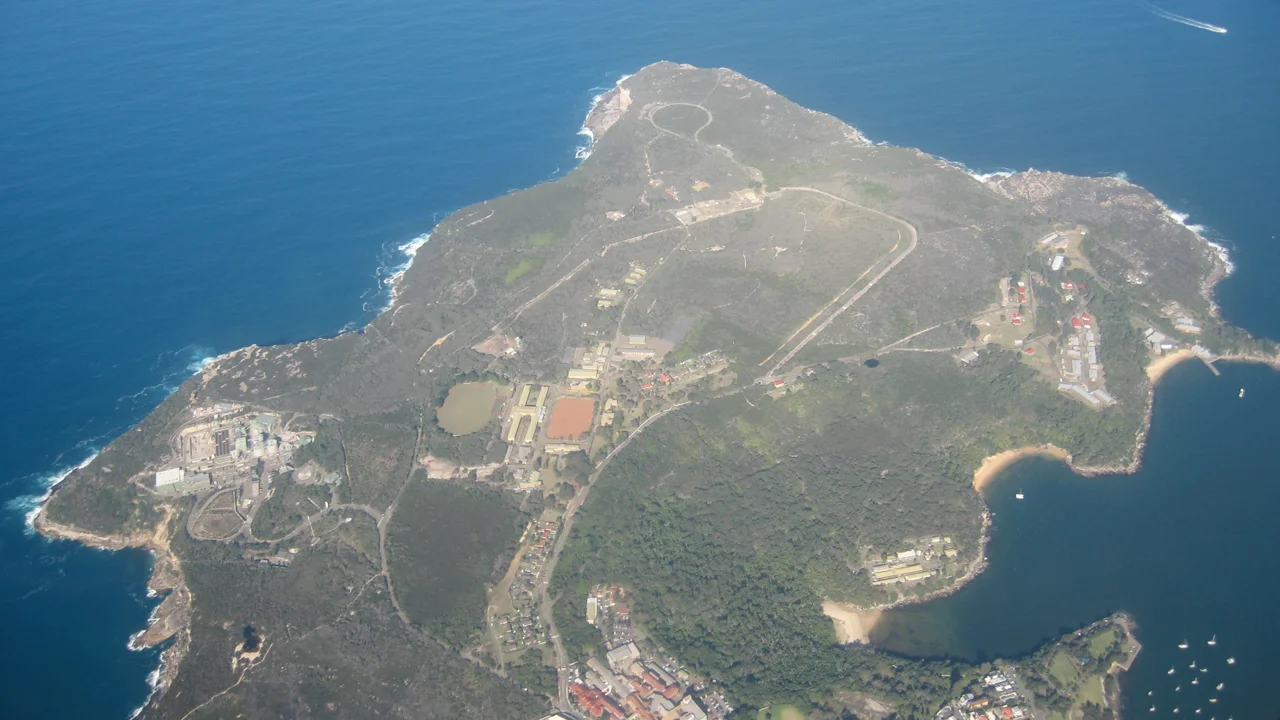

North Head Quarantine Station
Carved into the sandstone above the jetty are names, dates, and ships, hundreds of them, cut by the hands of people who were not allowed to leave. Some are crude scratches; others, made by stonemasons among the detained, are works of real skill. They stretch across more than a century of arrivals, each inscription a small act of defiance against being forgotten. This is North Head Quarantine Station, set on a high bluff at the very mouth of Sydney Harbour. For more than 150 years it was the threshold every suspect ship had to cross, the place where the hope of a new life was put on hold, and sometimes ended.
The Healers' Headland
Long before it was a place of confinement, North Head was a place of healing. The Gayemaygal people knew the headland as Car-rang-gel, and their Koradgee, the medicine men and women, used it for ceremony and ritual. The land is dense with their presence: more than forty recorded sites of rock engravings, campsites, burials, and shell middens speak to occupation of the Sydney Basin stretching back at least 20,000 years. The harbour these people knew was itself once a river valley, drowned by rising seas thousands of years ago; they would have witnessed its making. When European vessels first anchored in the coves below and quarantine began, the food-gathering and cultural life that had unfolded on these beaches for millennia was, in the words of the heritage record, abruptly halted. For many Aboriginal people the Heads became a symbol not of arrival but of loss.
An Island Nation's Gate
The station was born of fear of disease. As cholera swept Europe, Governor Ralph Darling's Quarantine Act of 1832 set aside the whole of North Head to hold arriving ships in isolation, and the complex operated from 14 August 1832 until 29 February 1984. The logic was geographic: an island colony could, in theory, keep contagion at the water's edge. Anyone aboard a ship carrying suspected smallpox, plague, typhus, or influenza could be detained here until deemed safe. Over its long life the station processed more than 13,000 people. The isolation that made it work also made it a small world unto itself, with its own wharf, hospital, shower blocks, and fearsome fumigation chambers where passengers and their belongings were disinfected. A light tram once ran between the buildings. Around it all stretched bushland and cliff, sealing the quarantined off from the city just across the water.
The Class System in Fences
Quarantine here was never equal. The station's layout was a map of colonial hierarchy, drawn in picket fences and separate paths designed to keep classes and races from mixing even in confinement. First-class passengers had their own quarters and amenities; steerage migrants had far less; and Asian arrivals were segregated again, housed in accommodation set aside specifically for them. The healthy were kept from the sick, the sick from the dying, the dying from the dead. You can still read this rigid order in the surviving fabric of the site, the subtle barriers and divisions that governed who could walk where. It is an uncomfortable kind of heritage, but an honest one, preserving in timber and stone the social attitudes of the colony and the people who were sorted by them.
The Ones Who Stayed
Not everyone who entered quarantine walked out. An estimated 572 people are buried at the station's cemeteries, and because no records survive from its first nine years, the true number of dead may exceed 600. They were migrants who had crossed the world and died within sight of their destination, never setting foot in the country they had sailed so far to reach. Their stories surface in the gravestones and in the inscriptions scattered across the rocks. The station saw waves of crisis: the smallpox epidemic of 1881 and 1882, which drove the colony to anchor a floating hospital ship in the harbour, and the deadly influenza pandemic of 1919, when soldiers returning from the First World War were held here, having survived the trenches only to face the flu in snake-infested bushland. Many of those who did survive quarantine made Australia their home, and their descendants still come to find a forebear's name carved in the stone.
Sanctuary Again
When the station closed in 1984, the headland began a long turn back toward sanctuary. For decades a Manly mayor named Percy Nolan had argued the land should become public open space, and his far-sighted idea finally came true; the whole 277-hectare site is now part of Sydney Harbour National Park, listed on the Australian National Heritage List. The isolation that once imprisoned people has preserved an extraordinary natural refuge. North Head shelters rare plants found almost nowhere else, alongside endangered long-nosed bandicoots and a colony of little penguins, the only population of the species that still breeds on the New South Wales mainland. The penguins have a precarious life in one of the world's busiest harbours, vulnerable to introduced predators. The same isolation that made this a place of grief now makes it one of the last wild fragments of Sydney's coast, and a place where the names in the rock can still be read.
From the Air
North Head Quarantine Station sits on the western side of North Head, the sandstone bluff forming the northern jaw of Sydney Harbour's entrance, at 33.81°S, 151.29°E. The headland rises about 80 metres above the sea, its cliffs capped with low heath rather than tall forest, which makes it stand out from the air. The station's cluster of pale buildings lies on the natural amphitheatre above Quarantine Beach (Spring Cove), facing back into the harbour; the open Pacific breaks against the cliffs to the east. Manly and its surf beach are just to the north; South Head lies across the harbour mouth. Best viewed from 1,500–2,500 feet. The nearest major airport is Sydney Kingsford Smith (YSSY / SYD), about 17 km south; Bankstown (YSBK) lies inland to the southwest. The Heads sit beneath controlled airspace serving YSSY.
Nearby Stories
- Royal National Park 28 km away
- Jervis Bay 107 km away
- Hive shipwreck 149 km away
- Apsley Falls 283 km away
- Smoky Cape Lighthouse 316 km away
- South West Rocks Pilot Station Complex 346 km away
- Roxy Theatre and Peters Greek Cafe Complex 413 km away
- 2003 Fiordland Earthquake 1774 km away