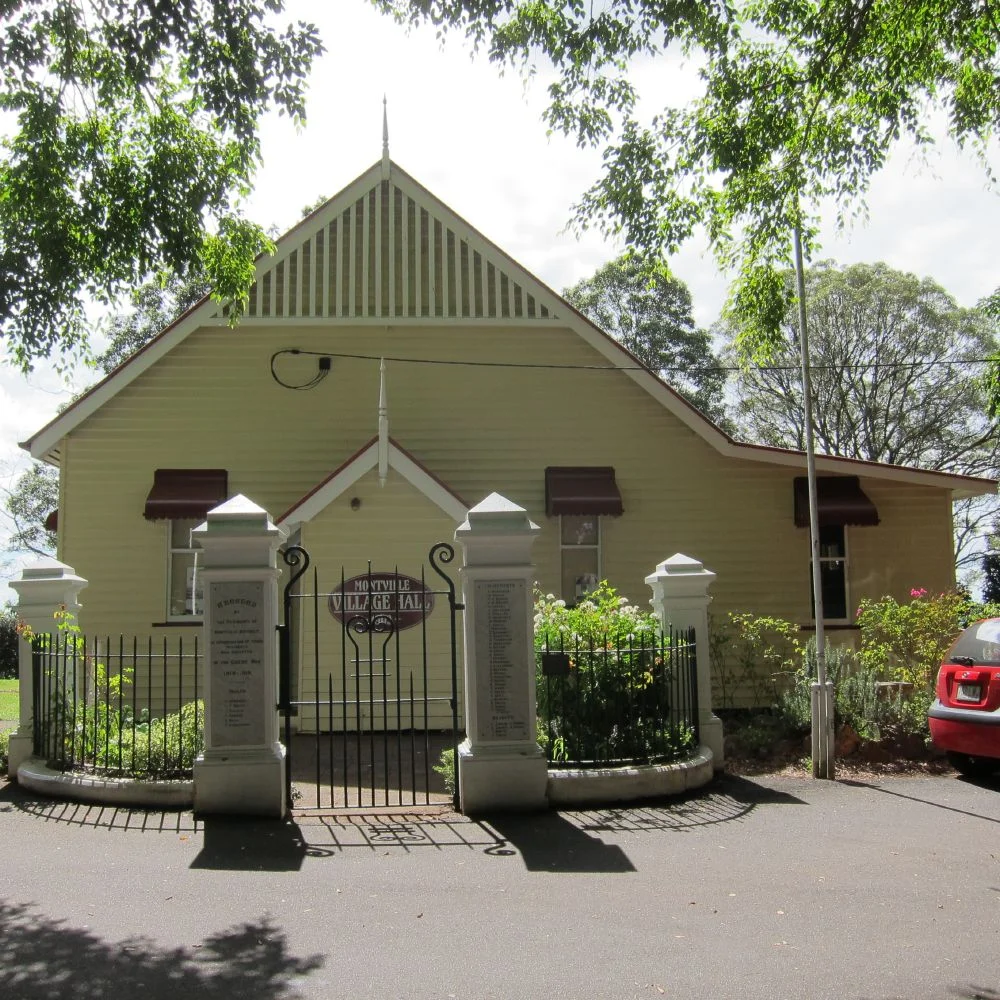

Montville Memorial Precinct
Most war memorials honour the men who went. The gates at Montville honour them too, but they also do something almost no other monument in Australia does: they carve in stone the names of six men who volunteered and were rejected. In a village this small, set high in the green Blackall Range above the Sunshine Coast, everyone knew who had stepped forward and who had not. To leave the rejected off the roll would have been to mark them with an absence. So Montville put them on, under the heading that everyone could read. It is a quiet act of fairness, set in marble, that has outlasted the war that prompted it.
A Village in the Range
Montville sits about 450 metres up in the Blackall Range, west of the Sunshine Coast, a village of timber shopfronts and Devonshire-tea cafes that draws visitors from across Australia. At its commercial heart is a leafy enclave the locals call the Village Green, a small triangular park shaded by enormous spreading figs. Around it cluster the elements of the memorial precinct: the gates, a row of memorial trees, a short street called Memorial Close, the weatherboard Montville Hall of 1903, and a former Soldiers' Memorial Hall. The whole arrangement is unusually compact. It is rare in Queensland to find so many kinds of war memorial, gates, trees, hall and honour rolls, gathered into one small, peaceful patch of ground.
The Gates and the Rejected
The memorial gates were unveiled on Armistice Day, 11 November 1921, three years to the day after the guns of the Great War fell silent. Four stone pillars carry wrought-iron gates and fencing in a low semicircle. The marble slabs record the local men who enlisted, thirty-three names, and above them the six who died. Then comes the part that sets Montville apart: a further list of six men, set down under the heading "Rejected." Across Australia, associations of rejected volunteers often petitioned to have their names added to memorials, usually without success. Their names sometimes reached an honour board, but almost never a public monument. At Montville, in a community where every face was known, the village chose to remember that they too had offered themselves.
Six Trees, Planted by Children
Across the Close from the gates, six tall weeping figs line the northern edge of the Village Green. They were not planted by dignitaries. In September 1923, schoolchildren from the nearby Montville State School put them in the ground as an Arbour Day project, after the head teacher, Arthur Suthers, arranged for the figs to stand as a living memorial. Each tree bears a small brass plaque inscribed with the years 1914 to 1918, the name of one of the six local men who died, and the words "Lest We Forget." A century on, those saplings have become a vast green canopy that overhangs the park, so that the men's names are now held aloft by trees children planted for them, long after the children themselves grew old.
The Maker's Hand
The gates came from the workshop of A. L. Petrie and Son, the most prolific maker of war memorials in Queensland in that era. Andrew Lang Petrie belonged to a family woven through the colony's history: grandson of Andrew Petrie, who oversaw works during Moreton Bay's penal days, and son of John Petrie, Brisbane's first mayor. Andrew Lang himself sat in the Queensland Legislative Assembly for thirty-three years. His firm's memorials stand across the southeast, at Toowong, Graceville, Chermside and beyond. But the Montville commission carries something the others do not, and it is not a flourish of design. It is the inclusion of those six rejected names, a small decision by a small community that turned an ordinary set of gates into something genuinely uncommon.
Dawn on Anzac Day
The precinct is not a museum piece; it works. Each year on Anzac Day, the village gathers here before first light. The crowd stands in Memorial Close, under the figs the schoolchildren planted, facing the gates and the names of the dead. Afterward, people move into Montville Hall, where honour boards for both world wars line the walls and the words "For King and Country" surmount the older one. Anzac biscuits are passed around; veterans have traditionally played a hand of two-up. The former Soldiers' Memorial Hall nearby, built in 1941 by First World War veterans as a clubroom, later became a church and community hall. In a busy tourist village, the precinct stays what it was always meant to be: a leafy, deliberate place to remember.
From the Air
Montville lies in the Blackall Range at about 26.688 degrees S, 152.893 degrees E, roughly 450 m above sea level, with the precinct at the junction of Main Street (the Montville-Mapleton Road) and Razorback Road. From the air the range rises as a forested green ridge west of the Sunshine Coast's beaches, with the Glass House Mountains as distinctive volcanic plugs to the south. The nearest airport is Sunshine Coast Airport (ICAO YBSU) at Marcoola, about 30 km east on the coast; Brisbane (YBBN) is roughly 90 km south. A good viewing altitude is 2,500-4,000 ft; the hinterland often holds morning cloud and mist in the valleys, so clear mid-morning light gives the best look at the village and its canopy of figs.
Nearby Stories
- Woodford Folk Festival 2.3 km away
- Aarhus Historic Shipwreck 20 km away
- Cape Moreton Light 48 km away
- Double Island Point Light 65 km away
- Main Range Railway 70 km away
- Bunya Mountains National Park 71 km away
- Hornet Bank Massacre 291 km away
- HMS Porpoise (1799) 509 km away