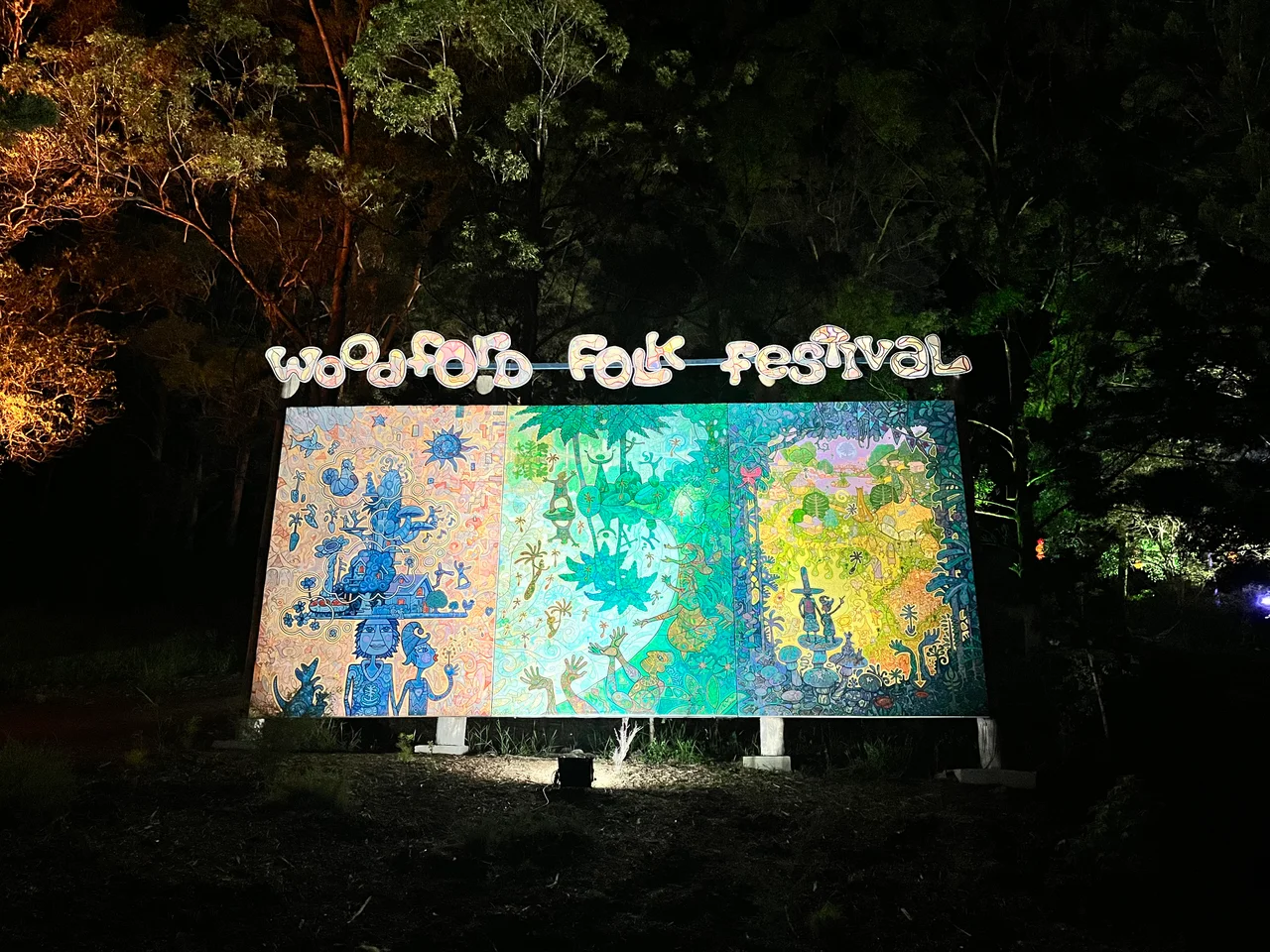

Woodford Folk Festival
On the last night of the year, more than twenty thousand people settle onto a grassy hillside in the dark and wait for something to burn. Lanterns made by hand over the previous week bob through the crowd. Then comes The Fire Event: dancers, music, towering sculptures, and finally flame, a great structure set alight to carry the old year off and usher in the new. This is how the Woodford Folk Festival ends, and for the people on that hill it is as fixed a part of New Year as midnight itself. The strangest thing about it is where it happens: not in a city, but on a former dairy farm in the green hinterland north of Brisbane that, three decades ago, was little more than bare paddocks.
A Festival That Built Its Own Land
Most festivals borrow a venue. Woodford built one. The event grew out of the Maleny Folk Festival, first held in 1987, and in 1994 the organisers bought an old dairy farm near the Sunshine Coast town of Woodford and named it Woodfordia. The land came worn out and treeless. So they planted it. Beginning with an annual tradition called The Planting in 1997, volunteers have put more than a hundred and thirty thousand subtropical rainforest trees into the ground, turning a barren property into a living parkland of orchids, ferns, and birdsong. The festival doesn't just occupy Woodfordia for a week each summer; it has spent thirty years growing the place into existence, root by root.
One of the Largest Gatherings in the Hemisphere
From homegrown beginnings, Woodford has swelled into one of the biggest cultural events of its kind in Australia and among the largest in the southern hemisphere. In the 2016 to 2017 season it drew over 135,000 patrons, its biggest year on record. In 2014 it pulled more than 126,000 people and pumped some twenty-two million dollars into the local economy. The festival runs across the turn of the year, typically from 27 December into the first days of January, a small temporary city with its own streets, stages, and rhythms. It has won national recognition, including Best Live Music Festival or Event at the National Live Music Awards, and in 2009 it was named one of Queensland's Q150 Icons.
Folk, and Then Some
The word 'folk' undersells it. Over the years the bills have ranged from Australian mainstays like The Cat Empire, Missy Higgins, John Butler Trio, and Kate Miller-Heidke to international names including Violent Femmes, Buffy Sainte-Marie, and Michael Franti. Aboriginal artists such as the late Archie Roach, Thelma Plum, Emily Wurramara, and Baker Boy have featured prominently, alongside Celtic fiddlers, Mongolian throat singers, comedians, circus acts, and spoken-word stages. Music is only part of it. Woodford folds in debate, workshops, philosophy, and craft, a sprawling cultural marketplace where you might catch a folk legend at midday and a fire-twirler at midnight.
Floods, a Pandemic, and a Hillside That Endures
Woodfordia's deep connection to its land has cut both ways. The Queensland floods of 2010 and 2011 swamped the site and left the festival's organisation facing repair bills in the millions. To keep it alive, the regional council bought the land and leased it back for fifty years, so the festival kept its home while shedding the debt. The pandemic forced a hiatus in 2020, the first serious break in decades, and after two missed years the festival returned in 2022 to the Woodfordia parklands. Each summer the crowds come back to the trees they helped plant, and each New Year's night the fire on the hill burns the old year down to embers.
From the Air
Woodfordia sits at roughly 26.92 degrees South, 152.76 degrees East, on a 500-acre property in the rural hinterland a short way north of the town of Woodford, in the Sunshine Coast region north of Brisbane. The nearest sizeable airfield is Caboolture Airport (YCAB), about 25 km southeast; Sunshine Coast Airport (YBSU) lies roughly 40 km to the northeast and Brisbane Airport (YBBN) about 60 km south. From the air during the festival's late-December run, the normally green parkland is transformed into a dense temporary city of marquees, stages, and tents, brightly lit after dark and unmistakable against the surrounding farmland. The volcanic spires of the Glass House Mountains rise just to the east, the best natural landmark for finding the site. Expect afternoon and evening thunderstorms over the festival's summer dates.
Nearby Stories
- Conondale National Park 12 km away
- Aarhus Historic Shipwreck 16 km away
- Thomas Petrie 22 km away
- Dunwich Benevolent Asylum 30 km away
- Main Range Railway 35 km away
- 2010-2011 Queensland Floods 67 km away
- Hornet Bank Massacre 302 km away
- HMS Porpoise (1799) 545 km away