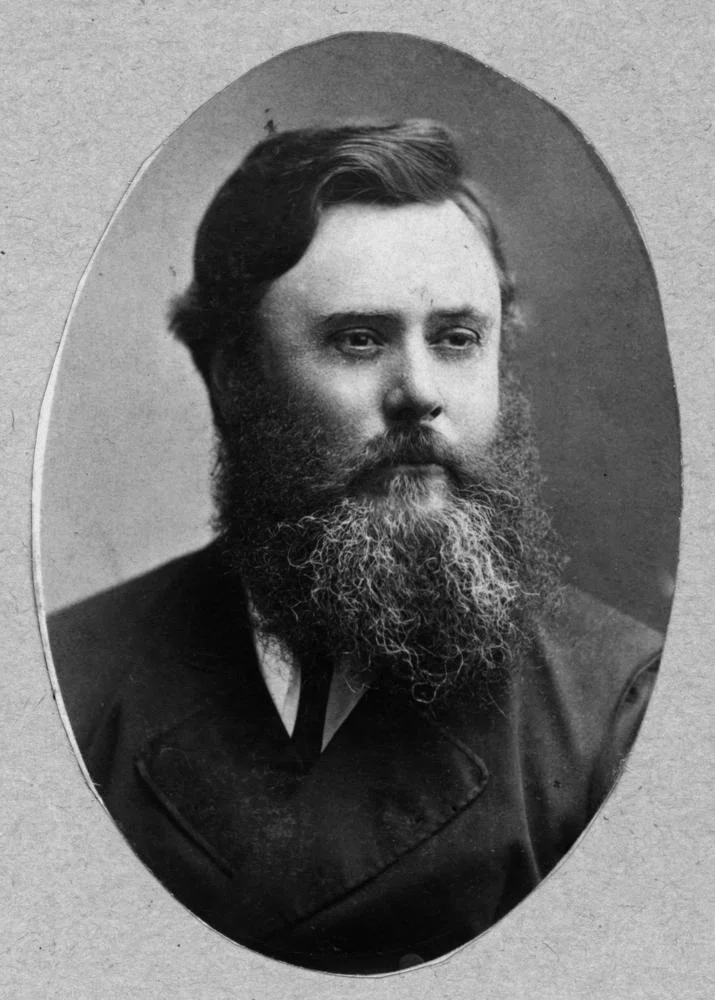

Thomas Petrie
Tom Petrie was six years old when his family arrived at the raw penal settlement on the Brisbane River in 1837, and he grew up in two worlds at once. The settlement's clerk, a convict, gave him his lessons; the Turrbal people gave him the rest. Allowed to roam freely with Aboriginal children, the boy learned to speak Turrbal, joined hunts and ceremonies, and was trusted in ways almost no other settler ever managed. He saw the brutality of the frontier up close, the floggings on Queen Street, men labouring in chains, and the colony's first hangings. But he also saw a culture from the inside, and what he absorbed as a child would, decades later, become one of the few records of Aboriginal Brisbane written by someone who had actually lived it.
The Bunya Feast
When Petrie was fourteen, the Turrbal elder Dalaipi took him on a journey that few outsiders ever witnessed. Every third year, when the great bunya pines of the ranges bore a heavy crop of cones, the Aboriginal peoples of southeast Queensland gathered in their hundreds for a feast that was part harvest, part festival, part diplomacy, with messengers sent far across the country to summon distant clans. The boy walked into the Blackall Range and shared in it. It is hard to overstate how rare that was. The bunya gatherings were among the most important events in the region's Aboriginal calendar, soon to be disrupted forever by clearing and settlement, and a settler's son sat among the trees and the fires and remembered it all his life.
Murrumba, the Good Place
In 1859 Petrie married Elizabeth Campbell and went looking for land of his own, and even this he did differently. Rather than simply taking up a run, he asked Dalaipi's advice. The elder's son, Dal-ngang, led him to his people's ancestral country on the North Pine River and offered it, only to learn with indignation that colonial paperwork had already granted it to someone else. Petrie negotiated a purchase and named his station Murrumba, a local word meaning 'good place.' Aboriginal workers helped him clear the land and raise the buildings. The arrangement sat inside a colonial system that was dispossessing the very people guiding him, a contradiction Petrie never fully escaped, but within it he dealt with the Turrbal as neighbours and partners rather than obstacles to be cleared away.
A Witness Who Spoke Up
In 1861 Petrie was called before a government committee investigating the Native Police, and his testimony cut against the grain of his time. Where many settlers spoke of Aboriginal people as savages or nuisances, Petrie said plainly that the old Brisbane clans were dying, poisoned by alcohol that whites supplied illegally, and that much of the trouble blamed on Aboriginal people was 'in great measure the fault of the white people themselves, and the way in which they treat them.' He had lived, he noted, where no other settler could remain, with several hundred Aboriginal people around him. His account was not free of the casual language of the era, but it carried something most official voices lacked: first-hand knowledge, and a refusal to repeat the comfortable lies.
His Daughter's Book
Petrie's deepest legacy was written down by someone else. In 1904 his daughter, Constance Campbell Petrie, published Tom Petrie's Reminiscences of Early Queensland, setting down the stories her father had carried since boyhood: Turrbal words and place names, customs, hunting and the bunya feasts, the people he had known by name. The book is still regarded as one of the best authorities on early Brisbane and a precious source on the region's Aboriginal life before colonisation overwhelmed it. Tom Petrie died in 1910, and that year the North Pine district was renamed Petrie in his honour. The name on the map remembers the grazier and the explorer. The book remembers something more important: the world he was let into as a child, and chose not to forget.
From the Air
Thomas Petrie's homestead site, Murrumba, lies near the township of Petrie at roughly 27.27 degrees south, 152.98 degrees east, on the North Pine River northwest of Brisbane, where the river broadens behind the North Pine Dam (Lake Samsonvale). From the air, the North Pine River winding toward Moreton Bay and the suburban grid of Petrie and Lawnton are the key references; the wooded ranges to the west rise toward the Blackall Range and the old bunya country; best viewed at 1,500 to 3,000 feet. The Glass House Mountains stand on the northern horizon. Nearest airports are Brisbane (YBBN / BNE) about 12 nautical miles southeast and Caboolture (YCAB) to the north; morning light is clearest before inland haze builds over the ranges.
Nearby Stories
- Bribie Island 12 km away
- Cressbrook Homestead 17 km away
- Beenleigh Rum Distillery 18 km away
- Main Range National Park 39 km away
- 2010-2011 Queensland Floods 47 km away
- Cape Byron 115 km away
- Cape Byron Light 145 km away
- HMS Porpoise (1799) 570 km away