.jpg)
Main Range Railway
To save money, the colony of Queensland gambled on a railway thinner than anyone had dared to run as a main line: a narrow gauge of just three feet six inches. Then it pointed that slender track at the wall of the Great Dividing Range and asked it to climb. Between 1865 and 1867, nine tunnels were bored, dozens of bridges flung across gullies, and the line hauled up roughly 365 metres of escarpment to reach Toowoomba. When it opened on 30 April 1867, it was the first railway in Australia to cross the Great Divide, and quite possibly the world's first main-line narrow-gauge railway.
The Engineer They Sent for Tunnels
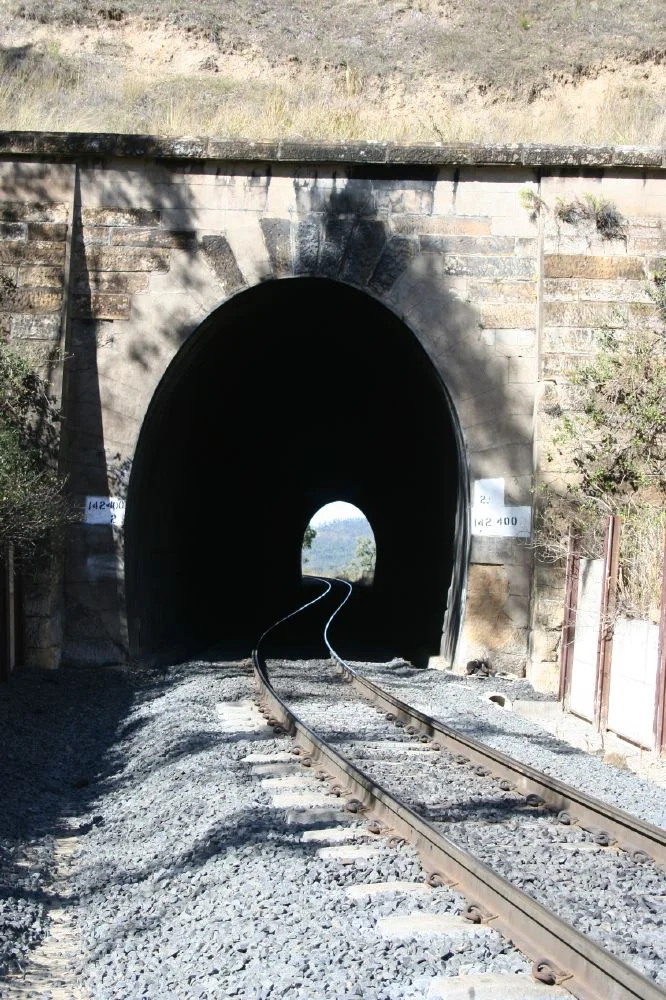
The contractors were the famous British firm Peto, Brassey and Betts, who had laid railways across continents. For the Main Range they needed a particular kind of expert, and they chose Robert Ballard as engineer-in-charge specifically for his skill at tunnelling, honed on difficult work in New South Wales. His nine tunnels still stand as some of the oldest railway tunnels in Australia, their portals faced in quarried sandstone, their ceilings lined with brick and dressed stone. One of them, Tunnel 8, hides a feature thought to be unique on any Australian railway tunnel: a small side gallery cut into the hillside. The line proved Ballard right. For all its difficulty, the Main Range has run for more than 150 years remarkably free of disaster, the worst being a collision at Murphys Creek in 1913 that killed six men.
A Hard Road to Work
Building the line was one feat; working it was another. For the men who drove the steam trains, the Main Range was among the most demanding stretches on the entire Queensland network. Sharp curves, steep grades, and dark tunnels conspired against every ascent. Crews had to nurse their coal and water carefully, and banking engines were stationed between Murphys Creek and Toowoomba to push struggling trains up from behind. Sandboxes lined the track to give the wheels grip, and after 1897 inner check rails were laid on the curves to guard against derailment. The railway transformed the Downs all the same. It became the great artery between Toowoomba and Ipswich, and the lines that grew from it reached Dalby by 1868 and Warwick by 1871, opening the inland to settlement and trade.
The Station That Grew a Garden
Halfway up the range, where a natural spring met a rare level stretch of track, the small station of Spring Bluff took root. For decades it was the principal halt on the climb and the only stop with a resident stationmaster. It might have stayed a purely practical place, but the railways began encouraging staff to beautify their stations, and Spring Bluff answered with extraordinary devotion. Through the 1930s and 1940s, Stationmaster Ralph Kirsop, his wife Lillian, and the night officers terraced flower beds into the escarpment with blue-metal stone, and the station won prize after prize for its displays. A London plane tree planted in 1870 still stands. Today, during Toowoomba's Carnival of Flowers each September, excursion trains still climb to Spring Bluff to see the gardens in bloom, carrying on a tradition more than a century old.
Concrete First and Coal Trains
The Main Range became a proving ground for engineering as much as a transport link. Near the summit stands Swansons Rail Bridge, an unreinforced concrete arch curved in plan across an unnamed gully, the first concrete arched rail bridge ever built in Australia, commanding a vast view over the Toowoomba Range from a spot reachable only by rail. At the top, the Ruthven Street overbridge rests on brick abutments believed to be the oldest of their kind in Queensland. Visitors in the nineteenth and early twentieth centuries marvelled at the sheer audacity of it all: a thread of track stitched up a mountainside through tunnel and cutting and curve. The marvel still works for a living. More than 150 years after it opened, the Main Range Railway carries most of its traffic the way it always did, hauling Queensland's wealth toward the coast, much of it now coal bound for overseas markets.
From the Air
The Main Range Railway climbs the eastern escarpment of the Great Dividing Range west of Brisbane, running from Murphys Creek at the foot of the range (about 27.42 degrees south, 152.05 degrees east) up to Harlaxton on the outskirts of Toowoomba near the summit (around 27.54 degrees south, 151.96 degrees east), with the midpoint station of Spring Bluff at roughly 27.49 degrees south, 152.01 degrees east. The line gains about 365 metres of elevation over its ascent. Toowoomba Wellcamp Airport (YBWW) lies west of the range top; the Oakey military aerodrome (YBOK) is nearby, so expect restricted airspace. Brisbane Airport (YBBN) is roughly 60 to 70 nautical miles east on the coastal plain. From the air, trace the steeply timbered escarpment between the Lockyer Valley and the Toowoomba tableland: the railway threads the spurs and gullies, briefly disappearing into tunnels and reappearing on curved embankments, with the green terraced gardens of Spring Bluff visible on a level shelf about halfway up. Clear, dry weather best reveals the winding line against the hillsides.
Nearby Stories
- North Ipswich Railway Workshops 20 km away
- Main Range National Park 22 km away
- Cressbrook Homestead 41 km away
- Woodford Folk Festival 41 km away
- Jimbour Homestead 43 km away
- Tamborine National Park 60 km away
- Warialda 217 km away
- Inverell 254 km away