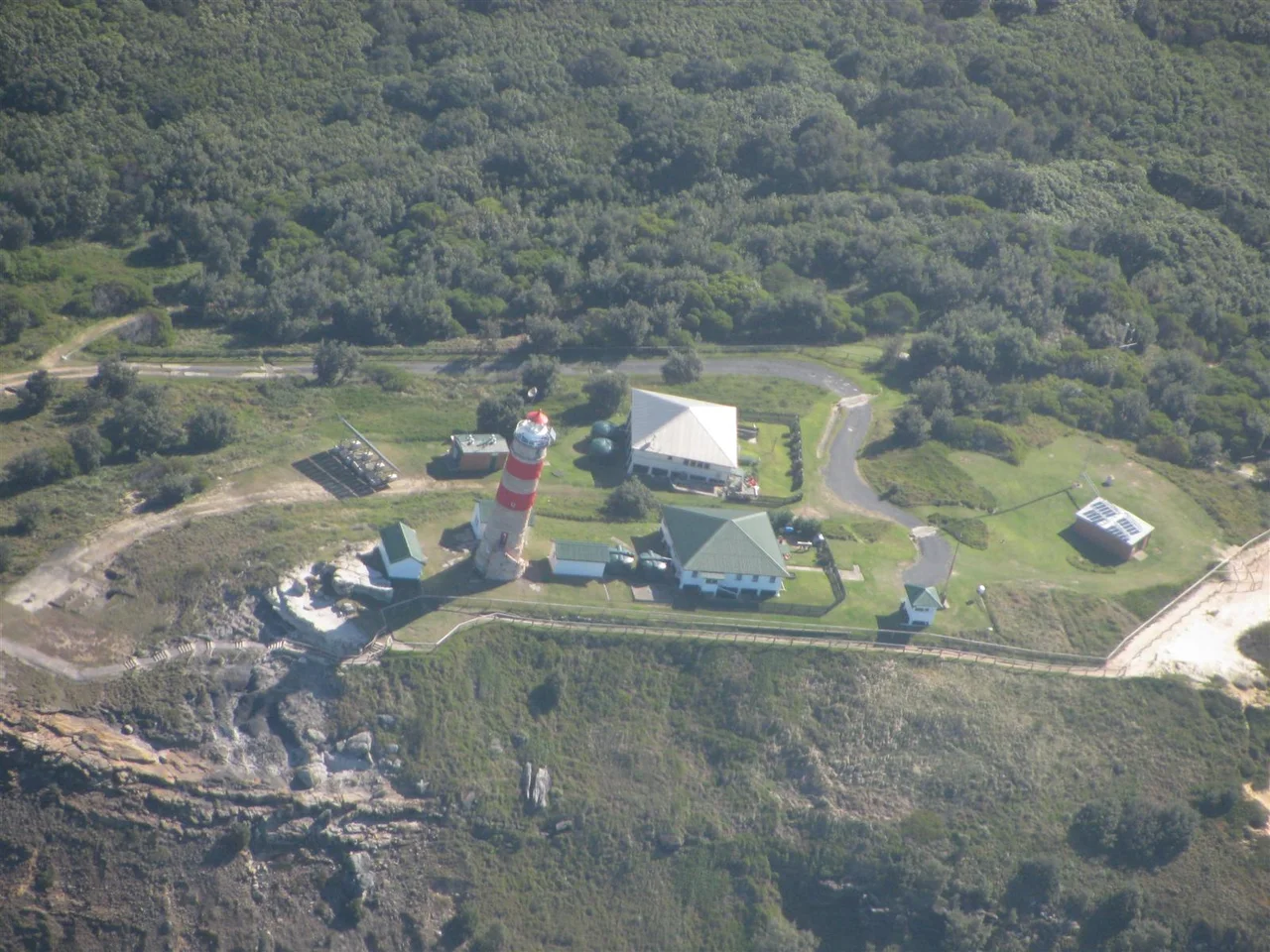

Cape Moreton Light
It was the only light on the whole Queensland coast when the colony was born. When Queensland separated from New South Wales in 1859, a single beacon stood watch over its 7,000 kilometres of shore: the sandstone tower at Cape Moreton, lit two years earlier, in 1857. More than a century and a half later it still turns above the cliffs at the northeastern tip of Moreton Island, the oldest lighthouse in Queensland and the only one ever built of stone. Its two broad red bands are unmistakable by day; by night its beam still sweeps the approaches to Brisbane, three revolutions every minute.
Built of Stone and Sentence
The lighthouse was a colonial undertaking in the most literal sense. Brisbane's residents petitioned for it in 1850; the New South Wales Colonial Architect, Edmund Blacket, drew the plans in 1854; and a contractor named Mark Farrell built the tower for £15,232 using convict labour, the cheap muscle on which so much of early Queensland was raised. Both the tower and its three keepers' cottages were cut from sandstone quarried nearby on the cape itself. The first light shone in February 1857, a catoptric apparatus of twenty-one oil-wick lamps backed by polished parabolic reflectors, visible far out to sea. For a young colony desperate to lure shipping into its harbours, that glow was an invitation written in fire.
Why Here, Why Then
For decades, ships preferred the southern entrance to Moreton Bay, between Moreton Island and Minjerribah, a shorter and gentler route. But that passage was treacherous, and as traffic grew the broader, safer northern entrance won out. Buoys were laid in the 1840s, the pilot station moved to Bulwer on Moreton Island in 1848, and the colonial government, eager to steer vessels toward the wider channel, resolved to crown the cape with a light. The hazard was no abstraction. Just offshore lay Smith's Rock, where in 1894 the barque Aarhus would strike and sink in fifteen minutes. The lighthouse existed precisely because these waters took ships, and it has been turning them aside ever since.
A Century of Reinvention
Few structures change so much while standing perfectly still. The Cape Moreton Light has run through nearly every technology of illumination in turn: oil wicks gave way to kerosene in 1873, then to acetylene gas, then to electricity in 1937, and finally to the solar panels mounted on its gallery today. In 1928 the tower itself was raised to its present height of about twenty-three metres to extend its reach, and in 1930 a new Chance Brothers lantern crowned it. The famous red bands were painted on in 1942. A telegraph office, a schoolhouse, a post office, and generations of keepers and their families once filled the station; the light that needed all of them now runs itself.
The Lonely Station
Three keepers' cottages still cluster on the headland in descending tiers, timber-framed and clad in fibro, the head keeper's house highest and grandest with its small fenced garden. One of the assistant's quarters became a museum in 1988, preserving the memory of a vanished way of life: families perched on a sand island, supplied by sea, their days governed by the turning of a lamp. The Australian Maritime Safety Authority runs the light now, automated and unattended. Reaching it still takes a ferry and a four-wheel drive, and the tower itself is closed, but the headland rewards the effort, with the wide blue sweep of the Coral Sea below and, in season, whales passing on the horizon.
From the Air
Cape Moreton Light stands at about 27.03 degrees south, 153.47 degrees east, on the northeastern headland of Moreton Island, the island's only rock outcrop. It is an unmistakable visual landmark from the air: a white-topped stone tower with two red horizontal bands, perched on cliffs where the calm of Moreton Bay meets the open Coral Sea. Brisbane Airport (YBBN) lies about 45 km west-southwest; the Sunshine Coast Airport (YBSU) is roughly 65 km northwest. The light is the natural reference point for fixing the position of nearby features, including Smith's Rock and the Aarhus wreck about two nautical miles to the northeast. Best viewed from 1,500-3,000 ft on a clear day; expect strong onshore winds and rough seas around the exposed headland, and watch for whales offshore between June and November.
Nearby Stories
- Montville Memorial Precinct 5 km away
- Woodford Folk Festival 19 km away
- St Helena Island National Park 28 km away
- Maroochy Air Crash 36 km away
- North Ipswich Railway Workshops 43 km away
- HMS Porpoise (1799) 522 km away
- Wreck Reefs 551 km away
- SS Elingamite: Gold, Fog, and a Captain Wrongly Blamed 1886 km away