
St Helena Island National Park
The island got its European name from an insult. In 1827 a Quandamooka headman named Eulope was accused of throwing a spear at a guard and taking an axe from the military post at Dunwich. The colony's notorious commandant, Captain Patrick Logan, exiled him to a low green island in Moreton Bay that the local people called Noogoon. Logan thought himself clever: because Eulope's powerful build reminded the British of Napoleon Bonaparte, they had nicknamed the headman 'Napoleon,' so Logan dubbed his place of exile St Helena, after the Atlantic rock where the real emperor was dying in captivity. The joke had a short life. Eulope knew Noogoon intimately, for his people had hunted turtle and flying fox there for generations, and within about three days he was gone.
Queensland's Inferno
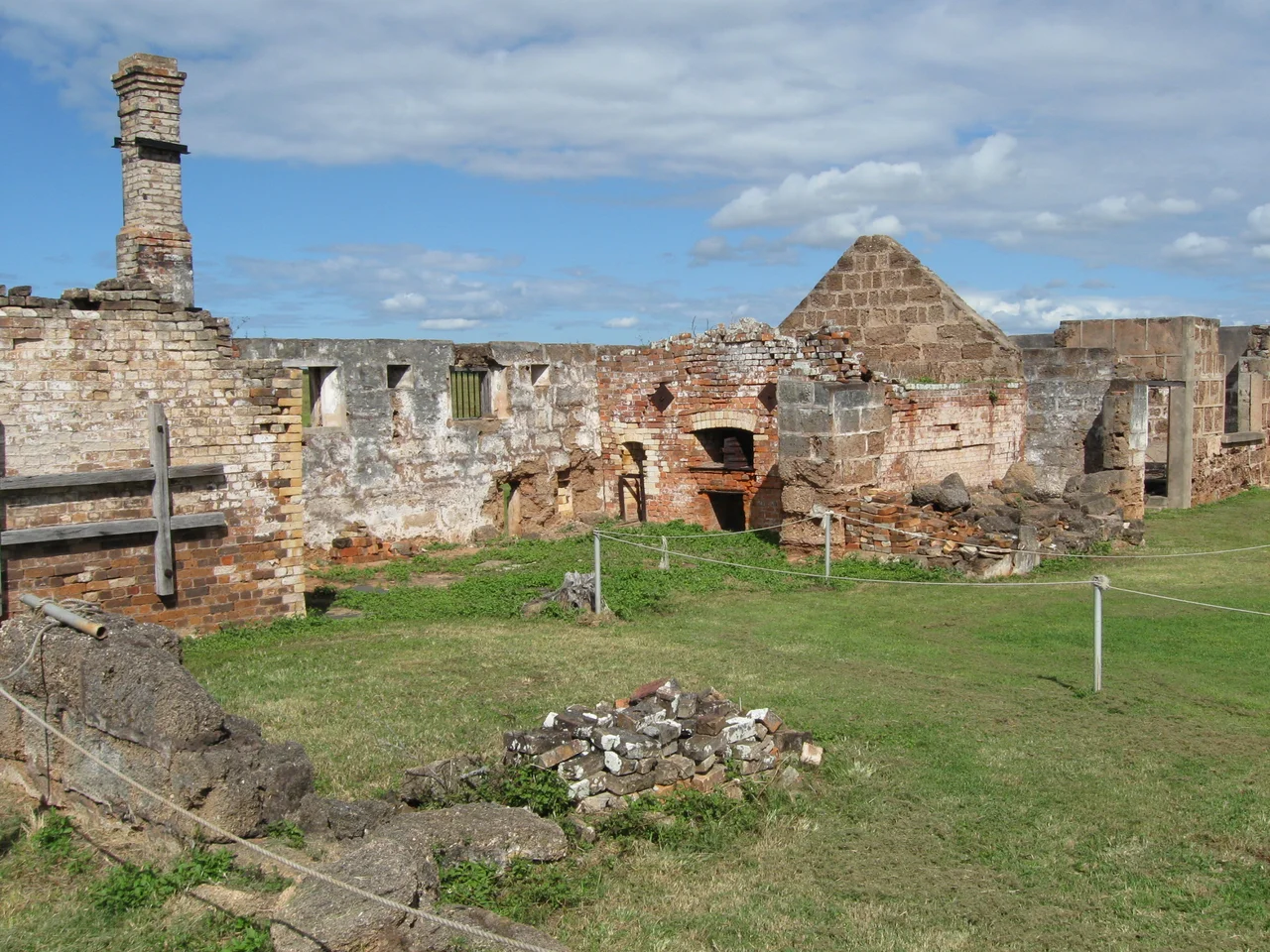
Four decades later the name turned grimly literal. Brisbane's gaol at Petrie Terrace had become so overcrowded and squalid that prisoners were instead set to work on St Helena, sinking wells, clearing scrub and quarrying stone. On 14 May 1867 the Governor proclaimed the island a penal establishment, and for the next sixty-five years it held many of the colony's longest-sentenced men. The early years were the cruellest. Punishment meant the lash, the gag, and the dreaded dark cells dug underground, where a man could be left in total blackness. From these years came the names the island still carries: 'the hell hole of the Pacific' and 'Queensland's Inferno.' These were real men in real darkness, and the ruins that survive on the island are, before anything else, a record of what was done to them.
The Prison That Fed Itself
And yet St Helena was no mere dungeon. Cut off by water and iron discipline, it became one of the most productive prison farms in the British world. By 1880 its mill was pressing more than seventy-five tons of sugar a year from cane the prisoners grew on the island's slopes. Their bricks went into Brisbane buildings; their boots, clothes and ship's rope, spun from imported sisal, were sold on the mainland. In the workshops men learned carpentry, tailoring, baking and butchery, trades meant to outlast their sentences. Administrators of the day held it up as a model prison, profitable and orderly. Later the sugar gave way to a herd of Ayrshire dairy cattle. The labour was forced and the framing was self-serving, but the skills, and for some men the structure, were real.
The Strikers and the Sea
Not everyone sent here was what the era called a criminal. In 1891, when shearers across Queensland struck against the squatters and the colony answered with troops and courts, the strike's leaders were charged with conspiracy and sedition and shipped to St Helena for three years' hard labour. One of them, Julian Stuart, left an account of the island that historians still read. The men who helped birth the Australian labour movement broke rock alongside murderers, their politics treated as a crime against the state. The island also kept its escape stories. In sixty-five years fewer than twenty-five serious attempts were made; most men were recaptured, but three vanished without trace, and two were drowned or taken by sharks in the bay they tried to cross.
Green Again
The prison closed in December 1932, downgraded in its final decade to a low-security farm, then dismantled brick by brick. Today Noogoon is a national park and the first historic site gazetted in Queensland, a place of grazing wallabies and roosting birds where stockade walls and the sugar mill stand roofless against the sky. Ferries cross from the mainland and guides walk visitors through the cell blocks and the underground punishment cells, telling the harsh and occasionally human stories of the men held here. The island holds two histories at once: the Quandamooka country it was for thousands of years, and the inferno the colony made of it for sixty-five. Standing among the ruins with the bay glittering on every side, you feel the strangeness of both.
From the Air
St Helena Island sits at roughly 27.393 degrees south, 153.232 degrees east, in Moreton Bay about 21 kilometres east of central Brisbane and 4 kilometres east of the Brisbane River mouth. From the air it is an unmistakable low, oval green island ringed by mangrove and mudflat, with the pale rectangular ruins of the prison stockade visible near its centre; best viewed at 1,500 to 2,500 feet. The Brisbane River mouth, the Port of Brisbane container terminals and the Fort Lytton headland to the west make useful approach references. Nearest airport is Brisbane (YBBN / BNE), about 12 nautical miles to the west-northwest; bay haze and afternoon sea breeze are common, and the surrounding shallows shift colour dramatically with tide and light.
Nearby Stories
- Bribie Island 12 km away
- Cressbrook Homestead 17 km away
- Beenleigh Rum Distillery 18 km away
- Main Range National Park 39 km away
- 2010-2011 Queensland Floods 47 km away
- Cape Byron 115 km away
- Cape Byron Light 145 km away
- HMS Porpoise (1799) 570 km away