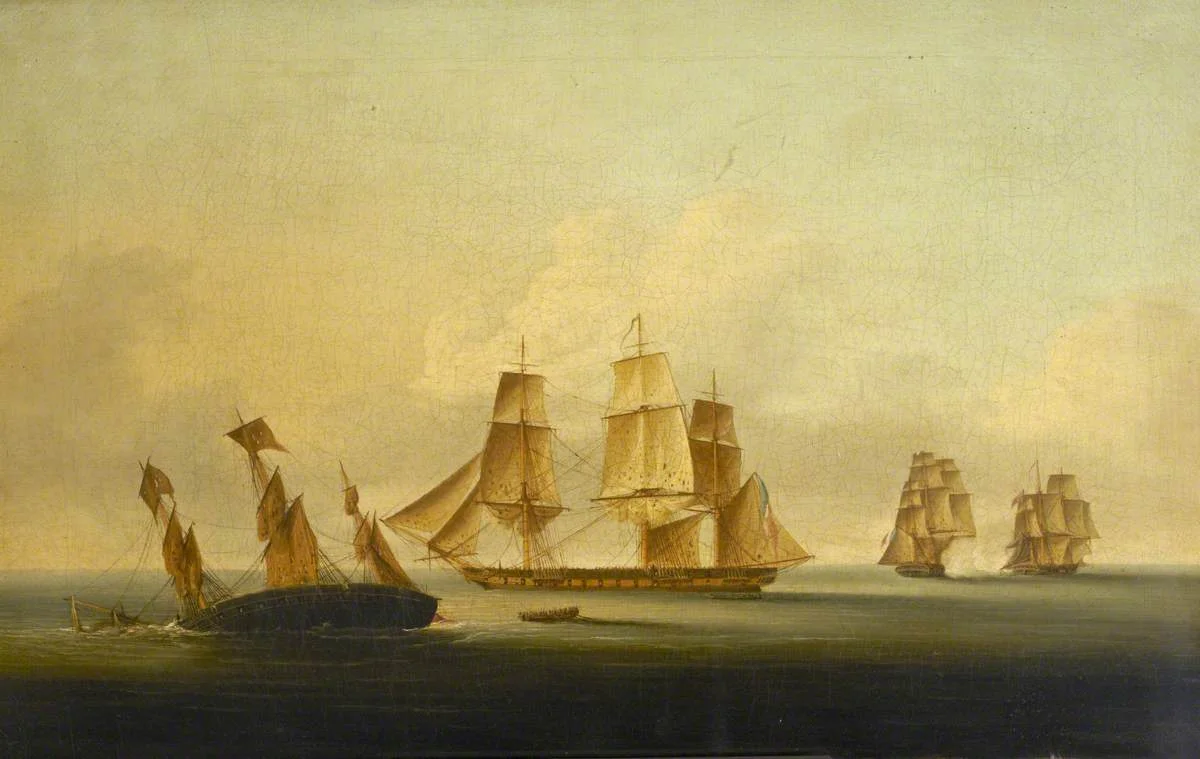
_-_End_of_the_Action_between_HMS_%27Arrow%27_and_%27Acheron%27_and_the_French_Frigates_%27Hortense%27_and_%27Incorruptible%27_-_BHC2384_-_Royal_Museums_Greenwich.jpg)
HMS Acheron (1803)
The Royal Navy liked to give its bomb-vessels the names of hell. These were squat, heavily built ships that hurled explosive shells from great mortars, and their crews sailed under labels like Vesuvius, Aetna, and Terror. Acheron took her name from the river of woe that the ancient Greeks placed at the edge of the underworld. She had not been born to it. She began life as a merchant ship in the Jamaica sugar trade, and she ended it as a burning wreck off the southeastern coast of Spain, sacrificed with a sister ship to buy a convoy of civilians their escape.
From Jamaica Trader to Bomb Vessel
She was launched at Whitby in 1799 under the plain name New Grove and spent her first years hauling cargo between London and Jamaica, later carrying goods to Suriname under a master named Barclay. It was ordinary commercial work, the backbone of an empire that ran on ships like her. In October 1803, with Britain again at war with Napoleon's France, the Admiralty bought her. At Woolwich Dockyard, through the winter into March 1804, shipwrights rebuilt the trader into a bomb-vessel, reinforcing her hull to absorb the recoil of her mortars. Commander Arthur Farquhar took command in December 1803 and sailed her for the Mediterranean, where the Navy was locked in the long, grinding blockade of the French fleet.
The Long Watch off Toulon
By July 1804 Acheron was one of the ships bottling up the French in Toulon, a monotonous, weather-beaten duty that Nelson's captains knew intimately. Early that August a storm blew the British squadron off station, and the French admiral Latouche Treville seized the gap to take his ships out for a training run, though he made no attempt at the grander voyage Napoleon wanted; sick already, he died within days. The blockade offered small rewards between long stretches of tedium. In November Acheron took the prize Adamo and shared in a string of captures made by Nelson's fleet. It was unglamorous, essential work, and it kept the French bottled where they could do no harm.
The Convoy and the Two Frigates
In January 1805 Acheron was ordered to a different task: shepherding merchant ships home. Alongside the sloop Arrow, under Captain Richard Budd Vincent, she escorted a convoy of nearly thirty merchantmen out of Malta toward England. Bad weather off Spain scattered the ships into two groups. Sighted off Cape Caxine on the third of February, the two powerful French frigates, Hortense and Incorruptible, gave chase and fell upon the convoy near Cape Palos on the fourth. Against frigates, a bomb-vessel and a sloop were badly overmatched, yet Arrow and Acheron turned to fight rather than flee. Their resistance bought precious time. Arrow's hold filled with water, four of her guns were torn from their mountings, and she took heavy casualties before she struck and rolled onto her beam ends, sinking as French boats pulled her survivors from the sea. Acheron, battered beyond saving, was set ablaze by her captors.
Burned, but Not for Nothing
The two small ships had done exactly what escorts are meant to do. While the frigates were occupied, the great majority of the convoy slipped away; the French managed to seize only three vessels, which they scuttled. Farquhar and his men were carried into Malaga and exchanged before long, and at the court martial that automatically followed the loss of any ship, held in Palma Bay off Sardinia, he and his crew were honorably acquitted. Farquhar was promoted to post captain for his bravery. Captain Vincent of the Arrow fared harder, held prisoner in Cartagena for nearly three months until Nelson arranged an exchange. Decades later, in 1847, the Admiralty struck the Naval General Service Medal for the action. By then only a single survivor from Acheron lived to claim the clasp engraved with her name and the date.
From the Air
The action unfolded off Cape Palos on Spain's Costa Calida, near 37.58 degrees N, 0.72 degrees W, a stretch of open Mediterranean southeast of Cartagena. The dominant visual landmark is Cabo de Palos itself, a rocky headland crowned by a 19th-century lighthouse, with the Mar Menor lagoon and its sandbar just to the north. A viewing altitude of 3,000 to 5,000 feet along the coast gives the best sense of the waters where the convoy scattered. Nearest airports are Region de Murcia International (LEMI), about 40 km to the northwest, and Alicante-Elche (LEAL), roughly 70 km north-northeast. Visibility over this coast is usually excellent, though the same winter gales that broke up the 1805 convoy can still churn the sea here.
Nearby Stories
- San Javier (Spain) 4.1 km away
- 2011 Lorca Earthquake 23 km away
- German submarine U-573 31 km away
- German submarine U-602 57 km away
- Villajoyosa 80 km away
- Cabo de Gata-Nijar Natural Park 82 km away
- SM U-39 107 km away
- Battle of Las Navas de Tolosa 197 km away