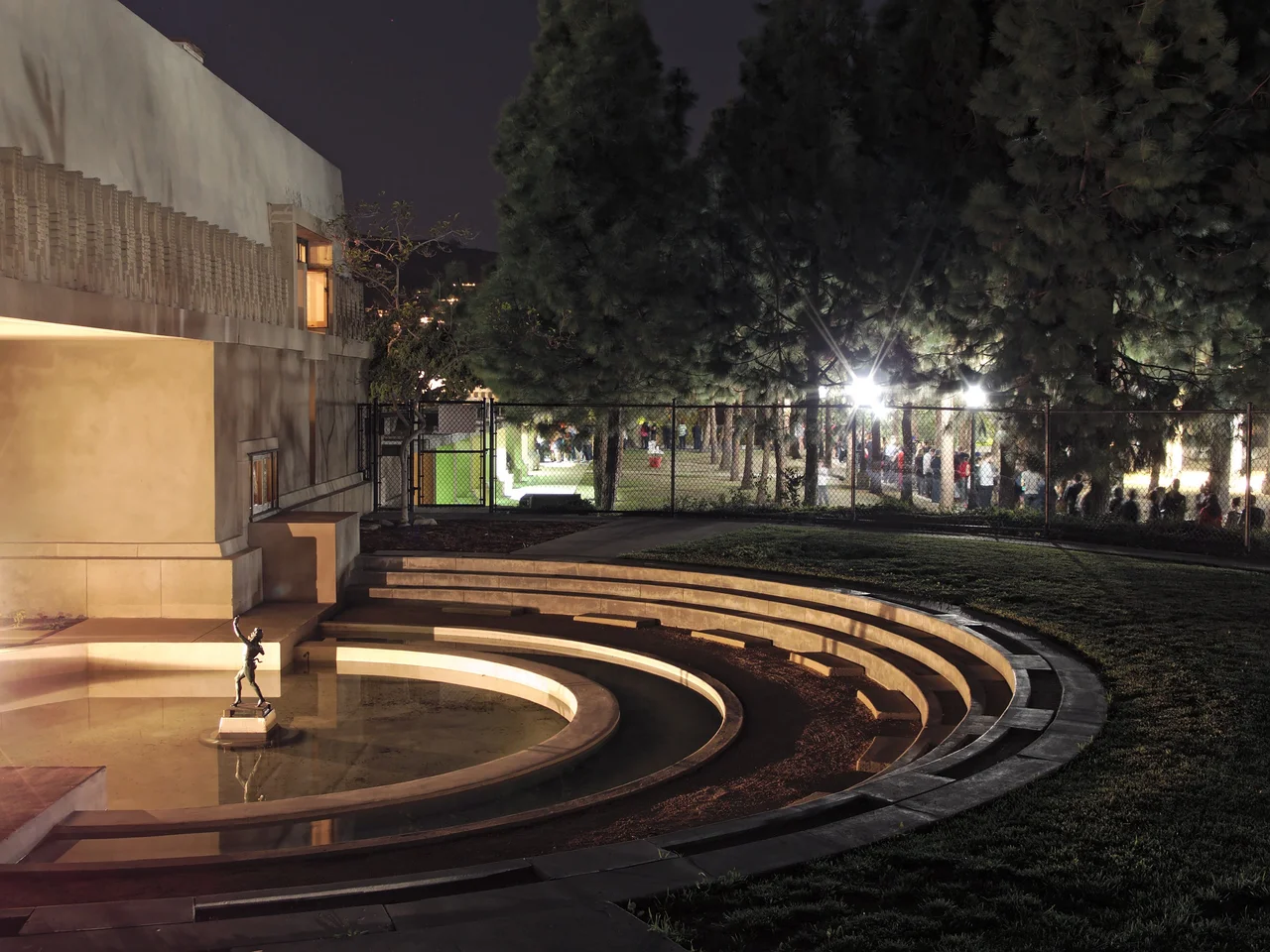

Hollyhock House
Frank Lloyd Wright designed hundreds of buildings over a career that spanned six decades, and almost every one of them looks like a Frank Lloyd Wright building. Hollyhock House, completed in 1921 on a hilltop in Hollywood, looks like something else entirely—like a building that arrived from a culture that never quite existed, assembled from Mayan geometry and California light and one woman's determination to have something unprecedented.
Aline Barnsdall and Olive Hill
Aline Barnsdall was an oil heiress with avant-garde tastes and the resources to act on them. She had been involved in progressive theater in Chicago and wanted to create a theatrical complex on the hilltop property she owned at 4800 Hollywood Boulevard—a site she called Olive Hill. The complex would include a theater, studios, and a residence for herself.
She hired Frank Lloyd Wright in 1919. Wright was between major commissions and between marriages; he was also at the peak of his theoretical powers. The project they developed together would test both of them. Barnsdall was opinionated and demanding; Wright was famously difficult to work with. The theatrical complex was never built as planned. The house was completed.
The Design
Wright named the house after Barnsdall's favorite flower, the hollyhock, which he abstracted into a geometric motif used throughout the design—in the roofline, in relief carvings on the walls, in decorative elements both structural and ornamental. The motif gave the building a visual language that was consistent without being literal.
The structure is approximately 6,000 square feet, organized around a central courtyard with a shallow reflecting pool. Three wings extend from the central block. The exterior walls of hollow clay tile lean slightly inward—a characteristic Wright used to suggest mass without actually using it—and are finished in stucco. The flat roofs and horizontal emphasis connect the building to the Prairie Style Wright had developed in Illinois, but the materials and light feel entirely Californian.
Rudolph Schindler and Richard Neutra both worked at the project as assistants to Wright, absorbing lessons from the commission that they would carry into their own careers shaping modernist architecture in Southern California.
Barnsdall's Donation
Barnsdall lived in the house only briefly before deciding that Los Angeles was not where she wanted to be. In 1927, she donated Hollyhock House and the surrounding Olive Hill property to the city, with the condition that it be used for arts programming. The site became Barnsdall Art Park, which it remains today—a public park with an art center, gallery, and the house itself.
The donation was an act of generosity and also of exasperation. Barnsdall and the city had disagreed repeatedly about the management of the property. The gift was partly a way of concluding a relationship that had become more trouble than it was worth.
World Heritage
Hollyhock House was designated a National Historic Landmark in 2007. In 2019, it was included in UNESCO's World Heritage List as part of the designation 'The 20th-Century Architecture of Frank Lloyd Wright,' which covers eight Wright buildings across the United States. It is the only World Heritage Site in the city of Los Angeles.
The house is open for tours, and visitors who arrive on the hilltop above Hollywood Boulevard are often struck by how fully the building maintains its strangeness. More than a century after its construction, Hollyhock House still looks like a building from somewhere else.
From the Air
Hollyhock House sits atop the Olive Hill site at 4800 Hollywood Boulevard, in Barnsdall Art Park. The hilltop is visible from the air as a raised, tree-covered promontory rising above the flat Hollywood grid, between Sunset Boulevard to the south and the Hollywood Hills to the north. Vermont Avenue runs north-south just to the west of the site. The 101 Hollywood Freeway is about a mile to the south. The building's flat rooflines and courtyard configuration are visible from low altitude. Nearest airports: KBUR (Burbank) to the north via the Cahuenga Pass, KLAX (Los Angeles International) to the southwest.
Nearby Stories
- Warner Grand Theatre 1.5 km away
- Silverado Fire 4.2 km away
- Nethercutt Collection 15 km away
- Fillmore and Western Railway 16 km away
- Amgen 19 km away
- Santa Barbara Island 36 km away
- San Bernardino Train Disaster 42 km away
- Calico: The Ghost Town Walter Knott Saved 111 km away