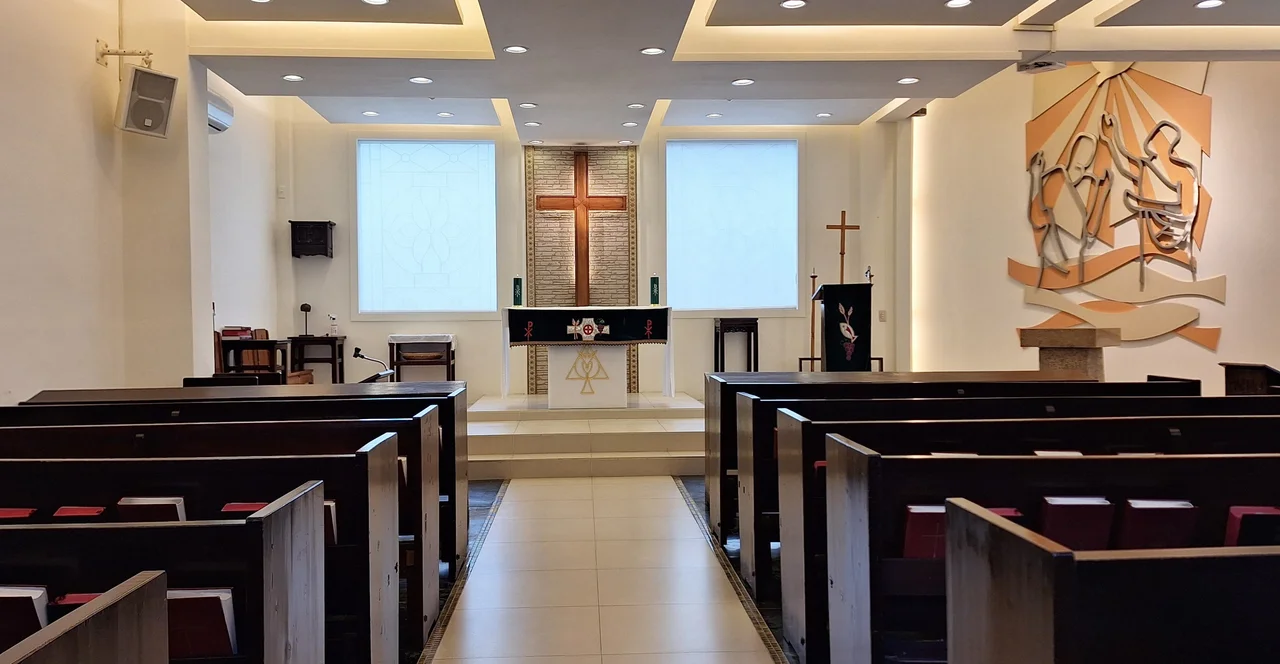

Holy Trinity Church (Keelung)
In a port city shaped by maritime trade, colonial history, and the relentless humidity of Taiwan's northern coast, a small Protestant congregation put down roots in 1953 and has not moved since. Holy Trinity Church in Keelung — formally known as 基隆聖三一堂 — sits on Tung Ming Road in the Xinyi District, about a kilometer from Keelung's central railway station and twenty minutes by taxi from the port. It is not a grand landmark in the way that Keelung's night market or its hilltop temples are grand. It is something quieter: a community that has outlasted several buildings, two generations of pastors, and the kind of structural decay that the city's famously wet climate can inflict on nearly anything over time.
A Church Founded on Pentecost
The congregation began with a deliberate symbolic choice. In May 1953, Bishop Charles P. Gilson of the Taiwan Episcopal Church chose Pentecost Sunday — the Christian feast that commemorates the founding of the early church — to consecrate Holy Trinity Church in Keelung. The move to this port city had begun the previous year, when Bishop Gilson dispatched the Reverend Yue-Han Lin to establish a congregation. By November 1952, Reverend Lin had purchased a two-story building at No. 53 Tung Ming Road. The following spring, with the bishop present and the liturgical calendar aligned, Holy Trinity officially opened. Reverend Lin became the first pastor and would shepherd the congregation through its formative years in a rented building that would eventually prove too small, too old, and too corroded by Keelung's relentless rainfall.
Built to Last: The 1967 Building
By the mid-1960s, the congregation had outgrown its original home. In February 1967, a new four-story building was completed at No. 163 Tung Ming Road — the address where Holy Trinity stands today. The design was pragmatic and layered, allocating each floor a distinct purpose. The second floor became the chapel, the center of the congregation's worship life. The third floor served as the priest's residence, keeping the pastor close to the community. The fourth floor housed a student dormitory for girls attending a local Keelung junior high school — a practical expression of the church's role in the wider neighborhood, not merely as a spiritual institution but as a place that provided support for the families around it. The first floor, by implication, was accessible to the street and the city.
The Work of Renewal
Keelung receives more rain than almost any city in Taiwan, and buildings here age in ways that landlocked places do not. By the time the Reverend Ling-Ling Chang became pastor in January 1991, the Holy Trinity building had absorbed decades of that moisture. The walls, inside and out, had begun to peel. The structure remained sound enough but had lost its outward dignity. What followed was a renovation effort that the church's own account attributes to the enthusiasm and dedication of parishioners and colleagues — a congregation rallying around its building, raising support, organizing labor, and returning their church to something that looked like what it was meant to be. The renovated building reopened with what the congregation called a "renewed path of missionary work." The phrase carries the weight of practical accomplishment: a community that repaired what it had and kept going.
Seventy Years and Counting
In June 2023, Holy Trinity Church, Keelung, celebrated the seventieth anniversary of its founding. The Reverend Hsun-Ming Lin has served as pastor since February 2014, continuing a line of pastoral leadership that stretches back to the congregation's first year. The church belongs to the Taiwan Episcopal Church, the Anglican body established in Taiwan, which has its own history tied to the island's complex twentieth century: colonial governance, political transition, and the gradual development of a distinctly Taiwanese Christian identity. Holy Trinity occupies a modest position in that larger story — one congregation in one port city, sustained by the people who have chosen to belong to it. That it has endured through seventy years of Keelung's weather, and the larger weathers of history, is itself worth noting.
From the Air
Holy Trinity Church sits at approximately 25.13°N, 121.76°E in the Xinyi District of Keelung, Taiwan's major northern port city. From the air at 3,000–5,000 feet approaching from the south over Taipei, the Keelung River valley is visible leading northeast toward the harbor. The Port of Keelung — one of Taiwan's busiest — is a clear visual landmark, with the city built densely around the harbor basin. The church itself is not visible from altitude but sits about 1 km inland from the port's eastern edge. Nearest major airport: RCSS (Taipei Songshan), approximately 25 km to the southwest. RCTP (Taoyuan International) lies roughly 50 km west-southwest. The Keelung area is frequently cloudy and receives some of the highest rainfall in Taiwan; low-visibility approaches are common, particularly in winter.
Nearby Stories
- Taoyuan Air Base 4.7 km away
- Min Ping Yu No. 5540 Incident 6.9 km away
- Neiwan 14 km away
- North Jiangsu Main Irrigation Canal 982 km away
- Sinking of MV Sewol 1049 km away
- General Cliff Rock Paintings 1058 km away
- Yellow Sea 1108 km away
- Sibuyan Island 1376 km away