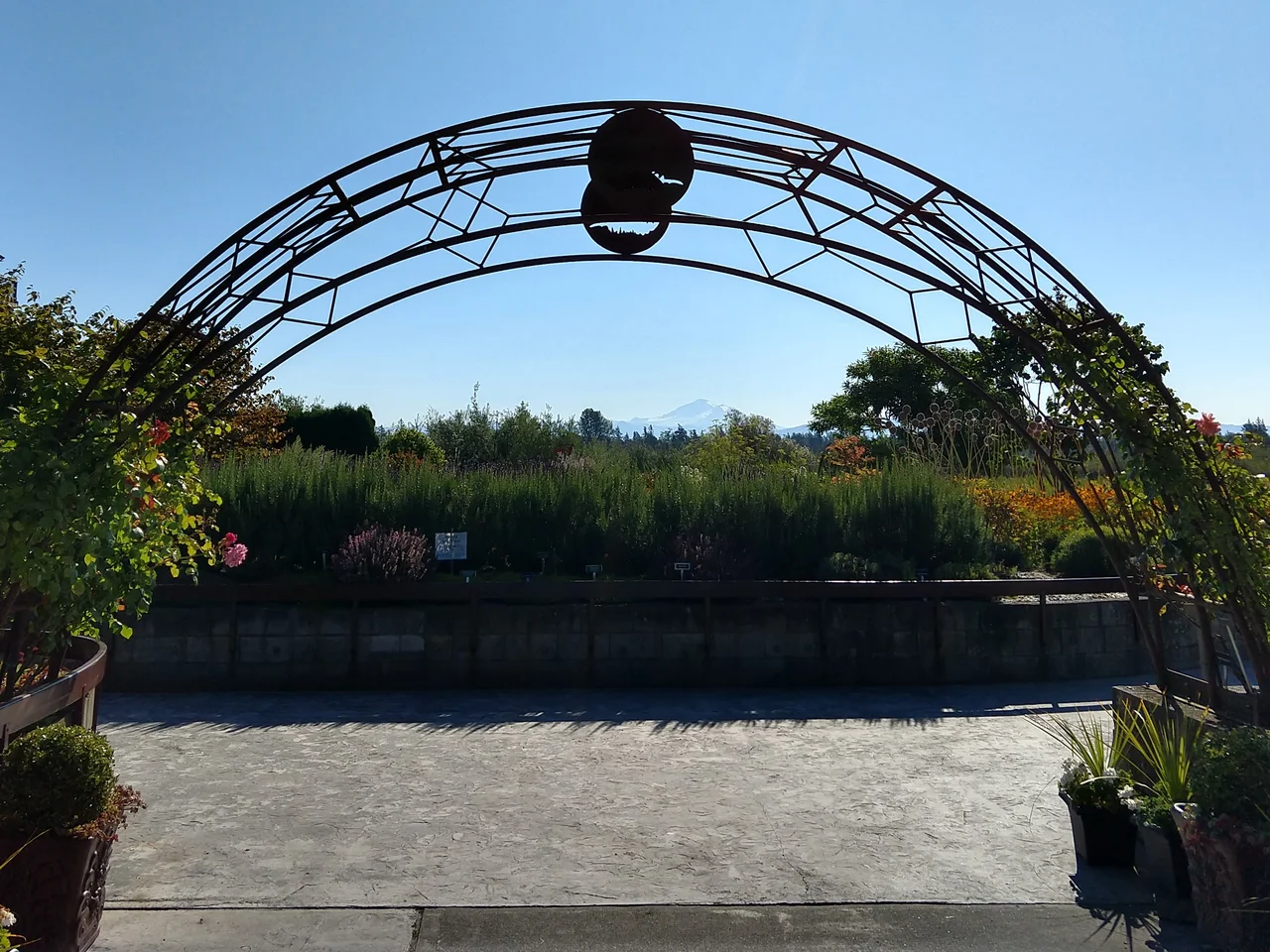

Hovander Homestead Park
The wood soaked for two years before anyone drove a nail into it. In June 1899, Hokan Hovander finished the plans for his farmhouse on the Nooksack River and ordered 52,000 board feet of fir and cedar, then put the whole order into linseed oil and left it to cure. It was a Swedish practice, and it was slow, and it worked: the house was finished in 1903 and the timber has not needed treatment since. More than a century and two floods' worth of river later, the building still stands on its raised platform above the flood land, which tells you most of what you need to know about the man who designed it.
Sixty Acres and Two Log Cabins
Hovander was an architect and bricklayer who came from Sweden and first settled in Seattle, then decided that what he wanted was farmland. In 1898 he arrived in Ferndale, in Whatcom County near the Canadian border, and paid $4,000 to Betsey Nielson for sixty acres on the Nooksack River. The purchase came with two log cabins, livestock and farm equipment — a going concern, in other words, rather than raw ground. He moved his family onto it and set about building something permanent. The eventual park would grow to 350 acres bordering the river and reaching across to Tennant Lake, but it started as a modest holding bought by a tradesman with a clear idea of the house he intended to put on it.
A Swedish House on American Flood Land
It was common practice among Northwest settlers in the late nineteenth century to build in the architectural idiom of wherever they had come from, and Hovander built Swedish. The house has large open rooms with windows and doorways proportioned to the space rather than to a catalogue, high ceilings, and egg-and-dart trim — a classical fertility motif reworked into the geometric idiom of Scandinavian folk ornament. There are no fireplaces anywhere in it. Instead it became one of the first houses in Whatcom County with central heating. Finished in 1903, it runs to 6,800 square feet with three bedrooms, a library, a dining room and a kitchen. The barn is the interesting exception. Hovander had no use for the small Swedish barns he had grown up with and admired the scale and lofts of American ones, so he designed a large, high-ceilinged structure and hired men from Bellingham to raise it. Both buildings sit on raised platforms, because the Nooksack floods and the river was here first.
Leontine's Kitchen
Leontine Hovander had trained as a cook in Sweden, and on a working farm that skill was infrastructure. She fed the family and the hired hands, day after day through planting and haying and slaughter. Swedish custom held that a farm wife took over management whenever her husband was away, and she did, which is why the farm workers knew and respected her as they did. The first crop off the land was oats. Sweet corn, hay, dried fruit and pork followed. Two orchards came with the property when Hovander bought it, and the apple orchard is still standing in the park today — one of the few things on the site that is neither restored nor reconstructed, but simply old and still producing.
What Tuberculosis Took
Not long after arriving, Hovander began building a Holstein dairy herd out of the twelve cows that came with the homestead. By 1919 it was over fifty head. That year the entire herd contracted tuberculosis from a source nobody identified, and all of it had to be destroyed — a life's work in animals, gone in a season. The family started over with Guernseys. Hokan himself had died in 1915, and Leontine and the children carried the farm on without him. Eight years after the cattle, the disease came back for the family. The two youngest children, Vera and Ada, both fell ill. Ada recovered. Vera died in 1929. Leontine lived until 1936 and died at seventy-seven. Their son Otis stayed on the farm longer than any of them, and was the last Hovander to live there.
The Tools Are the Family's
In 1969 Whatcom County Parks and Recreation bought the homestead from Otis for $60,000. He kept living in the house while the county repaired and renovated it, moving out in 1971 when the park opened to the public; he died in 1979. What makes the place work as a museum is that it was never emptied — the farm tools and most of the objects on display were used by the Hovanders themselves, and livestock were later brought back in to make the yard a working farmyard again rather than a diorama. The homestead joined the National Register of Historic Places in 1974 and took a National Trust for Historic Preservation award in 1978. A demonstration garden was later laid out to suggest what the family's own garden might have looked like; it doubles as a teaching plot, and its produce goes to the local food bank. Across the park, the Tennant Lake section adds an interpretive centre, a fragrance garden planted to be experienced by touch and smell, a wildlife viewing tower, and a boardwalk out over the wetlands. Guided historical tours run through late spring and summer.
From the Air
Hovander Homestead Park sits at 48.83N, 122.59W just south of Ferndale, Washington, on the west bank of the Nooksack River about 5nm northwest of Bellingham. From the air the park reads as a block of open pasture and orchard on the flood plain inside a bend of the Nooksack, with the large white farmhouse and its red barn clearly visible, and the dark wetland of Tennant Lake immediately west. Interstate 5 runs north-south about 1nm east; the Nooksack itself makes an unmistakable meandering line from the Cascade foothills out to Bellingham Bay, 4nm southwest. Mount Baker stands 30nm east-southeast on a clear day. Nearest airports: Bellingham International (KBLI) about 4nm southeast, Blaine Municipal (KBWS) 12nm northwest, and Abbotsford (CYXX) 15nm north across the border — watch the international boundary 8nm north. Best viewed from 1,500 to 2,500 feet. Winter and early spring flooding sometimes puts sheet water across these fields, which is exactly why the house sits on a platform.
Nearby Stories
- Naval Radio Section Aldergrove 5.2 km away
- Anacortes 6.8 km away
- Saturna Island 7.4 km away
- George Massey Tunnel 9 km away
- Mount Baker 13 km away
- Discovery Island (British Columbia) 17 km away
- North Cascades National Park 80 km away
- Manning Provincial Park 88 km away