
George Massey Tunnel
On 31 March 1964, a man named George Massey handed over a dollar and became the last person ever to pay a toll at the Deas Island Tunnel. He had spent years as the member of the legislature for Delta arguing that his constituents deserved a permanent crossing of the Fraser River instead of the Ladner Ferry, and the tunnel he got was, by any measure, a remarkable piece of engineering. He did not live to see it carry his name. Massey died in 1964, and in 1967 the province renamed the crossing in his honour — which means the man who paid the final toll was also the man the tunnel was eventually named for, a tidy piece of symmetry that almost nobody stuck in the southbound queue is thinking about.
Six Boxes on a Barge
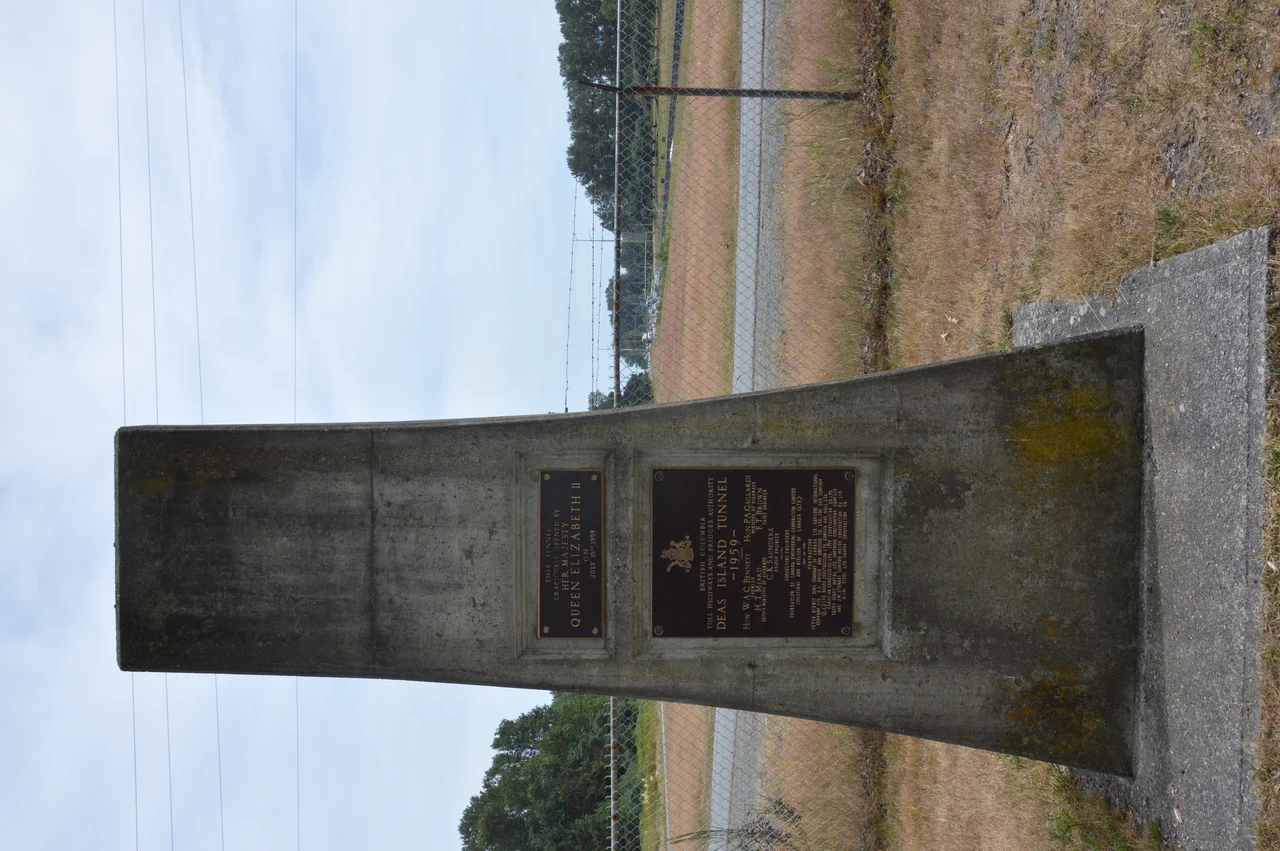
The Massey Tunnel was the first structure in British Columbia built using immersed tube technology, and the method is worth picturing. The tunnel was not bored through the riverbed. It was cast on land in six precast concrete sections — each 344 feet long, 78 feet wide, and 24 feet high — which were then sealed, floated out onto the Fraser on barges, manoeuvred into position above a shallow trench dredged into the loose sand and silt of the river bottom, and sunk. Once the sections were joined, crews buried them: 500-pound stones filled fifty feet out on either side, with a bed of 1,500-pound stones laid over the top as armour against the river's scour. Construction began in March 1957 and cost roughly $16.6 million. The tunnel opened to traffic on 23 May 1959 as the Deas Island Tunnel, and Queen Elizabeth II came for the official ceremony on 15 July.
The Lowest Road in Canada
At its deepest, the roadway runs about 22 metres below sea level — the lowest road surface in the country, and the only road tunnel in Canada that goes beneath sea level at all. The tube itself is 629 metres long, a single structure divided down the middle by a concrete wall so that each side carries two lanes, joining Richmond on the north bank to Delta on the south. Ventilation and pumping machinery sits in a building at each end, and concrete retaining walls carry the approaches out roughly 400 metres. Five kilometres downstream, the Fraser finishes its journey and empties into the Strait of Georgia. Dangerous goods are barred from the tunnel, and there is a hard height limit of 4.15 metres — a number that a certain number of truck drivers rediscover the hard way every year.
What It Is Resting On
There is a problem underneath. The tunnel was designed in the 1950s, when seismic engineering barely entered the calculation, and it sits on a layer of river sediment roughly 600 metres thick before anything like bedrock appears. In a major earthquake, that sediment could liquefy — behave momentarily like a fluid — leaving the structure with nothing beneath it. By the early 2000s the risk was well enough understood to act on, and a seismic retrofit ran from late 2004 to November 2006. Then came something more unusual. In 2009 an earthquake early warning system called Shakealarm was commissioned at the tunnel, the first commercial system of its kind installed to protect critical infrastructure anywhere in North America. It buys seconds to minutes. If a dangerous quake is inbound, gates at both portals close so that nobody else can enter, while anyone already inside drives out as normal.
Swing Gates and Bike Buses
The tunnel has been fighting its own capacity since almost the moment it opened. On 28 January 1981, a reversible lane system was introduced, part of a $2.5 million program that had already added a bus lane to the approaches. At peak hours, a line of swing gates squeezes one direction into a single lane and opens three lanes to the other — northbound into Vancouver in the morning, southbound out of it at night. Cyclists have had a harder time. It is illegal to ride or walk through the tunnel, so bikes depend on a fare-free shuttle that runs limited hours and carries seven at a time, or on TransLink buses whose two-bike racks fill up instantly during summer. Since this is the main route between Vancouver and the Tsawwassen ferry terminal, the bottleneck has been a long-running complaint. In June 2022 TransLink tried a Bike Bus with room for nine bicycles, running from late June to Labour Day between the ferry terminal and Bridgeport station.
The Tunnel After This One
Replacing the Massey Tunnel has consumed nearly two decades of provincial politics. A plan to widen it from four lanes to six surfaced in 2006. In 2012 the premier announced a full replacement within ten years, and by December 2015 the government had committed to a $3.5 billion bridge with associated interchange work. Metro Vancouver's mayors came out collectively against that bridge in June 2016 — the first time the board had opposed the project as a bloc — and asked Ottawa for a federal environmental review, which was declined in February 2017. Ground was broken in April 2017 amid protests. After the election that year, the incoming government scrapped the bridge and went back to consultation. In 2019 the mayors recommended a new eight-lane tunnel instead, and that plan received approval in August 2021. It is toll-free, includes pedestrian and bicycle facilities at last, carries a projected cost of $4.15 billion, and is scheduled to open in 2031.
From the Air
The George Massey Tunnel crosses beneath the south arm of the Fraser River at 49.1217 degrees north, 123.0756 degrees west, about 20 km south of downtown Vancouver and roughly 30 km north of the Canada-United States border at Blaine, Washington. Best viewed from 2,000 to 4,000 feet on an east-west track along the river. The tunnel itself is invisible, but the crossing is unmistakable: Highway 99 runs dead straight across the flat delta farmland of Richmond and Delta, dives into the ventilation buildings at each portal, and resumes on the far bank, with long concrete-walled approach cuts on either side. Deas Island lies immediately west. The Fraser empties into the Strait of Georgia about 5 km downstream, spreading a visible brown sediment plume. Nearest airports: Vancouver International (CYVR) roughly 10 km northwest — expect busy terminal airspace and approach paths directly over this area — Boundary Bay (CZBB) to the south, and Abbotsford (CYXX) to the east. The Fraser delta produces persistent radiation fog on calm autumn and winter mornings.
Nearby Stories
- Mudge Island 3 km away
- Mayne Island 4.9 km away
- Canadian Museum of Flight 6.1 km away
- Hovander Homestead Park 8.5 km away
- St. Augustine's Indian Residential School 8.8 km away
- Paldi, British Columbia 11 km away
- Golden Ears Provincial Park 20 km away
- Britannia Mine and the Mountain That Bleeds 25 km away