
J. Paul Getty Museum
There is a museum in the hills above Los Angeles that you cannot drive to from the parking lot. You take a tram. It climbs a ridge above the San Diego Freeway, and when the doors open you are standing above the city — above the smog line, above the noise — looking at architecture, gardens, and art assembled at a scale that only becomes possible when a single man leaves behind more than a billion dollars and an instruction to spend it on beauty. The J. Paul Getty Museum is, among other things, a monument to the consequences of almost incomprehensible private wealth.
Two Campuses, One Story
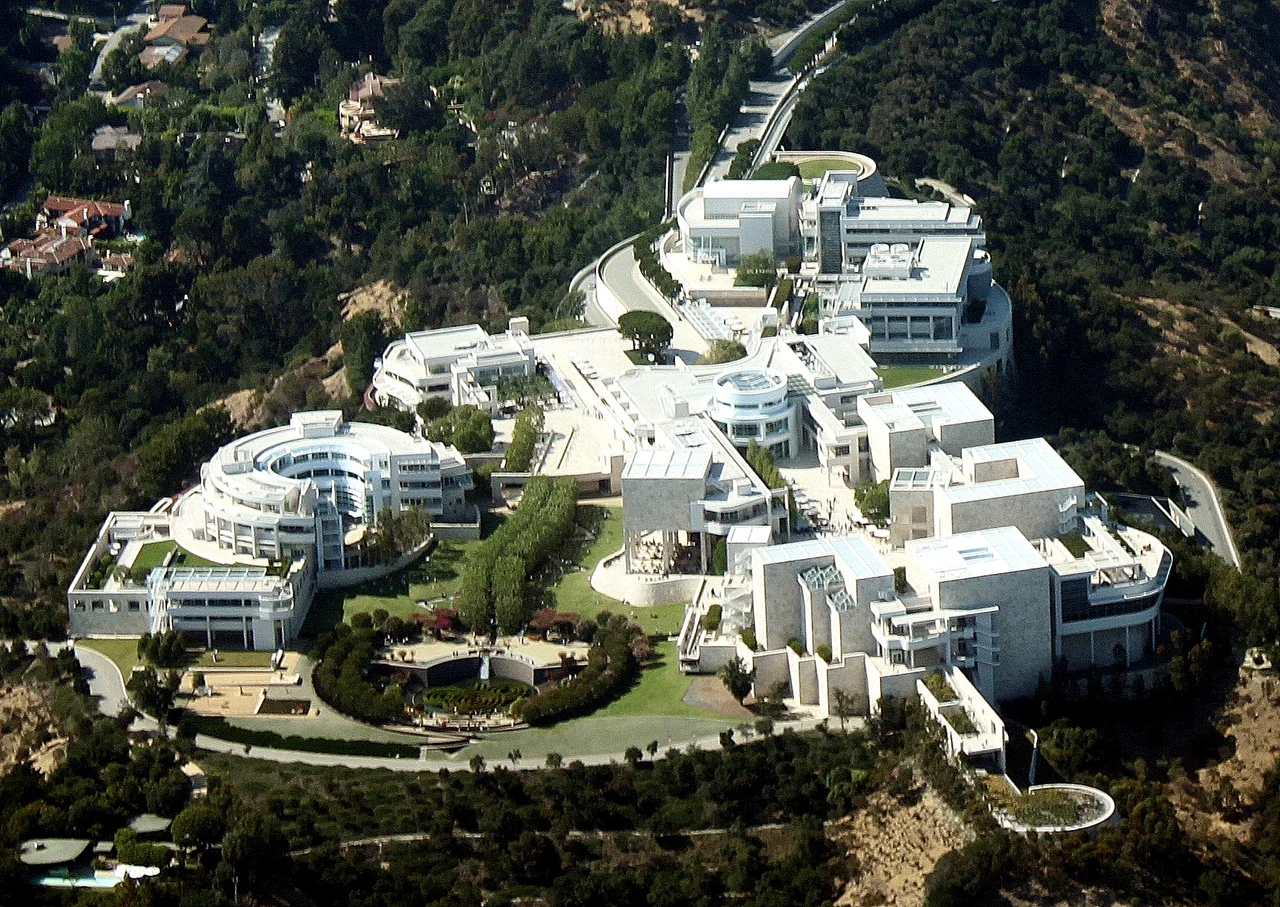
The Getty operates from two separate locations in Los Angeles. The Getty Center, perched on a 110-acre hilltop in the Brentwood neighborhood, opened in 1997 and houses the museum's primary collection of European paintings, drawings, sculpture, decorative arts, illuminated manuscripts, and photographs. The building complex was designed by Richard Meier and is itself a piece of architecture that draws visitors as much as the collection inside.
The original museum — the Getty Villa in Pacific Palisades — predates the Center by more than two decades. J. Paul Getty opened it in 1974, built as a re-creation of the Villa of the Papyri at Herculaneum, a Roman villa buried by the same eruption of Vesuvius that destroyed Pompeii. The Villa now focuses exclusively on antiquities from ancient Greece, Rome, and Etruria, following a renovation that reopened it in 2006.
The Richest Museum in the World
J. Paul Getty was, at the time of his death in 1976, the wealthiest person in the world. He left the bulk of his estate to the Getty Trust. In 1982, when that inheritance was finally settled, the trust received approximately $1.2 billion — making the Getty Museum instantaneously the richest art institution on earth.
That wealth created both opportunity and controversy. Through the 1970s and 1980s, the museum's antiquities curator, Jiří Frel, built the collection aggressively, acquiring objects of questionable provenance — including pieces that later turned out to be forgeries, most notoriously the Getty kouros, a marble statue of a youth that researchers ultimately concluded was a modern fabrication.
In 2005, the museum's subsequent antiquities curator, Marion True, was indicted by Italian authorities on charges related to trafficking in stolen antiquities. The case dragged on for years before Italian authorities allowed the statute of limitations to expire in 2010. The Getty returned numerous objects to Italy and Greece as part of settlement agreements, and the museum's acquisition policies were substantially reformed.
What the Collection Holds
The controversies over provenance have not diminished the quality of what the Getty Center displays. The paintings collection includes major works by Rembrandt, Van Gogh, Monet, Renoir, Cézanne, and Raphael. The illuminated manuscripts collection — substantially expanded by the 1983 acquisition of 144 manuscripts from the Ludwig Collection in Aachen, Germany — is among the finest in the Western Hemisphere.
The photographs collection traces the medium from its invention to the present day and has become one of the most important resources for the history of photography in the world. The decorative arts galleries contain furniture, tapestries, and objects from European royal households, displayed in period rooms that reconstruct the environments for which they were made.
Art on a Hill Above the City
Beyond the collection, the Getty Center is a destination in its own right. The gardens, designed by Robert Irwin in deliberate contrast to Meier's ordered architecture, descend into a central garden that changes with the seasons. The travertine terraces and open plazas frame views across the Los Angeles basin — west to Santa Monica and the Pacific, east to downtown, north to the Santa Monica Mountains.
Admission to the museum is free; only parking carries a charge, which is why the tram up the hill is not optional. The Getty draws more than 1.8 million visitors annually. Following the 2025 Southern California wildfires, the institution sold $500 million in bonds to fund protective measures for its collection — a reminder that in Los Angeles, even the most elevated institutions remain in dialogue with the landscape's volatility.
From the Air
The Getty Center is unmistakable from the air — a cluster of white travertine buildings on a prominent hilltop above the 405 freeway in Brentwood, at the western edge of the Santa Monica Mountains. The complex sits at approximately 900 feet elevation, giving it visibility from considerable distance. The Getty Villa is several miles to the west, near the coast in Pacific Palisades.
Nearby Stories
- Warner Grand Theatre 1.5 km away
- Silverado Fire 4.2 km away
- Nethercutt Collection 15 km away
- Fillmore and Western Railway 16 km away
- Amgen 19 km away
- Santa Barbara Island 36 km away
- San Bernardino Train Disaster 42 km away
- Calico: The Ghost Town Walter Knott Saved 111 km away