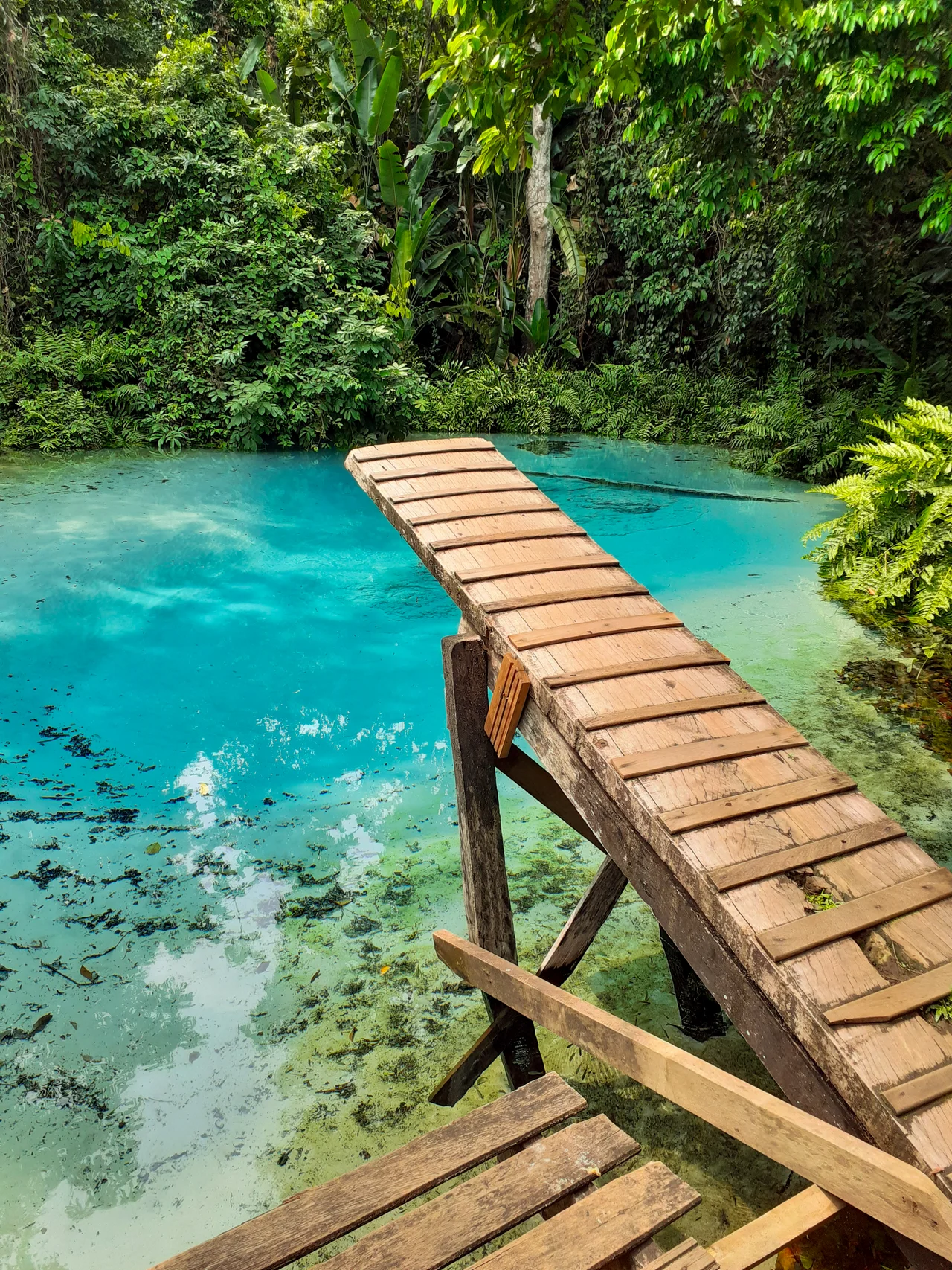

Jamanxim National Forest
In the 1970s, Brazil's military government encouraged nearly a thousand families to settle along the BR-163, a red-dirt highway being pushed through the Amazon to connect the soybean frontier of Mato Grosso with the Amazon River port of Santarém. Nobody gave those families land titles. Most are still waiting for them. In 2006, in an effort to slow one of the highest deforestation rates in the Amazon, the federal government drew a line around 1.3 million hectares of that same stretch and declared it the Jamanxim National Forest. The families were suddenly, by decree, inside a protected area. Everything that has happened since flows from that contradiction.
A Line Drawn Along a Highway
The BR-163 cuts through the heart of the state of Pará, slicing south to north through some of the most biodiverse forest in the world. Clearing tends to follow roads in the Amazon, and the deforestation statistics along this highway have been alarming for decades. The Jamanxim National Forest, created by decree on 13 February 2006, was one of a cluster of protected areas drawn along the highway to establish buffers, create law enforcement mandates, and, in theory, stop the frontier from advancing unchecked. The forest's 1,301,683 hectares are roughly 85 percent open rainforest and 14 percent dense rainforest. It lies entirely within the municipality of Novo Progresso - a boomtown whose economy has long depended on the very activities the national forest was supposed to restrain: logging, cattle ranching, and small-scale gold mining.
Settlers Who Were Invited
The central legal and moral knot here is that the people now inside the forest did not invade it. The Brazilian government, back during the dictatorship, had actively recruited them to settle along the highway as part of a national development project. Land titles were promised but never issued. When the national forest was created three decades later, those thousand or so families found their homes, pineapple plantations, and pastures suddenly subject to environmental regulations they had not expected and could not easily meet. In August 2009, Senator Flexa Ribeiro said a draft agreement between the federal conservation agency ICMBio and the inhabitants would waive fines for deforestation done before November 2007. Settler representatives challenged the legality of the national forest's creation itself, arguing that Brazilian law required local public consultation that had not meaningfully occurred.
The Pace of Loss
Whatever the legal merits, the forest kept falling. In 2009 alone, Jamanxim lost 60 square kilometers of coverage, with 18.8 square kilometers cleared in the single month of June. By that year, about 12 percent of the national forest had been cleared - and roughly half of that cleared land had been abandoned rather than converted to productive use, suggesting speculative clearing driven by the hope of land titles. IBAMA, the federal environmental agency, arranged with the National Supply Company Conab to remove 6,000 head of cattle from inside the forest. Another 15,000 were slated for removal. Enforcement actions seized chainsaws, fuel, tractors, and weapons. Most of the people ordered off the land, however, simply stayed. Where would they go?
Numbers That Did Not Agree
Negotiations dragged on for years. ICMBio proposed carving out 250,000 hectares inside the national forest for the settlers - effectively ceding about a fifth of the protected area to permanent agricultural use. The farmers' associations wanted 415,000 hectares. Neither side would meet in the middle. Proposals to shrink the forest further came from local business interests and state politicians. The October 2014 general election scrambled the political landscape, and negotiations collapsed early in 2015 without resolution. In July of that year, ICMBio reported that it had seized 850 recently felled logs, detected by DETER, the Amazon satellite monitoring system operated by Brazil's National Institute for Space Research. The chainsaws had not, in other words, stopped working.
In a Larger Protected Block
Jamanxim is not alone. The region around the BR-163 now contains twelve sustainable-use conservation areas and six strictly protected reserves. The protected areas include the Amazônia, Jamanxim, Rio Novo, and Serra do Pardo national parks, the Nascentes da Serra do Cachimbo Biological Reserve, and the Terra do Meio Ecological Station - together covering 6.67 million hectares. Add the national forests and environmental protection areas - the Tapajós APA, the Altamira, Amaná, Trairão, Itaituba I, Itaituba II, and Tapajós national forests, alongside Jamanxim itself - and the sustainable-use zone covers another 7.56 million hectares. On satellite maps, this mosaic shows as a large continuous green block, holding out against the cleared orange of the expanding agricultural frontier to its south. Whether that green will still be there in another twenty years depends on politics as much as it does on trees.
From the Air
Located at 7.54°S, 55.75°W in central Pará, Brazil, along the BR-163 highway corridor. Best viewed from 8,000-12,000 feet AGL during dry season (May-September). From altitude the contrast between the largely intact forest block and the cleared pastures to the south along the highway is striking. The nearest significant airports are Itaituba (SBIH), approximately 300 km northwest, and Novo Progresso's airstrip. Novo Progresso is the main town within the concession area.
Nearby Stories
- Rio Novo National Park 52 km away
- Tapajos Environmental Protection Area 93 km away
- Altamira National Forest 132 km away
- Crepori National Forest 136 km away
- Cachoeira dos Patos Dam 145 km away
- Nascentes da Serra do Cachimbo Biological Reserve 153 km away
- Tapajós–Xingu moist forests 193 km away
- Cachimbo Airport 196 km away