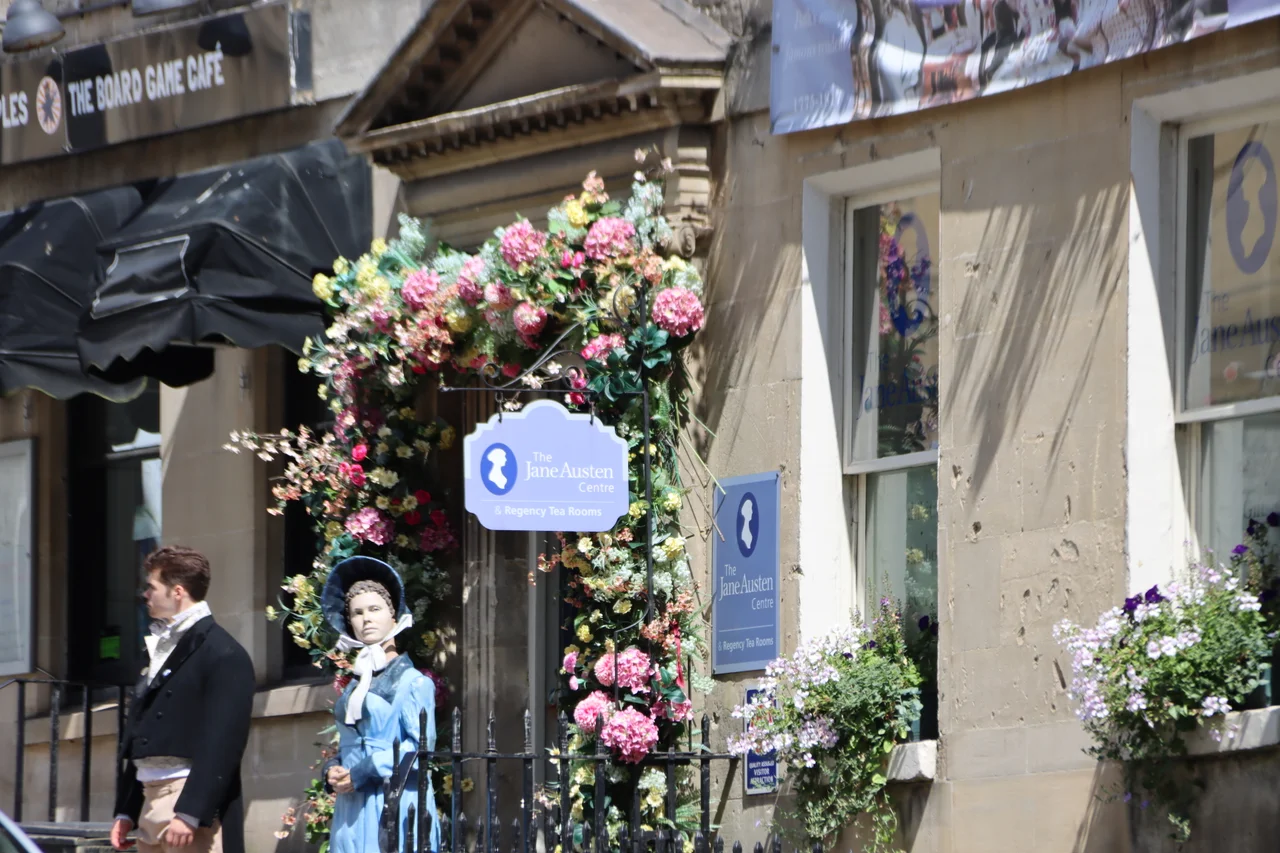

Jane Austen Centre
Jane Austen did not love Bath. She lived in the city for five years - from 1801 to 1806 - and the surviving letters suggest she found it cramped, overheated, socially exhausting and a little sad. Her father died there. She did not finish a novel in residence. And yet two of her completed books, Northanger Abbey and Persuasion, are set partly in Bath, and they capture the city's textures with such precision that visitors have been retracing her characters' footsteps for two centuries. The Jane Austen Centre, at 40 Gay Street, occupies a Georgian townhouse just down the road from one of Austen's actual addresses, and it has built itself around a paradox: Austen's most ambivalent residence has become her most enthusiastic shrine.
The Townhouse on Gay Street
Gay Street climbs north from Queen Square up toward the Circus, one of the canonical sequences of Georgian Bath laid out by John Wood the Elder and his son. The block at numbers 31 through 40 is Grade II listed - dressed Bath stone, regular sash windows, the disciplined classicism that Austen's characters knew as the visual common sense of their world. Number 25 Gay Street is where Jane Austen herself lived for some months in 1805 with her widowed mother and sister Cassandra, after her father's death. The Centre at number 40 is a few doors up the hill from her actual lodging. Inside, the permanent exhibition tells the story of Austen's Bath years - the lodgings, the social rituals, the Assembly Rooms, the visits to the Pump Room - and how the city worked its way into her fiction even as she chafed against living there.
The Forensic Waxwork
No one knows what Jane Austen looked like. The only verifiable image is a small watercolour by her sister Cassandra, which experts have called "a poor attempt" and Austen's own niece described as "hideously unlike" her aunt. The Centre decided to do something about this. In 2002, director David Baldock commissioned the forensic artist Melissa Dring - who had earlier reconstructed Vivaldi's likeness from eyewitness descriptions for a film company - to produce a new portrait from the surviving contemporary accounts. The painting was unveiled in December 2002. Nine years later, in 2011, the Centre took the process further: a three-dimensional life-size wax figure of Austen, based on Dring's portrait. The sculptor Mark Richards worked closely with Dring, hair and colour artist Nell Clarke, and costume designer Andrea Galer, who dressed the completed figure in authentic Regency clothes. It took three years. The waxwork was unveiled to the world's press on 9 July 2014. Visitors are sometimes startled by its height: five foot eight, which is tall by 21st century standards too, but contemporary accounts described Austen as "tall and slender," so the figure is probably right.
The Festival
Since 2001 the Centre has hosted the annual Jane Austen Festival, the largest and longest-running Austen festival in the world. It runs for around ten days in September. The opening event is a Grand Regency Costumed Promenade through the centre of Bath, in which hundreds of participants - several Guinness World Records have been set for the largest gathering in Regency dress - walk in formation through the Georgian streets. There are balls, plays, country dancing workshops, lectures, masquerades and tea parties. The Centre's own Regency Tea Rooms operate year-round, serving cream teas and Regency-themed menus to visitors who arrive in costume or in normal clothes and are equally welcome either way. The festival turns Bath, briefly, into the city Austen's characters knew - or at least into the costume drama version of it that two centuries of readers have built in their heads.
What Bath Did for Her
Whatever Austen thought of Bath in her own life, she gave it some of her most precisely observed pages. The cramped lodgings, the obligatory rounds of visits, the Pump Room with its dim mirrors and its anxious mothers, the Assembly Rooms with their tea, dancing and matchmaking - all of it sharpened her ear for the small social violence of polite society. Anne Elliot's walk through Bath's wet streets at the end of Persuasion, the moment of recognition between her and Captain Wentworth, takes place on real streets you can still walk. Catherine Morland's bewildered first encounters with Bath's social machinery in Northanger Abbey were almost certainly drawn from Austen's own. The Centre's exhibition argues, gently and convincingly, that Bath was the city Austen needed - the one she could not quite love, and could not quite stop writing about.
From the Air
The Jane Austen Centre is at 51.384 N, 2.36316 W on Gay Street, in the Georgian heart of Bath about a quarter-mile north-northwest of Bath Abbey. From the air, look for the sequence of John Wood the Elder's set pieces: Queen Square at the base, Gay Street climbing north, and the Circus at the top with the Royal Crescent a short distance to the west. Bristol Airport (EGGD) is 14 nm west; Kemble (EGBP) 19 nm north-northeast. Recommended viewing altitude 2,000-3,000 feet for the architectural set pieces of central Bath.
Nearby Stories
- Marlborough Castle 1.4 km away
- Clevedon Pier 4.6 km away
- Stourhead 5.6 km away
- Siege of Bridgwater (1645) 8.4 km away
- Raglan Castle 10 km away
- Berkeley Castle 12 km away
- Mottisfont Abbey 20 km away
- Blenheim Palace 33 km away