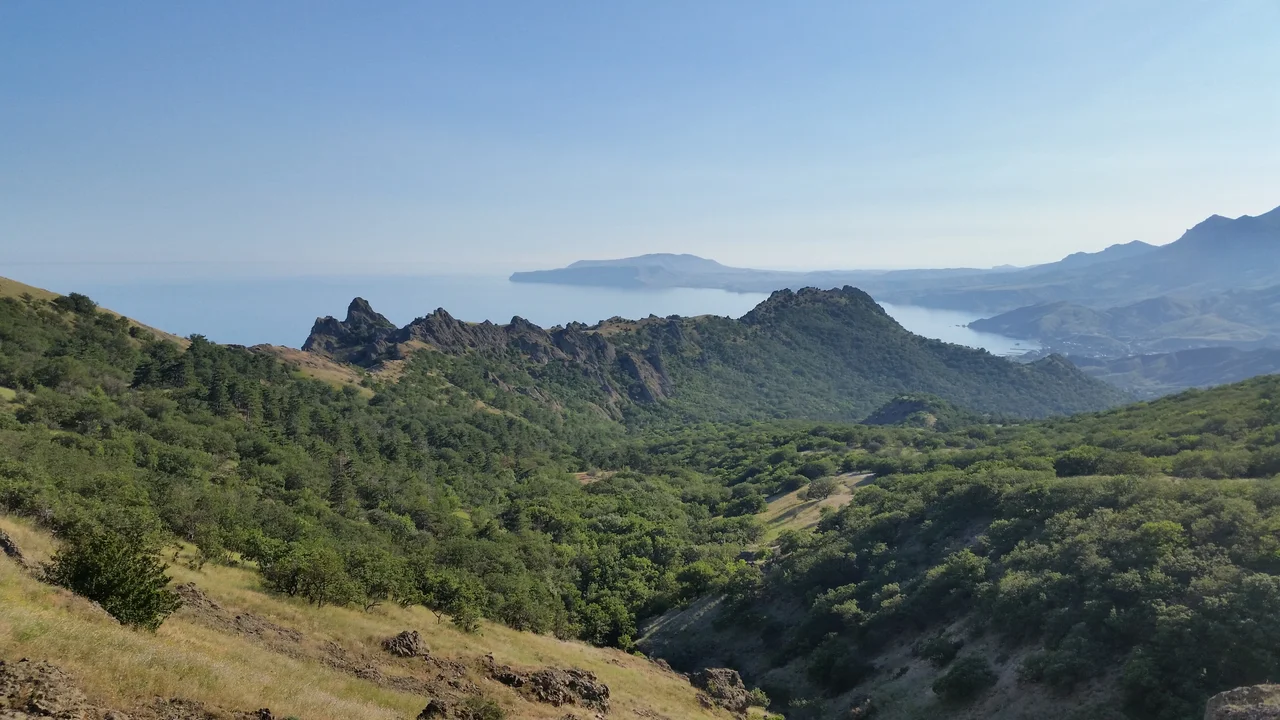

Karadag Nature Reserve
Fold together a dead volcano, a stretch of forested mountain, eight kilometers of cliff-lined coast, and a slice of the Black Sea itself, and you begin to understand why so much life has gathered at Karadag. Somewhere in these few thousand hectares live more than half of all the plant and animal species found on the entire Crimean peninsula, and a third of the species that exist nowhere else on Earth. Scientists have been counting them for over a century, and the tally keeps climbing: 1,154 kinds of vascular plant, 236 birds, 115 fish, 35 mammals. On the coast southwest of Feodosia, on the eastern tip of the Crimean Mountains, this is one of the richest small corners of nature anywhere on the Black Sea.
Where the Mountain Meets the Sea
Karadag's biodiversity is a gift of its geography. The reserve straddles both mountain and coast, and that variety of habitat, squeezed into a small area, multiplies the number of niches life can occupy. The volcanic massif of Kara Dag, born in the Jurassic, forms the spine of the reserve, its southern shores sloping down to a shoreline of bays, beaches, and grottoes with cliffs rising as high as 120 meters. More than 800 hectares of the protected area lie offshore, beneath the water, and the marine sector together with the pebble-and-boulder beach and the coastal cliffs is recognized as a Ramsar wetland of international importance. The coastal towns of Koktebel and Kurortne bracket the reserve to the north and south, marking the edges of a landscape that changes from mountain forest to open sea in the space of a single hillside.
Forest, Steppe, and the Cliff-Nesting Birds
Roughly 40 percent of Karadag is forested, a mix of hornbeam, ash, pine, and oak clinging to the slopes, while much of the rest is feather-grass steppe in eight distinct varieties. Into this patchwork the seasons arrive with sharp contrast. February hovers near freezing, but July averages nearly 24 degrees, and the reserve basks in some 2,200 to 2,300 hours of sunshine a year despite receiving little rain. The cliffs are especially precious to birds that hunt the sea. Among them nests a significant colony of European shag, a slim, dark cormorant that dives for fish and raises its young on the rock ledges above the waves. To watch them wheel out over the water and return to the cliffs is to see the mountain and the sea working as a single living system, each feeding the other.
A Century of Study
Karadag has been a place of learning as much as a place of refuge. For roughly a hundred years the reserve has been the subject of continuous scientific research, its cliffs and coves visited by generation after generation of naturalists drawn by that extraordinary concentration of life. Formal protection came in 1979, and today the reserve is administered by the Russian Academy of Sciences, whose staff continue the tradition of study while running educational programs and publications for visitors and students alike. It is a rare thing for a landscape to be both wild spectacle and open-air laboratory, but Karadag manages both. The traveler who comes for the dramatic coastline discovers, on closer look, that every cliff and grassy slope is also a page in one of the longest-running natural histories on the Black Sea.
From the Air
Karadag Nature Reserve centers on 44.94°N, 35.23°E, 36 km southwest of Feodosia on Crimea's southeast coast. From about 5,000 feet the dark volcanic massif, the wooded slopes, and the 8-kilometer cliff-lined shoreline between Koktebel and Kurortne stand out against the sea. Nearest airport is Simferopol (UKFF), roughly 65 nautical miles west-northwest.
Nearby Stories
- Battle of the Kerch Peninsula 13 km away
- Arabat Fortress 18 km away
- Bilohirsk 23 km away
- Opuk Nature Reserve 29 km away
- Partenit 38 km away
- Ayu-Dag 80 km away
- Syvash 107 km away
- 1976 Anapa Mid-Air Collision 115 km away