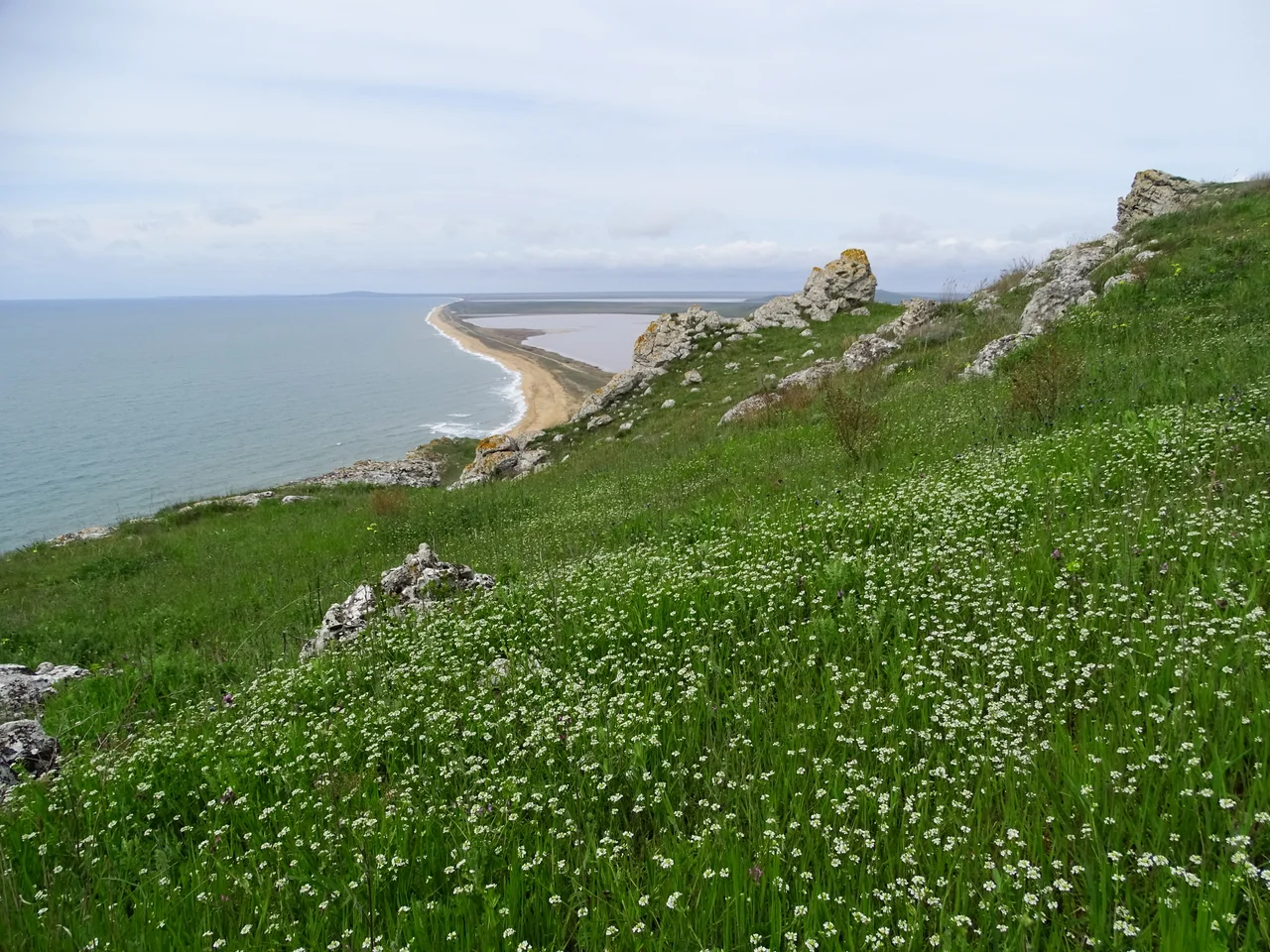

Opuk Nature Reserve
The plains of the Kerch Peninsula run flat and open for kilometer after kilometer, until, near the southern coast, the land suddenly rears up. Opuk Mountain breaks the horizon like a great stone table set down by giants, its flat summit reaching 185 meters, the highest point on the whole peninsula. It is not tall by the standards of real mountains, but here, where nothing else rises, it commands everything. Around this abrupt limestone massif spreads the Opuk Nature Reserve, a strict sanctuary on the Black Sea coast some thirty kilometers southwest of the city of Kerch, where a table mountain, a scarlet salt lake, and offshore islands of stone shelter an astonishing concentration of life.
A Table of Ancient Reef
Opuk Mountain is built from reef limestone, the compressed remains of an ancient sea, and the same stone shapes the karst landscape and the small islands scattered offshore. This geology is what sets the reserve apart from the ordinary steppe surrounding it. Where the plains are soft and cultivable, the mountain and its coast are hard, broken, and wild, riddled with the caves and hollows that limestone forms as water works through it over ages. To the west lie two salt lakes: shallow Koyashskoye, famous for turning pink, and the larger Uzunlarske. Along the shore run spits of sand and coquina, ridges made of crushed shell. The climate is dry and mild, ranging from around two degrees in January to twenty-three in July, with only modest rain, a landscape shaped as much by drought and salt as by the sea.
Two Hundred Kinds of Wings
The reserve is, above all, a place for birds. More than two hundred species have been recorded here, drawn by the meeting of mountain, steppe, wetland, and sea within a single compact area. Recognized as a Ramsar Wetland of International Importance, Opuk belongs to a global network of wetlands deemed essential to the planet's water birds and biodiversity. On the higher ground grow the plants of coastal steppe, while the sandy spits support Crambe and other species found nowhere but the Crimean Peninsula. It is this layering of habitats, each stacked against the next, that packs so much variety into so small a space, and that makes the reserve worth the strict protection it receives.
A Place Kept Apart
Opuk is a strict nature reserve, which means its first purpose is not recreation but preservation and scientific study. Mass tourism is prohibited here. No one builds facilities, hunts, or fishes within its boundaries. The land is deliberately held apart from the pressures that reshape so much of the coast, allowed to follow its own rhythms of migration, bloom, and season. Access is not entirely closed, though: three ecological trails wind through the reserve, and along them the staff themselves lead guided educational tours, offering visitors a carefully controlled glimpse of a place that owes its richness precisely to how little humanity is permitted to touch it.
Where the Rosy Starlings Come
One bird makes Opuk truly singular. This is the only place in Ukraine where rosy starlings nest, a species with pink-and-black plumage that gathers in noisy, wheeling flocks and chooses only the most particular of homes. That such a bird has settled here, and nowhere else in the country, says everything about how special this pocket of coast is. The mountain's cliffs and hollows, its offshore stone islets, its salt lakes and shell-sand spits, together create a mosaic of habitats that a rosy starling, or a rare orchid, or a migrating shorebird, cannot easily find elsewhere. Layered onto that natural richness is a deep human past: the ruins of ancient Greek settlements and later fortresses lie on and around Opuk mountain, so that the reserve protects not only living species but the traces of the people who once sheltered beneath this same limestone height.
From the Air
Opuk Nature Reserve centers on Opuk Mountain at 45.03°N, 36.19°E, on the southern coast of the Kerch Peninsula about 30 km southwest of Kerch. From 4,000 feet the flat-topped mountain is a striking landmark rising from otherwise level terrain, with the pink Koyashskoye Salt Lake immediately to the west and stone islets offshore. Nearest major airfield is Simferopol (UKFF), roughly 175 km to the west.
Nearby Stories
- Porthmion 4.6 km away
- Feodosiya 11 km away
- Taman 19 km away
- Crimean Nuclear Power Station 19 km away
- Soviet Destroyer Smyshlyony 19 km away
- Aeroflot Flight 6515 28 km away
- Valley of Ghosts 87 km away
- 1976 Anapa Mid-Air Collision 105 km away