.jpg)
Porthmion
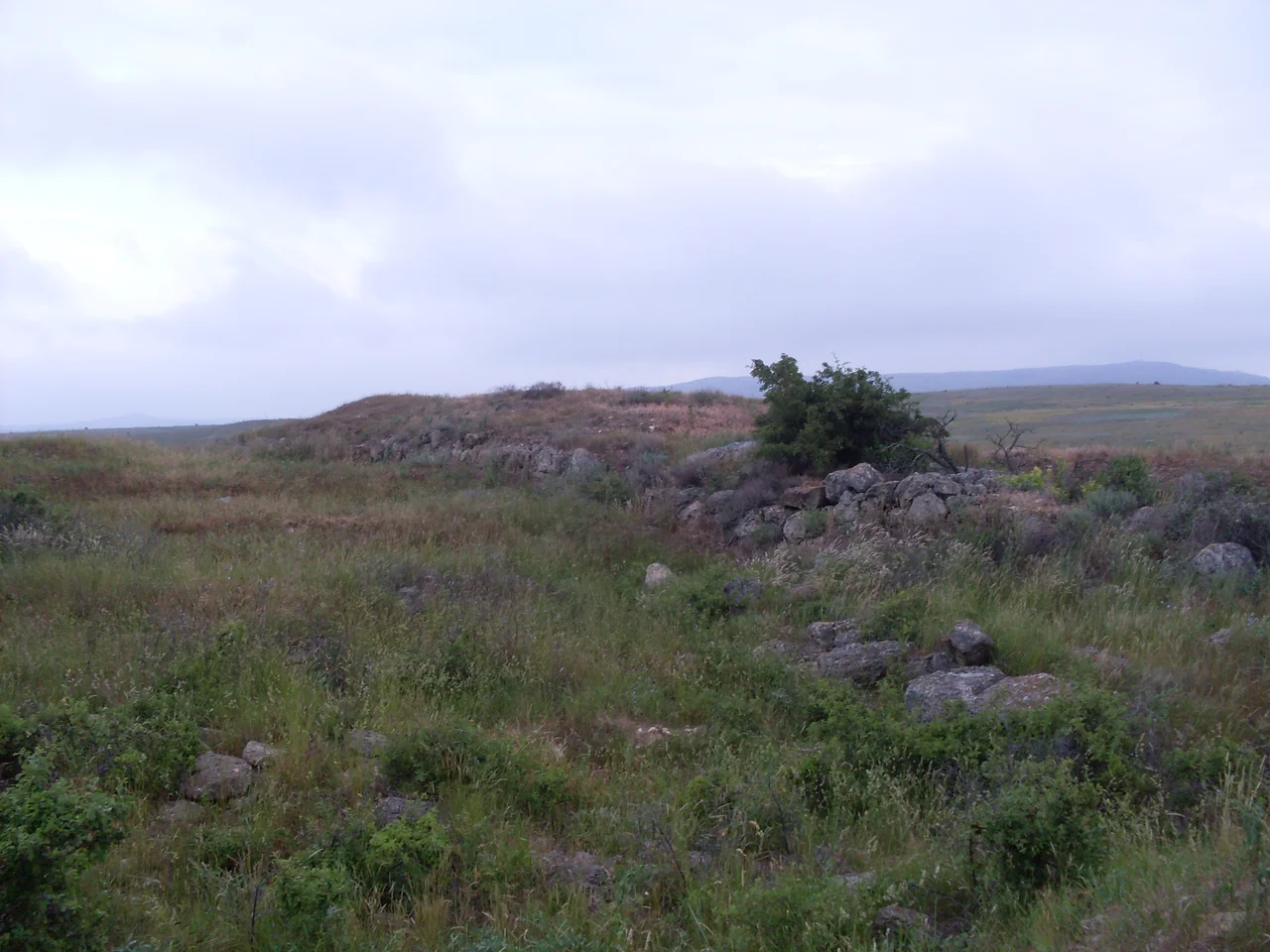
The town's name told you exactly what it was for. Porthmion comes from the Greek word porthmos, meaning "crossing," and this small fortified settlement on the Kerch Peninsula existed for one reason: to guard a ferry over the strait that separates Crimea from the Kuban. That crossing was one of antiquity's vital links, the point where the Northern Black Sea world stitched itself together across the water. Founded by Greeks at the end of the sixth century BCE on an elongated rocky plateau, Porthmion was never large, barely half a hectare at its height, but for four centuries it watched over the passage until, one quiet day in the first century BCE, its people simply walked away.
Ash and a Skull in the Wall
Some of the earliest defensive walls ever built on the Bosporus rose at Porthmion, thrown up almost as soon as the town was founded, mudbrick above a stone base at the most vulnerable approach. Then came catastrophe. Around the turn of the fifth century BCE, fire swept the entire settlement; excavators find the burnt layer everywhere, up to three centimeters thick, the finds within it scorched by intense heat. Just outside the eastern wall lay small fragments of a human skull. Among the wreckage archaeologists recovered a dagger and painted oil-flasks decorated with a Scythian gripping the reins of two horses, a haunting glimpse of the mounted nomads whose world pressed against these Greek outposts. The destruction was no isolated tragedy; other Bosporan towns burned in the same era, evidence of just how dangerous this frontier could be.
A Fortress Drawn on a Single Plan
When Porthmion rose again in the second half of the third century BCE, it was reborn as something rare: a fortress-city laid out all at once, walls and streets designed together as a single unit. Thick limestone ramparts enclosed a tidy grid of eight rectangular blocks, cut by three streets running east to west and three narrow lanes crossing them, the central lane splitting the town cleanly in two. In the northwestern corner stood a massive rectangular tower, its floor paved with stone slabs, and buried within it archaeologists found the remains of a dog, along with a scatter of small copper coins minted across the strait at Pantikapaion. The whole design betrays its purpose. This was a garrison town, built and manned by military settlers to hold the approaches to the European lands of the Bosporan Kingdom.
The Texture of an Ordinary Life
For all its military function, Porthmion's ruins are most moving in their smallness, the residue of ordinary days. In the houses excavators found hearths ringed with clay-coated stones, a stove built from two dressed limestone blocks, and a solid stone base that once held a wooden kitchen table. There was a portable stone winepress for making household wine, with amphora fragments used to drain the grape must, and in one utility room a stall for cattle, kept indoors against the cold. Loom weights and a small red-clay perfume flask speak to the women who lived and worked here. Then, around the middle of the first century BCE, it all ended, not in fire this time but in silence. The garrison withdrew and the town was abandoned, its defenders pulled back to newer fortresses deeper inland, and Porthmion was left to the wind and the crossing it had guarded so long.
From the Air
Porthmion lies at 45.37°N, 36.62°E on the northeastern Kerch Peninsula, on a low plateau near the coast of the Kerch Strait between the villages of Zhukovka and Opasnoye, below Mount Khroni. From the air, orient on the strait and the nearby northern tip of Crimea at Cape Fonar; the site is a low ruin best seen from lower altitudes. Nearest airport is Kerch's airfield, with Anapa-Vityazevo (URKA) across the strait.
Nearby Stories
- Koyashskoye Salt Lake 15 km away
- Temryuk 21 km away
- Akra, Crimea 25 km away
- Kerch Peninsula 27 km away
- Abrau Peninsula 47 km away
- Byriuchyi Island 98 km away
- Henichesk 159 km away
- Battle of the Kalka River 173 km away