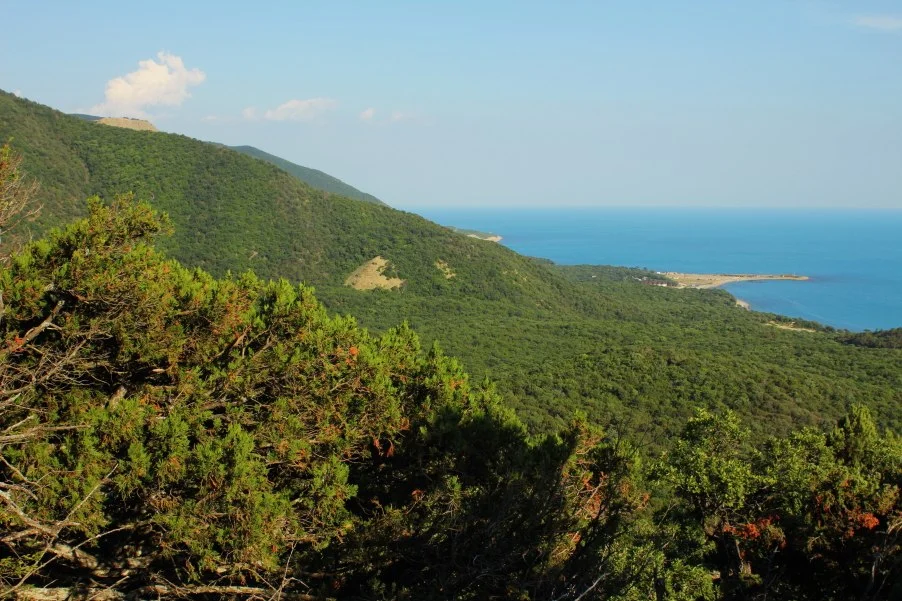

Abrau Peninsula
There is exactly one place in all of Russia where you can walk beneath wild pistachio trees and evergreen junipers, breathe air scented like a Greek hillside, and feel the dry heat of a Mediterranean summer. It is not in some distant southern republic. It is here, on the Abrau Peninsula - a stubby, rocky spur of the Greater Caucasus that shoulders out into the Black Sea between the port of Novorossiysk and the beaches of Anapa. Cross onto it and Russia's familiar birch-and-snow imagination falls away, replaced by something older and southern, a relic ecosystem clinging to the coast against every expectation.
A Slice of the South
The Abrau Peninsula is the only place in Russia that harbours genuine Mediterranean vegetation - and that single fact makes it extraordinary. Its climate is sub-Mediterranean: cool, rainy winters that never settle into stable snow cover, and hot, dry summers. The numbers tell the story of a place that leans toward the sea rather than the steppe - roughly 500 millimeters of rain a year, a July averaging a warm 23.7 degrees Celsius, a February hovering just above freezing at 2.7. This is the climate of the northern Mediterranean rim, somehow transplanted to the edge of southern Russia, and the plant life responds accordingly, filling the slopes with species you would sooner expect above the Aegean than the Black Sea.
Three Belts up the Mountain
Climb from shore to summit and the peninsula reveals itself in layers. Along the coastal slopes grow dry, sun-loving forests and shrublands - wild pistachio and three species of juniper, downy oak and oriental hornbeam, the classic scrub of a warm, water-thrifty land. Higher up, in the piedmont and low mountains, the vegetation shifts into a blend where oaks and junipers still hold but moisture-loving trees begin to intrude. Higher still, the low mountains give way to cool deciduous forests: oak and hornbeam joined by lime, maple, ash, and the smooth grey trunks of oriental beech. In a short vertical distance the land travels from something like Greece to something like central Europe, a compressed botanical journey packed onto one modest headland.
The Reserve at Utrish
Much of this rare landscape is protected within the Utrish State Nature Reserve, a sanctuary set aside to guard the peninsula's improbable communities of plants and the creatures that depend on them. The reserve preserves not just the showy trees but the whole living fabric of the place - down to the centipedes and millipedes beneath the leaf litter, which scientists have painstakingly catalogued as part of documenting one of the country's most singular ecosystems. To protect a relic is to bet that the past is worth keeping, and Utrish is that bet made real: a fenced-off promise that this last Mediterranean fragment on Russian soil will not be paved, plowed, or built into oblivion.
Walking a Rare Coast
For a visitor, the Abrau Peninsula offers the quiet thrill of the anomaly. The Black Sea glitters below rocky, aromatic slopes; the light is hard and bright the way it is in the south; and every plant underfoot is, in this latitude, a small botanical miracle. It sits within easy reach of two very different neighbors - the working harbor of Novorossiysk to the southeast and the family resorts of Anapa to the northwest - yet feels apart from both, a wild green parenthesis between them. Few places let you stand in one country and feel, unmistakably, the climate of another. Fewer still guard that feeling as carefully as this narrow, sunstruck spur of the Caucasus.
From the Air
The Abrau Peninsula juts into the Black Sea near 44.79°N, 37.53°E, between Novorossiysk and Anapa. From altitude the rugged, wooded headland and the deeply indented Utrish coastline stand out against the sea, with Lake Abrau tucked inland to the southeast. Nearest airports are Anapa (Vityazevo) Airport (ICAO URKA) just to the north and Gelendzhik (URKG) down the coast.
Nearby Stories
- Soviet Destroyer Smyshlyony 13 km away
- Taman 29 km away
- Taman Peninsula 29 km away
- Soviet Hospital Ship Armenia 211 km away
- Battle of the Tanais River 251 km away
- Livadia Palace 262 km away
- Beriev 282 km away
- Abkhazia 292 km away