
Taman
"Taman is the nastiest little hole of all the seaports of Russia. I was almost starved there, and into the bargain they tried to drown me." So begins one of the strangest chapters in nineteenth-century Russian literature, and the town Mikhail Lermontov describes is a real place: a low, wind-scoured Cossack village on the coast of Taman Bay, an inlet off the Kerch Strait. Lermontov set part of his novel A Hero of Our Time here, and the memorial house that honors him is now one of the village's proudest sights. But the writer's brief, uneasy visit is only the thinnest top layer of a settlement that has been inhabited, abandoned, and rebuilt for nearly three thousand years.
Cities Beneath the Village
Dig anywhere in Taman and you strike history. The modern stanitsa sits directly atop the ancient Greek colony of Hermonassa, founded in the sixth century BCE, and above the medieval trading town of Tmutarakan, once a far-flung outpost of Kievan Rus. Layer upon layer of civilization is stacked in the soil here, so much of it that the village supports an archaeological museum built in imitation of a Roman domus. From the end of the fifteenth century until 1783 this was Ottoman ground, guarded by a Turkish fortress; before that annexation it was administered from Kaffa across the strait. A fifteenth-century Turkish condensate pump still survives among the ruins, a small industrial relic from an age of empires that has otherwise dissolved into the earth.
The Cossacks Come Ashore
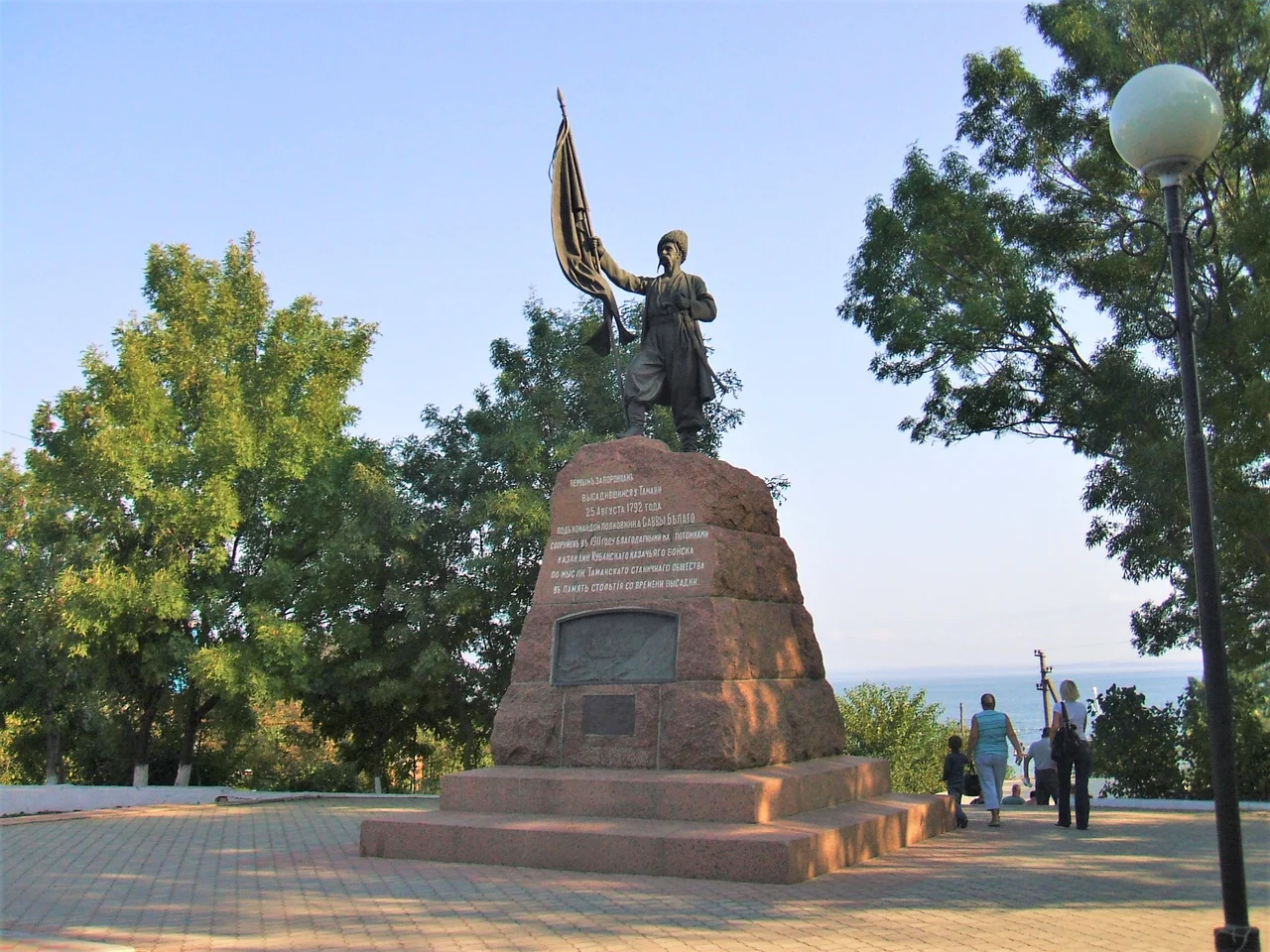
The Taman that exists today was born on August 25, 1792, when Zaporozhian Cossacks under Anton Golovaty landed here to establish the first garrison of the Black Sea Cossack Host. Golovaty made the settlement his residence, and the following year the settlers raised an Orthodox church that still stands as the oldest Russian Orthodox church in the Kuban region. For a while Taman held the official title of town, oddly enough without any government of its own, ruled instead from the neighboring stanitsa of Akhtanizovskaya. In 1849 the arrangement was tidied up and Taman became a proper stanitsa with its own local government. The Estonian sculptor Amandus Adamson later cast a bronze monument to those first Cossack settlers, unveiled in 1911, and it remains the symbol of the village and of Kuban Cossackdom, whose history fills a museum of its own.
War and the Working Coast
The twentieth century brought Taman its hardest years. From September 1942 the village lay under German occupation, and it was not fully freed until the invading forces were driven off the entire Taman Peninsula in October 1943, in some of the bitterest fighting of the war on the Black Sea coast. Peace returned the village to its quieter identity of vineyards and fishermen, and Taman still keeps a small wine-making museum that celebrates the grapes this sunny peninsula has always grown well. In recent decades the coastline has drawn heavy industry, with major port development pushed several kilometers south near the tiny village of Volna, where the Port of Taman handles grain and coal. Yet the old stanitsa itself endures much as travelers have always found it, a modest place living quietly on top of the ruins of empires.
From the Air
Taman sits at 45.22°N, 36.72°E on the Taman Peninsula, on the coast of Taman Bay just inside the mouth of the Kerch Strait. From the air, orient on the strait dividing the peninsula from Crimea and the broad enclosed waters of Taman Bay; the industrial Port of Taman lies a few kilometers south near Volna. Nearest airports are Anapa-Vityazevo (URKA) to the southeast and Krasnodar (URKK) inland.
Nearby Stories
- Temryuk 9.2 km away
- Kerch Peninsula 17 km away
- Battle of Kerch Strait (1790) 23 km away
- Abrau Peninsula 31 km away
- Koktebel 77 km away
- Arabat Spit 96 km away
- Byriuchyi Island 143 km away
- Battle of the Kalka River 192 km away