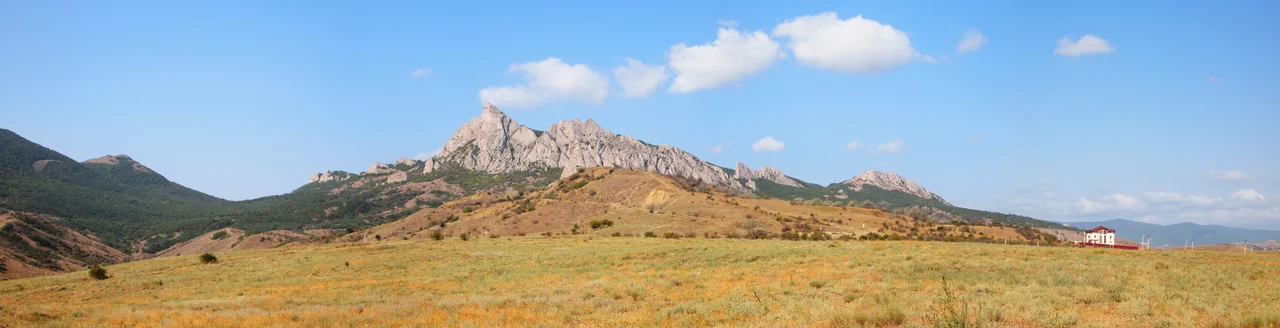

Koktebel
For a few decades in the early twentieth century, some of the finest poets in the Russian language kept finding their way to this small bay on the Crimean coast. They came to see one man. Maximilian Voloshin, poet and painter, made Koktebel his home and turned his house above the sea into a gathering place, and through its doors passed Marina Tsvetaeva, Osip Mandelstam, and Andrei Bely, who suffered the stroke here that would kill him within the year. They swam in the same bay you can still swim in, walked the same hills, and wrote remarkable poems with the black bulk of Kara Dag rising at the edge of every view. Koktebel is a resort town, one of the most popular in Crimea, but its deepest fame is literary, and the sea air here still carries the memory of the words made in it.
The Poet's House
Voloshin chose well. Koktebel sits roughly halfway along the coast between Feodosia and Sudak, a place of good light, warm water, and dramatic scenery, and the poet made his residence into something like an open salon for the Russian literary world. The guest list reads like an anthology. Tsvetaeva, one of the towering voices of Russian poetry, spent formative time here. Mandelstam, whose verse would later cost him his life in the Soviet camps, wrote in this bay. Bely, the Symbolist novelist and poet, suffered the stroke here in 1933 that ended his life in Moscow a few months later. What drew them was partly Voloshin himself, generous and magnetic, and partly the place, a landscape stark enough to sharpen a writer's eye. To walk the town today is to move through a setting that shaped some of the most enduring literature of its era.
Dolphins in the Bay, an Arch in the Sea
Beyond its literary ghosts, Koktebel offers the plain pleasures of a good coast. Climb into the eastern hills above the town and the whole bay opens beneath you, and often, out in the middle of the water, schools of dolphins break the surface, leaping and playing where the light catches the swell. From the harbor, boat trips run out around the neighboring nature reserve to see the coast's most famous feature, a natural stone arch reaching out into the sea several hundred meters offshore, carved from the volcanic rock of Kara Dag. There are wide beaches for swimming, horseback rides into the protected hills, and a long tradition of naturist beaches that has drawn visitors from Russia and Eastern Europe for years. The town wears its leisure comfortably, an easy counterpoint to the brooding mountain at its back.
Jazz Beneath the Volcano
Once each September, Koktebel trades poetry for music. The town hosts a jazz festival that fills its warm end-of-summer nights with sound, drawing crowds to a place better known for its silence and its scenery. It fits the character of Koktebel, which has always been a town that attracts artists and the people who love them. Accommodation here runs a little dearer than in many Crimean towns, and a little nicer for it, though a walk east down the main road toward the big landmark hotel turns up cheaper rooms that are clean and pleasant enough. Whether you come for the music, the beaches, the dolphins, or simply to stand where Voloshin once stood and look out at the same sea and the same black mountain, Koktebel rewards the visit. Few small towns carry so much culture so lightly.
From the Air
Koktebel lies at 44.96°N, 35.24°E on Crimea's southeastern Black Sea coast, midway between Feodosia and Sudak. From about 5,000 feet the crescent bay and the dark massif of Kara Dag immediately to the south are the defining landmarks, with the town's beaches lining the shore. Nearest airport is Simferopol (UKFF), roughly 65 nautical miles west-northwest.
Nearby Stories
- Battle of the Kerch Peninsula 13 km away
- Arabat Fortress 18 km away
- Bilohirsk 23 km away
- Opuk Nature Reserve 29 km away
- Partenit 38 km away
- Ayu-Dag 80 km away
- Syvash 107 km away
- 1976 Anapa Mid-Air Collision 115 km away