
Soviet Hospital Ship Armenia
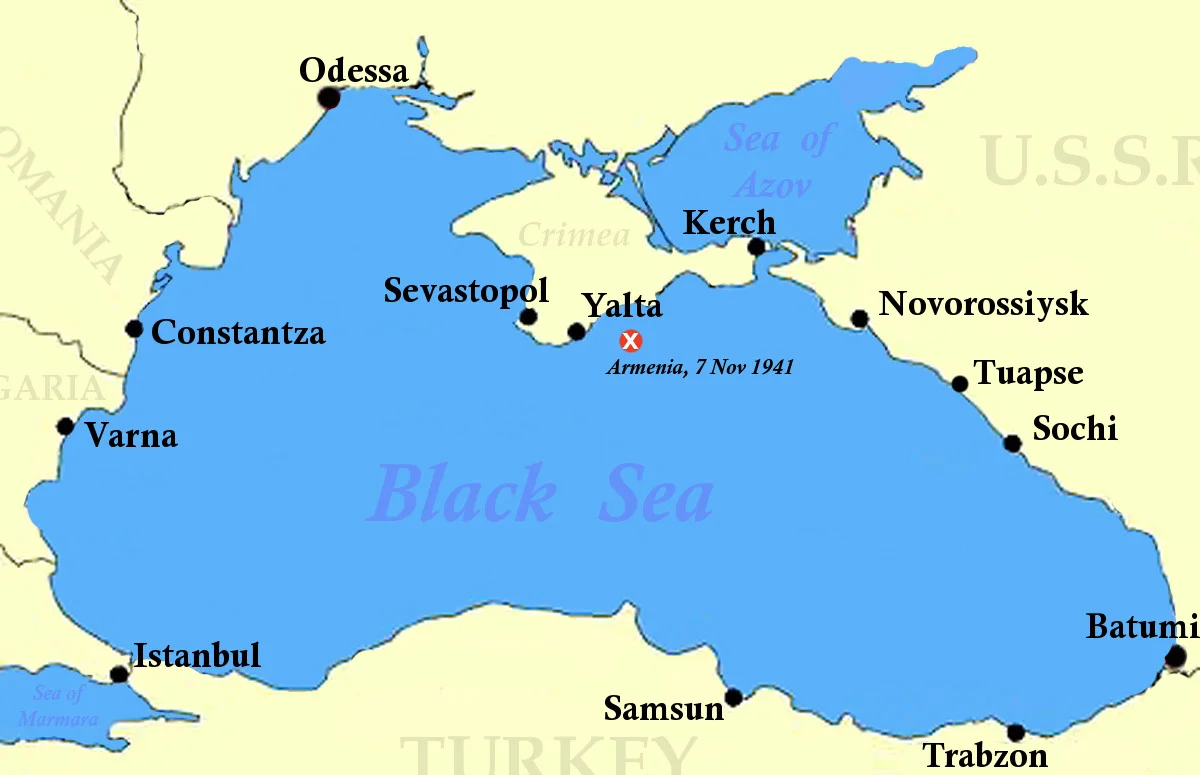
Somewhere in the deep water off the southern coast of Crimea lies a ship that carried thousands of people to their deaths in the span of a single morning. The Armenia was a hospital ship, her hull and decks marked with the great red crosses that were meant to make her untouchable. On 7 November 1941 those markings saved no one. When a German torpedo struck her, she broke in two and sank in roughly four minutes, so fast that of the thousands aboard, only eight lived. By even the most conservative count, it remains the deadliest maritime disaster in Russian and Soviet history, and one of the deadliest the world has ever known.
A Liner Turned to War
The Armenia had not been built for tragedy. She was launched in 1928 at the Baltic Shipyard in Leningrad, one of four graceful passenger liners of the Adzharistan class designed to ply the Black Sea, and among the very first passenger ships the young Soviet Union produced. For a dozen years she carried travelers along the Crimea and Caucasus coasts. Then war swallowed her purpose. Requisitioned by the Soviet Navy and repainted as a hospital ship, she was pressed into far grimmer service. By late October 1941 the German 11th Army under General Erich von Manstein had sealed off the Crimean Peninsula and laid siege to Sevastopol, and the sea was the only road left out of the trapped city. Into that narrow lifeline the Armenia was sent, to carry away the wounded, the doctors and nurses who tended them, and the civilians with nowhere else to run.
A Night of Chaos
The loading, on the night of 6 to 7 November, was desperate. Sevastopol seemed on the verge of falling, and thousands crowded aboard: entire hospital staffs, officials and their families, and the wounded by the thousand, bound for the safety of Tuapse across the Black Sea. Then came an order that would prove fatal. Captain Vladimir Plaushevsky was told to divert to Yalta, down the coast, and take on still more people. There, in the dark, no one even recorded who came aboard; soldiers and civilians were simply packed onto the already overcrowded decks. Plaushevsky wanted to sail while night still hid them, but he was held in port to wait for an escort. Not until seven in the morning did the Armenia finally leave Yalta, in daylight now, shepherded by two small armed boats and two fighter planes, a thin guard for so precious a cargo.
Four Minutes
By the strict laws of war, a hospital ship is meant to sail unarmed and unescorted, immune to attack. The Armenia was neither. She carried light anti-aircraft guns, she had previously moved troops and supplies, and that morning she steamed under military escort, and so, in the pitiless calculus of the moment, her protected status was gone. A German torpedo bomber found her over the water. Two torpedoes fell; one missed, one struck home. The ship split apart and went under in about four minutes, far too fast for the thousands trapped below and on her packed decks. Estimates of the dead range from five thousand to seven thousand souls. Whatever the true figure, it dwarfs the losses of far more famous disasters, and it happened to people already broken by war, seeking only to escape it. In the grim ranking of single-ship catastrophes, the Armenia is often placed third in all of history, behind only the Wilhelm Gustloff and the Goya, two German ships crowded with refugees and troops that Soviet submarines sank in the Baltic in the closing months of the war. It is a terrible company to keep, three vessels bearing the desperate away from advancing armies, all lost with staggering numbers aboard. The wreck of the Armenia lay hidden for generations, its resting place disputed until searchers reported finding her at last, decades after she vanished beneath the Black Sea, a quiet grave for thousands whose names were never written down.
From the Air
The approximate sinking site lies off Crimea's southern coast near Yalta, around 44.25°N, 34.28°E, in the open Black Sea. From 5,000 to 7,000 feet the mountainous Crimean shoreline around Yalta is the key visual reference, with the water offshore dropping quickly to great depth. Nearest airport is Simferopol International (UKFF), roughly 45 miles to the north across the Crimean Mountains.
Nearby Stories
- Cape Martian Reserve 4.3 km away
- The Charge of the Light Brigade: The Most Famous Military Blunder in History 12 km away
- 1988 Black Sea Bumping Incident 14 km away
- Novyi Svit Winery 40 km away
- Novyi Svet 70 km away
- Tottenham (1802 Indiaman) 351 km away
- Januarius MacGahan 388 km away
- Abkhazia 509 km away