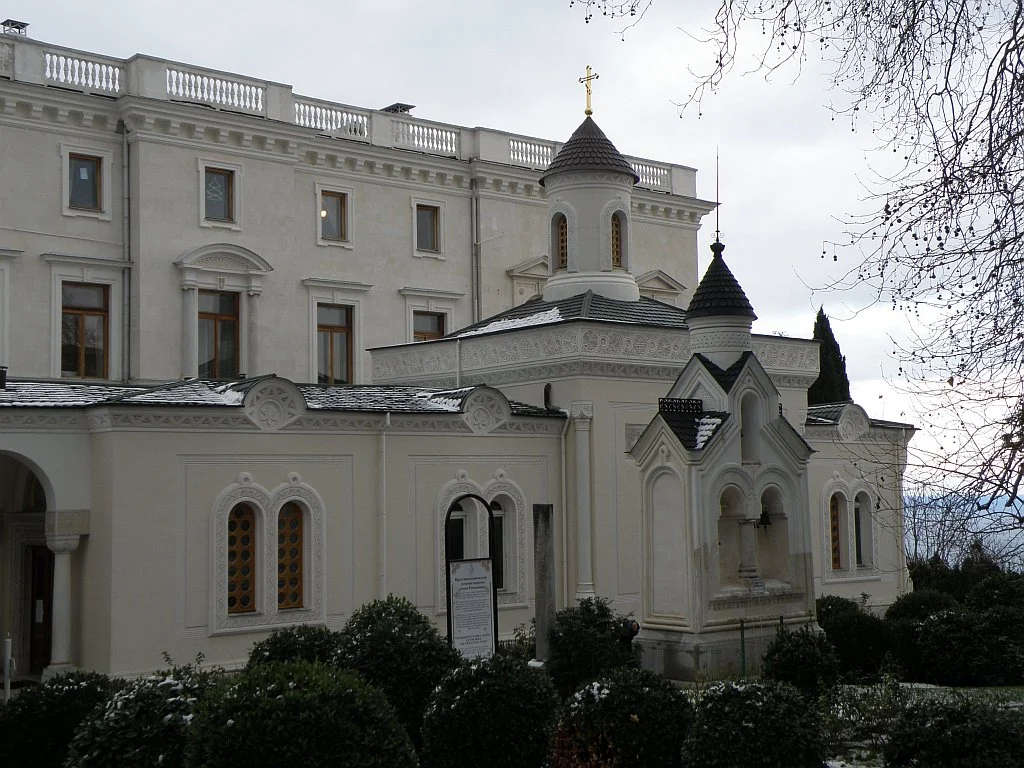

Livadia Palace
In November 1911, a girl celebrated her sixteenth birthday in a brand-new white palace above the Black Sea. She was Grand Duchess Olga, eldest daughter of Tsar Nicholas II, and Livadia Palace was the family's radiant summer retreat, all Carrara marble and Italian courtyards and sea light. Within a decade the Romanovs would be gone, swept away by revolution and murder. And within a generation, this same palace would host a very different gathering: Franklin Roosevelt, wheeled through its halls in February 1945 as the leaders of the Allied powers met here to shape the world that would follow the Second World War.
A Palace for the Last Tsar
The Livadia estate had passed through many hands, once granted to the Greek naval hero Lambros Katsonis and later held by the Polish Potocki family, before it became an imperial summer residence in the 1860s. The architect Ippolito Monighetti raised a large palace, a small palace, and a church there. Tsar Alexander II favored the estate, and his son Alexander III lived and died in the smaller palace. When Nicholas II inherited it, he had the grand palace torn down and replaced with something finer. Around 1909 he engaged Nikolay Krasnov, Yalta's most fashionable architect, who had designed the grand ducal residences at nearby Koreiz. The imperial family discussed the plans intently, deciding that all four facades should look different, and after just seventeen months the new palace was inaugurated on 11 September 1911.
White Limestone and Florentine Light
The result was one of the most elegant buildings on the coast, built of white Crimean limestone in the Neo-Renaissance style. Its features read like a tour of the Mediterranean: an arched portico of Carrara marble, a spacious Arabic patio and a separate Italian one, a Florentine tower, ornate Bramantesque windows, and bays set with jasper vases. A gallery links the palace to a neo-Byzantine church of the Exaltation of the Cross. Inside are 116 rooms in a medley of styles, a Pompeian vestibule, an English billiard room, a Neo-baroque dining room, and a study of maple wood in the Jacob style that Nicholas II especially admired. For the imperial family, it was less a seat of power than a beloved seaside home.
Flight and Nationalization
That home did not survive the revolution intact. After the February Revolution of 1917, the tsar's mother, Dowager Empress Maria Feodorovna, fled to Livadia with other members of the imperial family. She was eventually rescued from Crimea by the British warship HMS Marlborough, sent by her nephew, King George V, a rare escape in a family that would mostly meet a far darker end. The palace itself was nationalized. By a decree signed by Vladimir Lenin in December 1920, it was turned to the treatment of workers, opening as a peasant sanatorium that specialized in fighting tuberculosis. The tsar's summer paradise had become, quite deliberately, a place of healing for the very class whose revolution had ended his reign.
Where the World Was Divided
Livadia's most famous hour came in February 1945. With the Second World War drawing toward its close, the palace hosted the Yalta Conference, the meeting where Roosevelt, Churchill, and Stalin negotiated the shape of the postwar order. Roosevelt and the American delegation were lodged in the palace itself, while the Soviets stayed at the nearby Yusupov Palace and the British at the Vorontsov Palace some eight kilometers away. The decisions taken in these rooms would help define the map of Europe for decades. Today Livadia is a museum, its recovered furnishings on display, drawing visitors fascinated above all by the events of 1945, a palace that witnessed both the last golden summers of a dynasty and the birth of a new world order.
From the Air
Located at 44.468 degrees N, 34.144 degrees E, above the coast at Livadiya just southwest of Yalta. Best viewed from around 3,000 to 5,000 feet, where the white palace and its formal gardens stand out on the green hillside above the Black Sea, with the Ai-Petri ridge rising behind. The nearest major airport is Simferopol (UKFF), roughly 50 km to the north.
Nearby Stories
- Cape Sarych 1 km away
- Crimean Nature Reserve 6.1 km away
- Battle of the Alma 21 km away
- Novyi Svit Winery 22 km away
- Novyi Svet 50 km away
- Januarius MacGahan 365 km away
- Tottenham (1802 Indiaman) 396 km away
- Abkhazia 513 km away