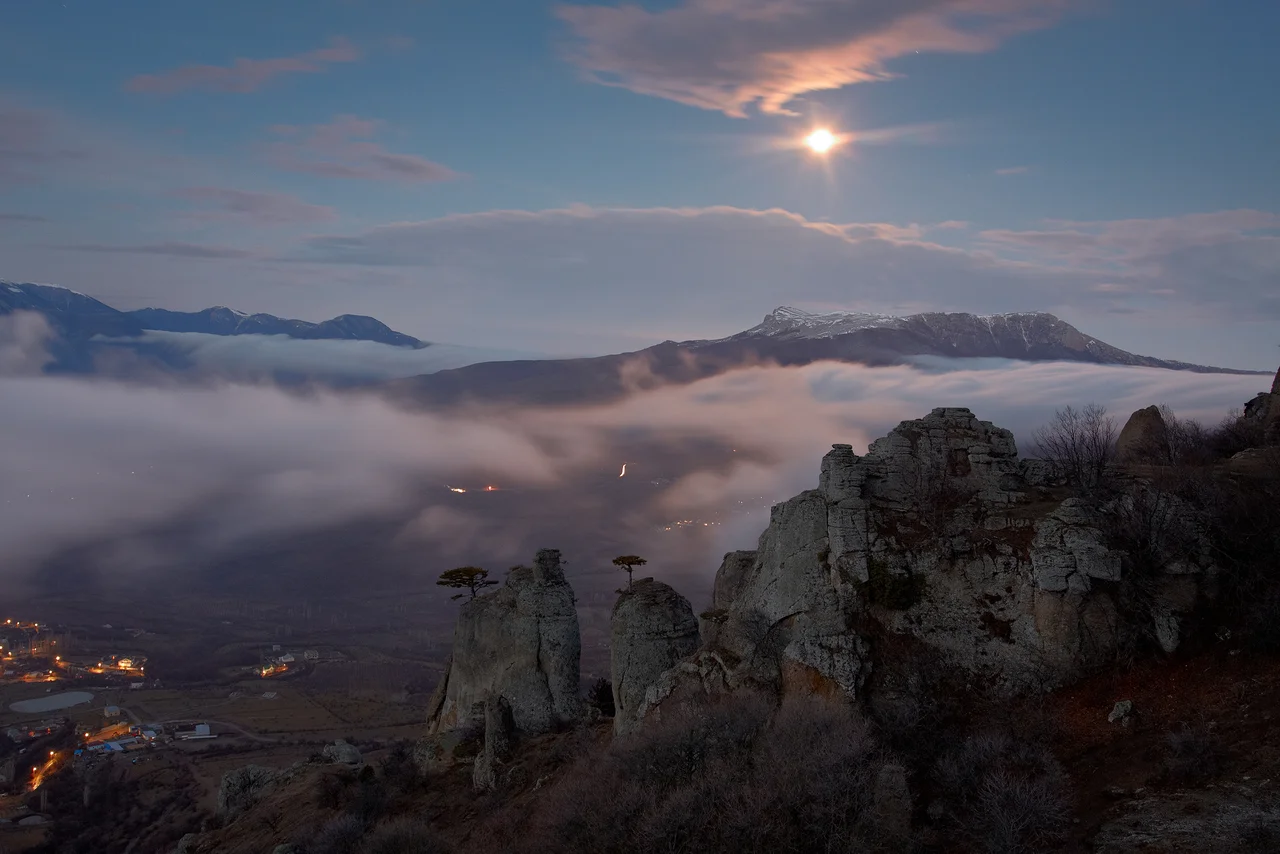

Valley of Ghosts
When the fog rolls across the southern slope of Demirci, the stones begin to move. Hundreds of weathered pillars stand scattered on the mountainside above Alushta, some resembling human figures, some animals, some creatures out of fairy tales, and in the shifting haze they seem to change shape, appear, and dissolve. Locals have long called this place the Valley of Ghosts, and the name is more than poetry. This is the only spot in all of Crimea where you can witness the Brocken spectre, the eerie optical trick in which your own shadow is cast, magnified and ringed with light, onto the mist below.
The Smoking Mountain
The mountain earned its reputation for mystery long before anyone measured its rocks. In the Middle Ages it was called Funa, a name meaning roughly "fuming" or "smoky," for the thick fog that so often clings to its slopes. Later the mountain took the name Demirci, meaning "smith" in the Crimean Tatar language, and the village at its foot took the name too. That village exists still, though it is now called Luchyste. The stone figures themselves crowd the southwestern face, and they are not entirely stable: major rockfalls reshaped the valley in April 1894 and again in August 1966, part of a long history of tumbling stone stretching back centuries. The mountain, it seems, is still sculpting itself, one collapse at a time.
Older Than the Mountains Around It
The geology behind the ghosts is genuinely strange. Southern Demirci is built of conglomerate, a jumble of boulders, pebbles, sand, and clay cemented together in a shallow sea back in the Late Jurassic. But locked inside that conglomerate are chunks of pink granite dated to between 650 and 950 million years old, far older than the surrounding clay and sandstone of the Crimean Mountains, which formed a mere 160 to 200 million years ago. In other words, the mountain contains stone hundreds of millions of years older than itself. Wind and rain wear the softer cement away faster than the hard granite blocks, and over immense stretches of time this uneven erosion has left the boulders standing proud as pillars, spires, and the uncanny figures that give the valley its name.
The Blacksmith Turned to Stone
Where geology gives one explanation, legend gives another. The old stories tell of a cruel blacksmith who set up a forge on the smoking mountain and forced the strongest men of the village to labor there making weapons, working them until some died. When the villagers begged him to leave, he answered with fire. At last a girl named Maria climbed the mountain alone to confront him. He refused her too, and killed her, and at that the mountain itself could bear no more. It swallowed the blacksmith and his men and carried the villagers safely home. When the smoke cleared, hundreds of stone figures stood on the slope, the twisted likenesses of the blacksmith and his henchmen, with a single graceful pillar at the summit shaped like Maria. From that day, the story says, no smoke ever rose from the mountain again.
A Fortress and a Film Set
History and popular culture have both left their marks here. Near the old village stand the ruins of Funa Fortress, built between the thirteenth and fifteenth centuries as an outpost of the Principality of Theodoro, a small Byzantine-descended state that used it to keep the rival Genoese from pushing inland. A towered, two-story church once stood within, sheltering a family vault whose remains survive. In more recent memory, the surreal landscape drew filmmakers: the beloved Soviet comedy Kidnapping, Caucasian Style shot key scenes among these rocks, and the valley has stood in for otherworldly places on screen more than once. Fortress, film set, geological oddity, and ghost story all at once, the Valley of Ghosts is a place that seems designed to spark the imagination, and the fog only deepens the spell.
From the Air
The Valley of Ghosts sits at 44.75 degrees north, 34.41 degrees east, on the southern slope of the Demirci massif just northeast of Alushta on Crimea's south coast. From the air, look for the broken, pillared southwestern face of Southern Demirci above the village of Luchyste, often capped or veiled by the characteristic local fog. The nearest airport is Simferopol International (ICAO UKFF), roughly 30 kilometers to the northwest.
Nearby Stories
- Object 100 8.1 km away
- Livadia Palace 11 km away
- Battle of the Alma 12 km away
- Novyi Svit Winery 13 km away
- Saky Air Base 16 km away
- Surp Khach Monastery 20 km away
- Taigan Safari Park 23 km away
- Abkhazia 523 km away