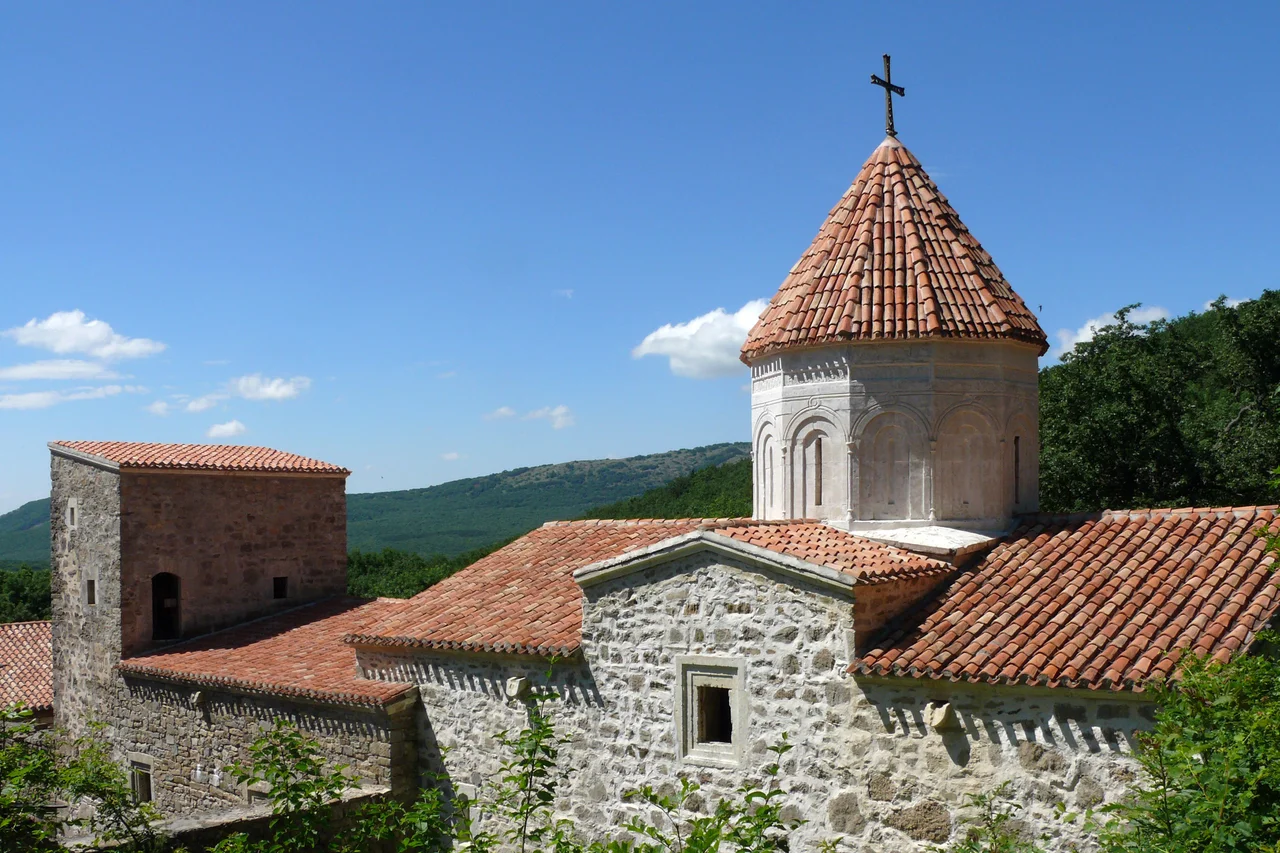

Surp Khach Monastery
You reach it by climbing away from the town, up into wooded hills where the noise of the valley falls behind you. There, tucked into a fold of the Crimean forest near Staryi Krym, stand the stone walls of Surp Khach, the Monastery of the Holy Cross, founded in 1358. For nearly seven hundred years, Armenians have made their way up these slopes to pray in this quiet place. It is one of the most important surviving witnesses to the Armenian presence in medieval Crimea, and despite everything the centuries have thrown at it, it endures as a spiritual center and a destination for pilgrims.
Armenians in the Crimean Hills
The monastery is a legacy of one of Crimea's great medieval communities. In the fourteenth century, when Surp Khach was founded, Armenians formed a substantial and influential population in the eastern part of the peninsula, merchants and craftsmen and clergy who made this land a far outpost of Armenian Christian life. The Monastery of the Holy Cross became a heart of that community's faith, an Armenian spiritual center whose importance is measured in the sheer devotion it inspired. Its very name, Surp Khach, invokes the cross at the core of Armenian Christianity, and for the faithful who climbed to it, the journey up into the hills was itself an act of pilgrimage, a tradition the monastery has sustained across the centuries.
A Landholder Brought Low
For most of its history the monastery was not only a place of prayer but a considerable institution in its own right. Before the Soviet state nationalized it, Surp Khach held some four thousand acres of land, a substantial estate that speaks to how significant and well-endowed the monastery had become over the generations. That wealth vanished in the twentieth century, when the property was seized. The Soviet era used the old monastery for a succession of secular purposes that could hardly have been more distant from its founding intent, pressing it into service at various times as a Young Pioneer camp for children and even as a tuberculosis clinic. It was an indignity common to religious houses across the region, yet the buildings themselves survived the century of repurposing intact.
Endurance and Return
What makes Surp Khach remarkable is simply that it is still here, and still holy. Where so many religious sites were lost outright, this one weathered its Soviet decades and remained standing, its medieval stonework preserved in the hush of the forest. It has reclaimed its role as an Armenian spiritual center and a place of pilgrimage, drawing visitors and worshippers back up into the hills much as it did in the fourteenth century. Its significance has even been recognized in modern currency, appearing on a commemorative silver coin. To arrive at Surp Khach today, after the long climb, is to stand before a building that has outlasted the empire that built it, the state that seized it, and the years that tried to make it something it was never meant to be.
From the Air
The monastery lies at 45.00°N, 35.06°E in forested hills just south of Staryi Krym, in the eastern Crimean Peninsula about 25 km west of Feodosia. From roughly 2,000 to 2,500 feet look for it nestled among dense woodland below the ridgelines, with the town of Staryi Krym to the north; low altitude and clear air are best for spotting it. Nearest airports are Feodosia (UKFF) to the east and Simferopol (URFF) to the west.
Nearby Stories
- Valley of Ghosts 9.2 km away
- Aeroflot Flight 6515 17 km away
- Crimean Nuclear Power Station 23 km away
- Akmesdzhyt Friday Mosque 30 km away
- Battle of the Kerch Peninsula 41 km away
- Alushta 49 km away
- Syvash 82 km away
- Soviet Destroyer Smyshlyony 99 km away