.jpg)
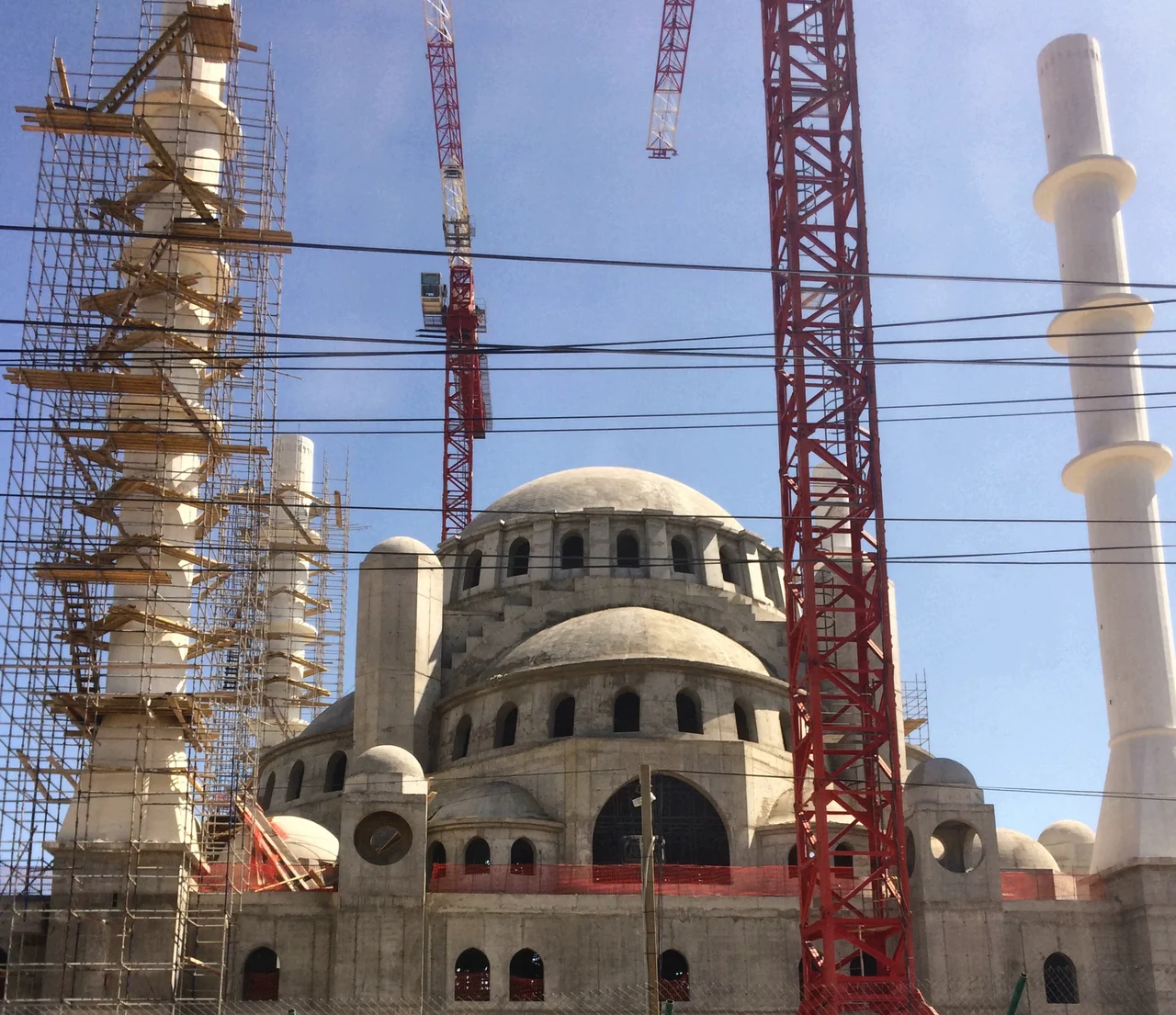
Akmesdzhyt Friday Mosque
For years the plot on the edge of Simferopol held nothing but ambition and around a hundred thousand pieces of limestone, hauled there by hand and waiting for a mosque that seemed as if it might never come. The Crimean Tatar community had been seeking permission to build a central mosque on this ground since 1996, and the effort stretched on so long that in 2008 supporters raised a tent city on the site in protest. When the Akmesdzhyt Friday Mosque finally opened its doors on 9 December 2023, it was the largest mosque in Crimea, a soaring answer to a wish that had outlasted nearly three decades of delay.
The Long Wait
The mosque's story is, first, a story of patience. From the mid-1990s onward, requests to build on the site met refusal after refusal, with permits granted and then rolled back and alternative locations proposed and rejected. The Crimean Tatars, the indigenous Muslim people of the peninsula, pressed on regardless, and by 2008 they had begun transporting roughly 100,000 limestone blocks to the ground in a show of determination. Construction at last began in September 2015. Even then the finish line kept receding, the completion date pushed from 2020 to 2021 and beyond, until the building was finally consecrated in December 2023. For a community that had waited a generation, the opening marked the arrival of a spiritual home long promised and long deferred, the seat of the spiritual administration of Crimea's Muslims.
A Marriage of Styles
The mosque is a deliberate blend of traditions. Its chief architect, Idris Yunusov, drew on the cross-dome plan of Byzantine architecture, echoing the great Hagia Sophia in Istanbul, with a central dome resting on a ring of semi-domes, and looked as well to the historic Juma-Jami mosque in Yevpatoria. Onto that Byzantine bone structure he layered the Ottoman Baroque, a marriage of Ottoman form and European Baroque ornament. The tulip, a signature flourish of Ottoman design, blooms throughout, appearing in the stained-glass windows and much of the painting. To root the building in Crimea rather than merely echo Istanbul, craftsmen from Kazan wove in authentic Crimean Tatar patterns drawn from the region's traditional clothing, so that the decoration would speak specifically of this land and its people.
Marble, Lead, and Four Minarets
For all its ornamental delicacy, the mosque is built to endure. Its frame is reinforced concrete, its exterior faced in marble, and its great dome, rising twenty-eight meters, is sheathed in twenty tons of lead. Four minarets, each carrying a distinct Ottoman influence, mark the corners of the complex and give the Simferopol skyline a new silhouette. The mosque does not stand alone: around it lie administrative and guest buildings, a flower garden, a park, galleries, and a fountain, the whole arranged as a serene precinct rather than a single structure. Among the outbuildings is a nineteenth-century guest house that blends Moroccan, classical, and South Coast Crimean Tatar styles. Together they form a landmark that took a generation of persistence to raise, now firmly part of the city's fabric.
A Center of Its Own
The building is more than an architectural showpiece; it is the administrative and spiritual heart of Muslim life on the peninsula, the seat of the spiritual administration of Crimea's Muslims. Its very name binds it to the city's oldest identity. Akmesdzhyt is a form of Aqmescit, the White Mosque, the medieval name Simferopol carried for centuries, and by taking it the new mosque reaches back past the imperial city to the Crimean Tatar town that came before. That continuity was deliberate. The debates that surrounded the design, over how much should be Ottoman and how much authentically Crimean Tatar, were really debates about identity, about how a community long dispersed should picture itself in stone. What rose in the end was both grand and rooted, a mosque that borrows Istanbul's silhouette while insisting, in every tulip and woven pattern, that it belongs to Crimea.
From the Air
The Akmesdzhyt Friday Mosque stands at 44.93 degrees north, 34.14 degrees east, on the eastern side of Simferopol on the central Crimean plain. From the air its large lead-covered central dome and four minarets make it one of the most recognizable structures in the city. The nearest airport is Simferopol International (ICAO UKFF), about 8 kilometers to the northwest of the city center.
Nearby Stories
- Eski Kermen 4.3 km away
- Crimean Mountains 5.1 km away
- Battle of the Alma 11 km away
- Perchem 12 km away
- Juma-Jami Mosque 29 km away
- Aeroflot Flight 6515 40 km away
- Battle of Eupatoria 71 km away
- 1976 Anapa Mid-Air Collision 198 km away